

Commentary
How is AI reshaping space security, creating governance challenges, and where does international diplomacy stand today?
Tejas Bharadwaj, Almudena Azcárate Ortega
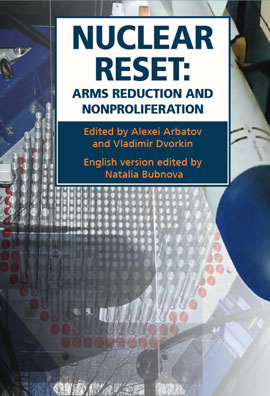
The concept of nuclear disarmament as an essential condition for nuclear nonproliferation is again entering the realm of practical politics, but the movement toward nuclear disarmament is extremely difficult and fraught with great dangers.
Source: Moscow: Carnegie Moscow Center

The continued image of nuclear arms as an indispensable pillar of superpower security combined with the absence of progress on the issue of nuclear disarmament spurs the risk of nuclear proliferation and eventually military or terrorist use of nuclear arms. Nuclear Reset: Arms Reduction and Nonproliferation refutes the argument put forward by many politicians and experts, both in Russia and internationally, of a “civilizing effect” of nuclear weapons in international relations—implying nuclear states’ restraint in their foreign and military policies in the face of fears of nuclear catastrophe.
The book argues that after decades of heated debate the concept of nuclear disarmament as an essential condition for nuclear nonproliferation is again entering the realm of practical politics. Since genuine and consistent movement toward nuclear disarmament is extremely difficult and fraught with great dangers; realism and professionalism is required, taking into account all of the subtleties and the political, economic, military, and technological interrelationships around the issue. The book suggests that in this context there is a need for thorough and well-grounded linkage of all of the elements of the process and both its bilateral and multilateral formats.

Alexey Arbatov
Alexey Arbatov is the head of the Center for International Security at the Primakov National Research Institute of World Economy and International Relations.
Vladimir Dvorkin
Major General Dvorkin (retired) is a chief researcher at the Center for International Security at the Institute of World Economy and International Relations.

Natalia Bubnova
Former Head of Content Production, Moscow Center
Natalia Bubnova was head of content production at the Carnegie Moscow Center. She previously served as deputy director for communications at the Carnegie Moscow Center.
Carnegie India does not take institutional positions on public policy issues; the views represented herein are those of the author(s) and do not necessarily reflect the views of Carnegie, its staff, or its trustees.

How is AI reshaping space security, creating governance challenges, and where does international diplomacy stand today?


Tejas Bharadwaj, Almudena Azcárate Ortega

This piece argues that India’s central challenge is not managing a single flashpoint but resolving the underlying tension between expansion and institutional coherency of the BRICS grouping.

Vrinda Sahai

The U.S.–India semiconductor cooperation story is well-stocked with top-level strategic intent. What remains unresolved, however, are some underlying challenges that will determine whether the cooperation actually functions. Three such friction points stand out.

Shruti Mittal

India and the United States are close to concluding a Reciprocal Defense Procurement Agreement (RDPA) that will allow firms from the two countries to sell to each other’s defense establishments more easily. While this may not remedy the specific grievances both sides may have regarding larger bilateral issues, an RDPA could restore some momentum, following the trade deal announcement.

Konark Bhandari

On the last day of the India AI Impact Summit, India signed Pax Silica, a U.S.-led declaration seemingly focused on semiconductors. While India’s accession to the same was not entirely unforeseen, becoming a signatory nation this quickly was not on the cards either.
Konark Bhandari