

Paper
Douglas H. Paal
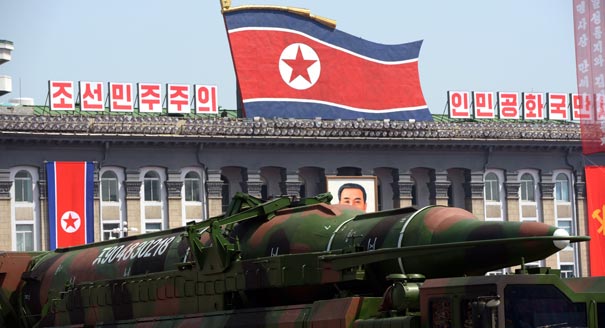
Source: Getty
Although movement is being made toward the resumption of six-party talks with North Korea, persistent disagreements will likely prevent any meaningful progress toward the denuclearization of the Korean Peninsula.
North Korea and the other members of the six-party talks are picking up the pace of diplomacy preceding a staged resumption of the suspended talks. The outlook for diplomatic engagement is the best it has been in two years, but the prospects for a satisfactory outcome have never looked worse.
Twice last year Chinese chief negotiator Wu Dawei, as host of the six-party talks, proposed a three-stage effort to rebuild trust in the process that had been destroyed by Pyongyang’s preemptive missile testing and other provocations immediately after the Obama administration took office. The three stages were to begin with informal chats between diplomats from the United States and North Korea, followed by an informal meeting of the six parties to agree on the difficult agenda for a formal meeting, and finally by the formal meeting itself.
Twice last year, the United States agreed to begin the process of feeling out the North, only to have the sinking of the South Korean corvette, the Cheonan, in March and then the shelling of Yeonpyeong Island in November, abort the first-stage meetings. Attitudes naturally hardened in both Washington and Seoul with the South demanding—with American concurrence—an apology for both incidents before any talks would resume. A meeting early this year between military representatives of the two sides collapsed as soon as it started over the South’s demand for an apology.
Throughout this period, China has worked hard to get the parties back together, evidently believing that the process of dialogue is more important than the objective of denuclearizing the peninsula. North Korea has been a difficult partner for China and Beijing was slow to counsel Chairman Kim Jung Il to ease up on his repeated provocations, though it ultimately did so following a show of American toughness over the cycle of increasing tension.
All sides are now preparing propaganda campaigns to portray their stances as more reasonable than those of the other countries involved. For some time, the North has appealed for food aid to relieve a “natural disaster,” which is evidently a euphemism for the way it governs its own territory. Obligingly, the UN’s World Food Program has asked its members to contribute over 400 thousand tons despite considerable experience with the North misappropriating the food to its military and not to starving peasants. The United States and others are skeptical absent a proper verification mechanism, but are under growing pressure to comply.
Former President Jimmy Carter will soon be in Pyongyang as part of a group of former leaders that calls itself “The Elders.” This will presumably give Kim Jung Il a sounding board for whatever modest concessions he deigns to make to South Korea over last year’s provocations. (Carter’s trip received zero support from the Obama administration.)
At a recent meeting hosted in Germany by the Aspen Institute between U.S. and North Korean experts, the delegates from Pyongyang reportedly did not deny responsibility for the two incidents last year, showing greater flexibility on the subject than their Chinese apologists and perhaps presaging how the North and South will handle the demand for apologies. But the North also indicated no willingness to abandon nuclear weapons without unacceptable security concessions from the United States, including dismantling the Japanese and South Korean alliances and folding the nuclear umbrellas they provide.
Judging from Wu Dawei’s current visit to Seoul and his reception of the North’s chief negotiator earlier this month in Beijing, the pieces are coming together for North-South talks to resume, somehow finessing or meeting the need for apologies. Wu is trying to stage manage the process to contain tensions, appease Pyongyang, and reduce the need for Beijing to choose whether or not to support its Northern ally at the expense of good relations with the South.
If North-South talks do not break down, Washington and Seoul have agreed that the United States will commence, with Seoul’s support, bilateral discussions on Pyongyang’s renewal of adherence to the joint statement of September 2005 promising eventual denuclearization. On the way to an informal meeting of the six-party talks there is still a great deal of underbrush to clear away, as both the United States and North Korea blame the other for the breakdown of the talks at the end of the George W. Bush administration.
For its part, the Obama administration appears to be proceeding with its eyes wide open to the risks, including from within the administration, that it will be sucked into a process for a third time that fails to deliver denuclearization. Since the NATO attacks commenced against Libya’s Muammar Gaddafi, it is hard to imagine the lesson is lost on Kim Jung Il that giving up weapons of mass destruction will not guarantee his regime’s outlook for survival. The appointment of Sydney Seiler as a new director of Asian affairs at the National Security Council reinforces this skepticism by placing one of America’s officials most knowledgeable about North Korea near the center of the process. The prospects for talks are bright and the prospects for results dim.

Distinguished Fellow, Asia Program
Paal previously served as vice chairman of JPMorgan Chase International and as unofficial U.S. representative to Taiwan as director of the American Institute in Taiwan.
Recent Work
Douglas H. Paal


Douglas H. Paal, Tong Zhao, Chen Qi, …
Carnegie India does not take institutional positions on public policy issues; the views represented herein are those of the author(s) and do not necessarily reflect the views of Carnegie, its staff, or its trustees.

How is AI reshaping space security, creating governance challenges, and where does international diplomacy stand today?


Tejas Bharadwaj, Almudena Azcárate Ortega

After the chill in ties between 2020 and 2024 that brought India–China relations to their lowest point in several decades, the two countries have engaged each other afresh. This paper argues that there are predominantly four imperatives guiding India’s approach to China, and they exist in an order of priority.

Saheb Singh Chadha

This piece argues that India’s central challenge is not managing a single flashpoint but resolving the underlying tension between expansion and institutional coherency of the BRICS grouping.

Vrinda Sahai

A partnership between India, a country of subcontinental size, and Africa, a continent of fifty-four countries, may seem asymmetric until one notes that both are home to nearly the same number of people—1.4 billion. This essay spells out the existing challenges to the partnership, its optimal potential, and the possible pathways to realize it over the next quarter-century.

Rajiv Bhatia

The U.S.–India semiconductor cooperation story is well-stocked with top-level strategic intent. What remains unresolved, however, are some underlying challenges that will determine whether the cooperation actually functions. Three such friction points stand out.

Shruti Mittal