

Commentary
Dmitri Trenin
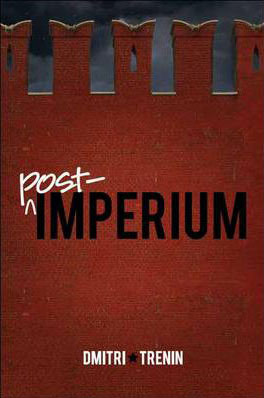
Moscow needs to drop the notion of creating an exclusive power center in the post-Soviet space. Like other former European empires, Russia has no choice but to reinvent itself as a global player and as part of a wider community.
Source: Washington
The war in Georgia. Tensions with Ukraine and other nearby countries. Moscow's bid to consolidate its "zone of privileged interests" over former Soviet republics. These volatile situations all raise questions about the nature of Russia’s relations with its neighbors and prospects for future regional stability.
In Post-Imperium: A Eurasian Story, also available in Russian, Dmitri Trenin argues that Moscow needs to drop the notion of creating an exclusive power center in the post-Soviet space. Like other former European empires, Russia has no choice but to reinvent itself as a global player and as part of a wider community.
Trenin’s vision for Russia is a changed, open Euro-Pacific country that is savvy in its use of soft power and fully reconciled with its former dependents. While acknowledging that this scenario may sound too optimistic, Trenin warns that the alternative is not a new version of the historic empire but ultimately the marginalization of Russia in international affairs.
"... as Mr Trenin convincingly argues, Russia is not a neo-imperialist state, but a post-imperialist one that lacks both vision and appeal, and the economic and human resources for any expansion."
—The Economist, December 3, 2011
Former Director, Carnegie Moscow Center
Trenin was director of the Carnegie Moscow Center from 2008 to early 2022.
Recent Work
Dmitri Trenin
Dmitri Trenin
Carnegie India does not take institutional positions on public policy issues; the views represented herein are those of the author(s) and do not necessarily reflect the views of Carnegie, its staff, or its trustees.

After the chill in ties between 2020 and 2024 that brought India–China relations to their lowest point in several decades, the two countries have engaged each other afresh. This paper argues that there are predominantly four imperatives guiding India’s approach to China, and they exist in an order of priority.

Saheb Singh Chadha

This piece argues that India’s central challenge is not managing a single flashpoint but resolving the underlying tension between expansion and institutional coherency of the BRICS grouping.

Vrinda Sahai

A partnership between India, a country of subcontinental size, and Africa, a continent of fifty-four countries, may seem asymmetric until one notes that both are home to nearly the same number of people—1.4 billion. This essay spells out the existing challenges to the partnership, its optimal potential, and the possible pathways to realize it over the next quarter-century.

Rajiv Bhatia

The India–EU Free Trade Agreement (FTA) is shaping up to be one of the most consequential trade negotiations, both economically and strategically. But, what’s in the agreement, what’s missing, and what will determine its success in the years ahead
Vrinda Sahai, Nicolas Köhler-Suzuki

Trump 2.0 has unsettled India’s external environment—but has not overturned its foreign policy strategy, which continues to rely on diversification, hedging, and calibrated partnerships across a fractured order.



Milan Vaishnav, ed., Sameer Lalwani, Tanvi Madan, …