

Commentary
Muhammad Faour
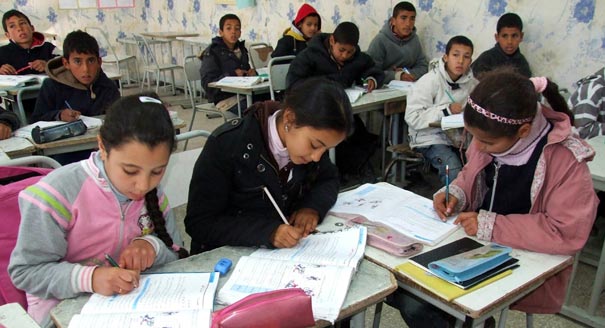
Source: Getty
Absent a good education environment, there is little room for the Arab world’s youth to turn into responsible citizens who can consolidate and stimulate social transformation to bring about more prosperous and free societies.
The youth of the Arab world have driven much of the popular upheaval that has overtaken the region in the last year. Calling for fundamental political and economic change, they seek to remake their societies into more open, global players. But if that grassroots momentum is to be solidified, real societal reform must take place.
In burgeoning democracies such as Tunisia, Egypt, and Libya, schools can be change agents and effective elements in the development of long-lasting democratic skills and values such as freedom, equality, social justice, and respect for diversity and basic human rights. With more than 40 percent of people in the Arab world under the age of eighteen, schools are key social and political actors that can strongly impact the process of democratization.
A growing body of research has shown that a positive school climate is imperative to ensuring progress on this front. The character and quality of school life, which reflects values, goals, organizational structure, interpersonal relationships, and teaching and learning practices, can either promote or hinder a student’s education and future success.
Unfortunately, in much of the Arab world school climates are generally negative. Indexes that combine data from three international studies and measure schools’ safety, teaching, learning, and institutional environments in fourteen Arab countries paint a picture that is far from rosy. Many students do not feel safe physically, socially, and emotionally in schools. Substantial percentages of teachers entered their profession with deficient academic preparation and pre-service training and do not receive adequate and appropriate professional development during service. Reliance on rote memorization of facts, student and teacher absenteeism, classroom overcrowding, and limited resources all contribute to the problem as well.
Much needs to be done. First and foremost, decisionmakers must find the political will to endorse serious comprehensive education reforms that target the entire school culture. All Arab countries should improve the status and qualifications of their teachers, and establish systems of good governance at both the local and central levels along with transparency and public accountability. Absent a good education environment, there is little room for the Arab world’s youth to turn into responsible citizens who can consolidate and stimulate social transformation to bring about more prosperous and free societies.

Former Senior Associate , Middle East Center
Faour was a senior associate at the Carnegie Middle East Center, where his research focused on education reform in Arab countries with an emphasis on citizenship education.
Recent Work
Muhammad Faour
Muhammad Faour
Carnegie India does not take institutional positions on public policy issues; the views represented herein are those of the author(s) and do not necessarily reflect the views of Carnegie, its staff, or its trustees.

A partnership between India, a country of subcontinental size, and Africa, a continent of fifty-four countries, may seem asymmetric until one notes that both are home to nearly the same number of people—1.4 billion. This essay spells out the existing challenges to the partnership, its optimal potential, and the possible pathways to realize it over the next quarter-century.

Rajiv Bhatia

An Israeli response to Iran’s October 1 attack is imminent. The key question is of its intensity and potential fallout, both within Iran, in terms of nuclear security policy changes, and across the broader region. The coming days are likely to reshape West Asia irreversibly.
Gaddam Dharmendra

As India’s economy recovers from the coronavirus pandemic, Indian businesses need efficient financial structures to regain their ground. Key reforms to India’s Insolvency and Bankruptcy Code could fill these gaps.

Anirudh Burman

Access to cross-border data is an integral piece of the law enforcement puzzle. India is well placed to lead the discussions on international data agreements subject to undertaking necessary surveillance reforms.

Smriti Parsheera, Prateek Jha

After the coronavirus pandemic wanes, how will China’s reorientation of the Belt and Road Initiative to address global health concerns influence its relationships with South Asian countries?


Deep Pal, Rahul Bhatia