

Commentary
Dmitri Trenin
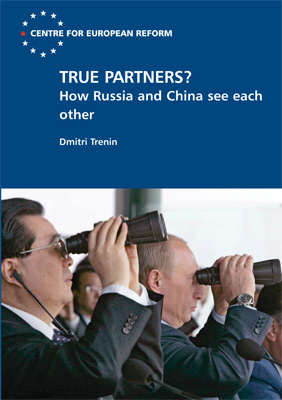
Despite the overlapping interests of Russia and China, the two countries are not allies. Moscow will not accept a junior position vis-à-vis Beijing, while the Chinese regard Russia as a fading power.
Source: Centre for European Reform Report

To the Chinese, by contrast, Russia’s decline from being a Soviet-era superpower to its present status as a second tier power is but one of a number of great changes in the emerging international system. In overall GDP, China has overtaken Japan to become the world’s second largest economy. In terms of foreign trade volume, it has replaced Germany as the world’s top exporter. The UK’s handover of Hong Kong to China in 1997, and Portugal’s withdrawal from Macau in 1999, symbolized the end of a century and a half of humiliating Western occupation of parts of China’s territory. During the eurozone crisis, China was even being touted as a possible financial savior of the European Union. As for Russia, Beijing has learned to use its former mentor-turned-enemy-turned-partner as a source of raw materials, especially energy. It has also been able to rely on Russia as a strategic cushion, to strengthen its hand in opposing Western-led liberal interventionism. Beyond this, however, the Chinese do not seem to have a strategy for dealing with Russia.
The paper begins with a parallel description of Moscow’s and Beijing’s “strategic universes”—their respective security outlooks—and the place of the other country therein. With reference to Russia, it stresses that China’s rise has made Moscow’s view of the world far less Western-centric. With reference to China, it explains how and why the Russia relationship stands out among links with the major world powers, and what value it holds for Beijing.
The paper then assesses the two countries’ principal interests in key areas: global governance; regional issues; trade and investment, with a particular attention to energy; and arms transfers and their strategic implications. Despite the growing inequality of the relationship, the paper seeks to go beyond an assessment of the balance of power by analyzing each party’s interests and motives. The paper ends with reflections on the future of Sino-Russian relations, in bilateral, regional and global contexts.
Former Director, Carnegie Moscow Center
Trenin was director of the Carnegie Moscow Center from 2008 to early 2022.
Recent Work
Dmitri Trenin
Dmitri Trenin
Carnegie India does not take institutional positions on public policy issues; the views represented herein are those of the author(s) and do not necessarily reflect the views of Carnegie, its staff, or its trustees.

After the chill in ties between 2020 and 2024 that brought India–China relations to their lowest point in several decades, the two countries have engaged each other afresh. This paper argues that there are predominantly four imperatives guiding India’s approach to China, and they exist in an order of priority.

Saheb Singh Chadha

This piece argues that India’s central challenge is not managing a single flashpoint but resolving the underlying tension between expansion and institutional coherency of the BRICS grouping.

Vrinda Sahai

A partnership between India, a country of subcontinental size, and Africa, a continent of fifty-four countries, may seem asymmetric until one notes that both are home to nearly the same number of people—1.4 billion. This essay spells out the existing challenges to the partnership, its optimal potential, and the possible pathways to realize it over the next quarter-century.

Rajiv Bhatia

The India–EU Free Trade Agreement (FTA) is shaping up to be one of the most consequential trade negotiations, both economically and strategically. But, what’s in the agreement, what’s missing, and what will determine its success in the years ahead
Vrinda Sahai, Nicolas Köhler-Suzuki
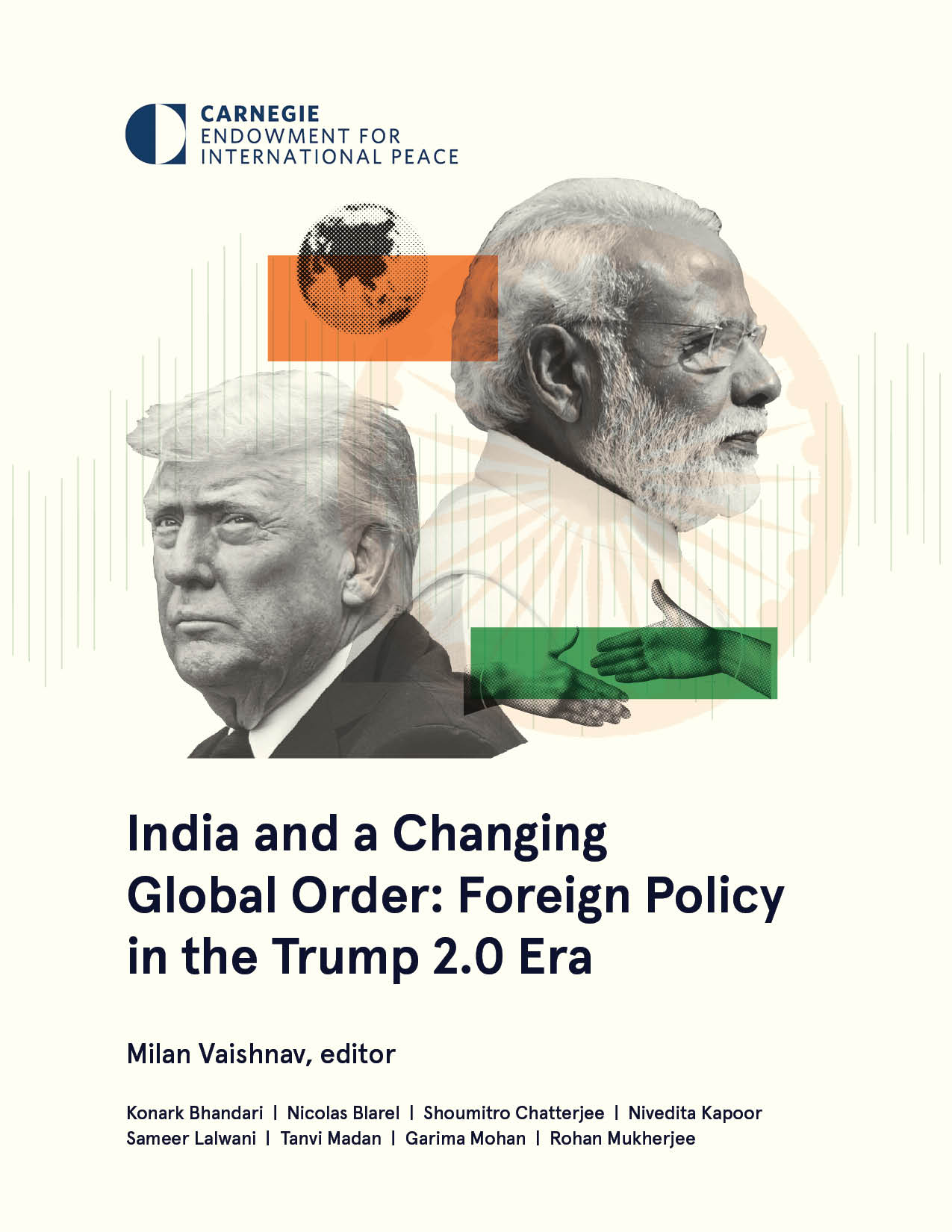
Trump 2.0 has unsettled India’s external environment—but has not overturned its foreign policy strategy, which continues to rely on diversification, hedging, and calibrated partnerships across a fractured order.

Milan Vaishnav, ed., Sameer Lalwani, Tanvi Madan, …