

Commentary
Alexey Malashenko
Source: Getty
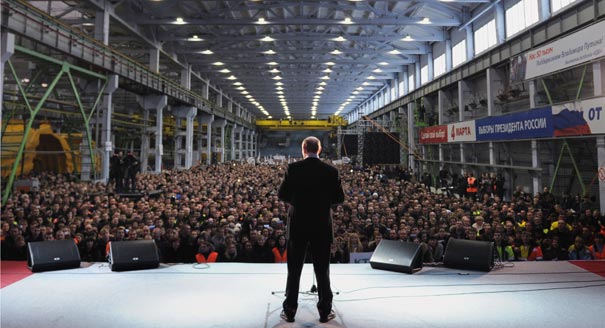
Vladimir Putin secured his return to power in Sunday’s Russian presidential election. Though that result came as no surprise, the issue of what will come next for Russia is still an open question.
Vladimir Putin secured his return to power in Sunday’s Russian presidential election. Though that result came as no surprise, the issue of what will come next for Russia is still an open question.
I would not exclude the possibility that victorious Putin might want to exact some kind of revenge and punish his opponents for all their criticism, protests, and general disobedience. The increased pressure on the Russian mass media, the search for terrorists plotting to eliminate the leading candidate on the eve of the election, and Putin’s statement on the opposition’s possible plans to assassinate some well-known politician in order to provoke unrest in the country all underscore the likelihood of this outcome.
A harsher response from the authorities to ongoing protests against fraud and violations in the presidential election is possible as well. Frightened by the thought of a second round of voting, the authorities pulled out all the stops over the weekend and many election violations were reported.The Kremlin will also continue to crack down on the Russian mass media, especially on electronic outlets—and it might even tighten its grip. Ninety-nine percent of all television programs will remain the official powers’ sanctuaries. The authorities will also continue their search for means by which to turn up the heat on Internet discussions. Studying China’s and Iran’s success in this area keeps Russian law-enforcement officials up at night.
If this proves to be the Russian authorities’ response to the recent events, it would appear that the state is having a “nervous breakdown” of sorts. There are certainly plenty nervous people in the Kremlin right now.
What should we expect in the more distant future?
All the political reforms announced by now-outgoing president Dmitri Medvedev—such as direct elections of regional governors and amendments to the election code—will commence. However, all these reforms are tactical rather than strategic. They reflect the ruling class’s overarching goal of preserving its power at all costs—even if that power has to be retouched a bit with vague democratic strokes.
The party system will be reformed, resulting in the disappearance of the unpopular, heavy-handed United Russia, which looks to have worn out its welcome. New political parties, including some liberal parties, will replace the outdated, outspent organizations, and the Communist Party will be partially reconstructed.
The issue of the Kremlin’s relations with the “informal opposition” will be resolved according to the opposition’s willingness to play by the Kremlin’s rules. If some of the opposition leaders abide by the rules, they will later be allowed into the State Duma. New starts and starlets will also appear on Russia’s political horizon.
I believe that the most important issue will be whether the current ruling class realizes that Russian society has gone through fundamental and possibly irreversible changes, that the old way of governing the state has become ineffective and largely useless. While Putin has returned as president of Russia, “Putinism” as a model of state governance, designed to serve one person whose authority was based on a small clan of close associates, is no more.
Former Scholar in Residence, Religion, Society, and Security Program
Malashenko is a former chair of the Carnegie Moscow Center’s Religion, Society, and Security Program.
Recent Work
Alexey Malashenko
Alexey Malashenko
Carnegie India does not take institutional positions on public policy issues; the views represented herein are those of the author(s) and do not necessarily reflect the views of Carnegie, its staff, or its trustees.

This piece argues that India’s central challenge is not managing a single flashpoint but resolving the underlying tension between expansion and institutional coherency of the BRICS grouping.

Vrinda Sahai

A partnership between India, a country of subcontinental size, and Africa, a continent of fifty-four countries, may seem asymmetric until one notes that both are home to nearly the same number of people—1.4 billion. This essay spells out the existing challenges to the partnership, its optimal potential, and the possible pathways to realize it over the next quarter-century.

Rajiv Bhatia

The India–EU Free Trade Agreement (FTA) is shaping up to be one of the most consequential trade negotiations, both economically and strategically. But, what’s in the agreement, what’s missing, and what will determine its success in the years ahead
Vrinda Sahai, Nicolas Köhler-Suzuki
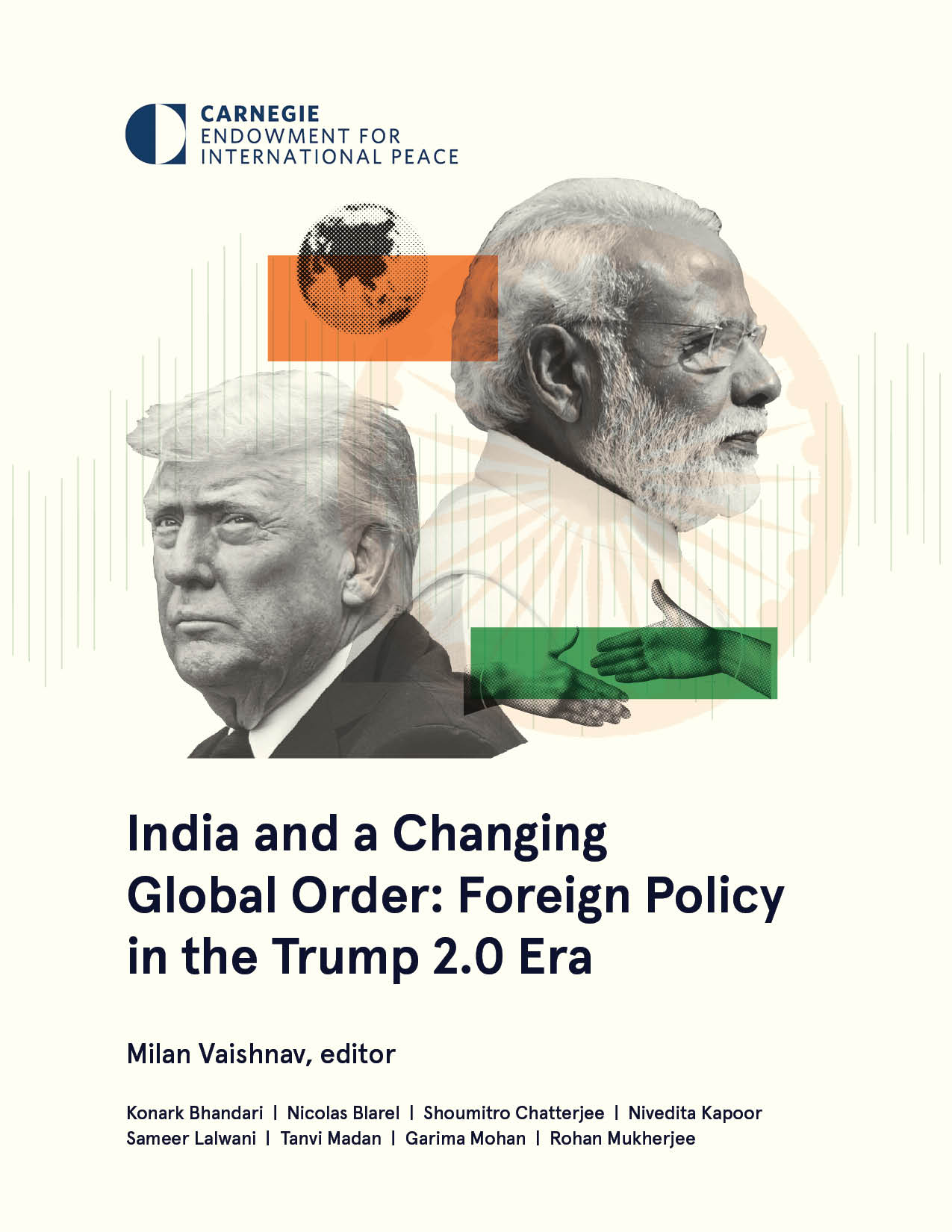
Trump 2.0 has unsettled India’s external environment—but has not overturned its foreign policy strategy, which continues to rely on diversification, hedging, and calibrated partnerships across a fractured order.


Milan Vaishnav, ed., Sameer Lalwani, Tanvi Madan, …

This piece examines India’s response to U.S. sanctions and tariffs, specifically assessing the immediate market consequences, such as alterations in import costs, and the broader strategic implications for India’s energy security and foreign policy orientation.
Vrinda Sahai