

Paper
Ashley J. Tellis
Source: Getty
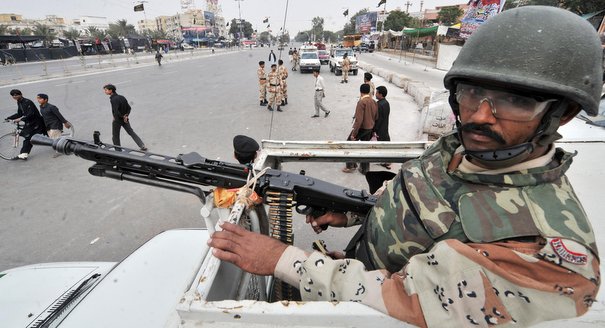
Irrespective of how Afghanistan's coming security transition pans out, one country may be on a surprising course to a major strategic defeat: Pakistan.
Irrespective of how the coming security transition in Afghanistan pans out, one country is on a surprising course to a major strategic defeat: Pakistan. Every foreseeable ending to the Afghan war today—continued conflict with the Taliban, restoration of Taliban control in the southern and eastern provinces, or a nationwide civil war—portends nothing but serious perils for Islamabad. But judging from Pakistan’s behavior, it appears as if this fact has eluded the generals in Rawalpindi.
Ever since the Soviet invasion of Afghanistan, Pakistan has had one simple strategic goal on its western frontier: ensuring that Afghanistan remains a stable but subordinate entity deferential to Pakistan’s sensitivities on all matters of national security. Such deference was sought for a host of reasons. Islamabad wanted a guarantee that Kabul would not reignite the dispute over the countries’ common border (the Durand Line) and would not seek to mobilize the region’s Pashtun populations in support of either absorption into Afghanistan or the creation of a new nation. The Pakistani leadership also aimed to ensure that Afghanistan would not enter into close geopolitical affiliations with other, more powerful countries, such as the United States or India, in order to increase Kabul’s autonomy from Islamabad.
Amid the chaos that emerged after the Soviet withdrawal from Afghanistan, Pakistan settled on supporting the Afghan Taliban as its strategic instrument for securing Kabul’s compliance with its objectives. Although the Taliban were not always dependable surrogates on these matters, they appeared better than other Afghan rivals, and hence Islamabad—despite its denials—has stuck by them to this day.Whatever the intended benefits of this strategy, it has alienated both the broader Afghan populace and the government in Kabul, which now views Pakistan as a habitually hostile neighbor. It has also undermined the U.S.-led international stabilization effort in Afghanistan, as well as hopes for a peaceful security transition—not to mention infuriating Washington, which now views Pakistan as a perfidious partner. And it has provoked heightened regional rivalry involving Afghanistan’s neighbors, especially Iran, India, the Central Asian republics, and Russia, all of whom are determined to prevent a Pakistani-supported Taliban takeover of Afghanistan.
Worst of all, Islamabad’s strategy promises to fundamentally undermine Pakistani security. Every one of the three possible outcomes of the Afghan security transition leaves Pakistan in a terrible place.
The most likely consequence of the security transition is a protracted conflict between the government of Afghanistan and the Taliban that continues long after coalition forces have ceased active combat operations. These relatively low, but still significant, levels of violence would tax Afghan national security forces, distract the central and provincial governments, threaten the security of the average Afghan, and generally retard Afghan stabilization and reconstruction.
While such problems would be serious—though perhaps manageable for Kabul—they would by no means be favorable to Pakistan. A continuing insurgency in Afghanistan will further inflame passions in Pakistan’s own tribal areas and, given the links between the Afghan and Pakistani Taliban, will intensify the threats to Pakistan’s own internal stability at a time when the country’s economic condition remains parlous and its relations with the West precarious. Most problematically, this outcome would deepen the estrangement between Afghanistan and Pakistan, induce Kabul to be even less accommodating of Islamabad’s concerns, and push Afghanistan into a tighter embrace of Pakistan’s rivals.
The more serious, though still middling, outcome of the security transition could be a de facto partition of Afghanistan arising from a steady increase in Taliban control that is limited to the Pashtun-majority areas in the southern and eastern provinces. Beyond undermining Kabul’s effort to preserve a unified Afghan state, this consequence would put at risk the international community’s contributions toward reconstruction in Afghanistan.
If Islamabad is satisfied by such a result, it should think again. Although the Taliban’s reoccupation of its heartland might appear to produce a barrier region controlled by Islamabad’s proxies, its worst consequences would not be limited to the inevitable meltdown in Afghanistan-Pakistan relations. Rather, the chief concern is the chaos that would ensue from Kabul’s military efforts (almost certainly aided by Pakistan’s regional rivals) to regain control of these territories—a chaos that would inescapably bleed into Pakistan’s frontier regions.
Even if Afghanistan were to eventually fail in these operations, the outcome would be deadly for Pakistan. Any Taliban control of southern and eastern Afghanistan would lay the geographic and demographic foundations for resuscitating the old Pashtun yearnings for a separate state, a “Pashtunistan” that would threaten the integrity of Pakistan. Given the current resentment of the Taliban leadership toward its Pakistani protectors, Rawalpindi should not to be consoled by the prospect of a Pashtun buffer along Pakistan’s western borders.
The last and most dangerous potential outcome of the security transition in Afghanistan would be the progressive Taliban takeover of the south and east en route to a larger attempt to control all of Afghanistan. This would be a replay of the tragic events Afghans faced between 1994 and 2001, and would plunge the country into a Hobbesian civil war. All Afghan minorities as well as Pakistan’s larger neighbors would be implicated in a cauldron intended to prevent Islamabad from securing its desired “strategic depth” at their expense.
A cataclysmic conflict of this sort would be the worst kind of disaster for Pakistan. It would not just provoke major refugee flows that would further undermine Pakistan’s difficult economic condition. It would also integrate the violence and instability currently persisting along Pakistan’s western frontier into a vast hinterland that opens up even greater opportunities for violent blowback into Pakistan itself. The disorder that such a scenario portends would not only put paid to any Pakistani dreams of “strategic depth”—assuming this concept was sensible to begin with—but it would end up embroiling Pakistan in an open-ended proxy war with every one of its neighbors.
None of the plausible outcomes of the security transition advances Pakistan’s goal of creating a stable Afghanistan that would be sensitive to Islamabad’s core security concerns. Without doubt, Pakistan deserves secure borders and peaceful frontiers. Yet its own strategies—supporting insurgency and terrorism against its neighbors—have undermined its objectives. If Pakistan’s continuing behavior is any indication, it does not yet appear to have grasped this fact.
An unhappy ending to the security transition is practically guaranteed by Islamabad’s unwillingness to press the Afghan Taliban’s Quetta Shura to pursue reconciliation with Kabul and its reluctance to even call publicly upon the Taliban leadership to seek peace. On top of that is Pakistan’s continued reticence to clarify its preferred outcomes from the reconciliation process and its unproductive haggling over transit compensation for NATO shipments into Afghanistan.None of this convinces Afghanistan and the wider region that Pakistan means well. It may be true that Kabul will suffer most of all from Pakistan’s actions. But the generals in Rawalpindi ought to remember that their country too is facing strategic defeat if the international community fails in Afghanistan.
Former Senior Fellow
Ashley J. Tellis was a senior fellow at the Carnegie Endowment for International Peace.
Recent Work
Ashley J. Tellis
Ashley J. Tellis
Carnegie India does not take institutional positions on public policy issues; the views represented herein are those of the author(s) and do not necessarily reflect the views of Carnegie, its staff, or its trustees.

After the chill in ties between 2020 and 2024 that brought India–China relations to their lowest point in several decades, the two countries have engaged each other afresh. This paper argues that there are predominantly four imperatives guiding India’s approach to China, and they exist in an order of priority.

Saheb Singh Chadha

This piece argues that India’s central challenge is not managing a single flashpoint but resolving the underlying tension between expansion and institutional coherency of the BRICS grouping.

Vrinda Sahai

A partnership between India, a country of subcontinental size, and Africa, a continent of fifty-four countries, may seem asymmetric until one notes that both are home to nearly the same number of people—1.4 billion. This essay spells out the existing challenges to the partnership, its optimal potential, and the possible pathways to realize it over the next quarter-century.

Rajiv Bhatia

The India–EU Free Trade Agreement (FTA) is shaping up to be one of the most consequential trade negotiations, both economically and strategically. But, what’s in the agreement, what’s missing, and what will determine its success in the years ahead
Vrinda Sahai, Nicolas Köhler-Suzuki
The induction of INS Aridhaman, which features several technological enhancements, now gives India the third nuclear ballistic missile submarine to ensure continuous at-sea deterrent.

Dinakar Peri