

Paper
James L. Schoff, Douglas E. Rake, Joshua Levy
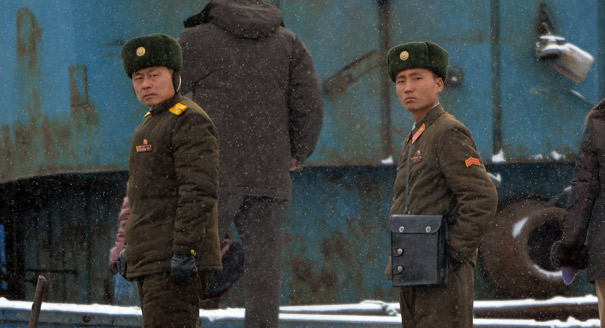
Source: Getty
Stabilizing the Korean Peninsula requires regional solidarity. Tougher sanctions or high-level dialogue with Pyongyang could erode that necessary cohesion.
The North Korean government and its young leader, Kim Jong Un, are threatening the United States and its allies with nuclear war. The North is apparently preparing for a new missile test and warning diplomats in its capital that their safety cannot be guaranteed if conflict erupts. Other East Asian nations are growing concerned about the bellicose rhetoric, notably China, which previously tolerated Pyongyang’s aggressiveness.
A key question now is whether the United States and its allies should take a more proactive approach. But it is clear at this stage that continuity and consistency are critical.
As tensions have ratcheted up, the Obama administration—with mixed results—has charted a course of strategic patience. It has combined prudent defense and deterrence with quiet diplomacy among the North’s neighbors and reassurance for U.S. allies in the region. The goal is to convince North Korea that it will lose any fight, U.S.–South Korean solidarity is unshakable, the region collectively opposes aggression, and the North’s current behavior will only lead to further isolation and a bleaker future.At this stage, no one knows how serious the situation on the peninsula could become. “Morning Calm” may be one way to read the Chinese characters for the name of the Korean Peninsula, but that has certainly proved elusive lately. North Korea might initiate violence, perhaps on purpose to push back against international sanctions or to prove its deterrent capability and gain acceptance for its nuclear and rocket programs. It could also spark conflict by accident through miscalculation.
The South Korean government believes that promises of swift and strong retaliation are the best way to deter attacks (and it might be right). But such a stance puts the peninsula on an unpredictable hair trigger and could lead to dangerous escalation.
Some advocate applying more pressure, either through tougher financial sanctions on the North’s banks or ramped-up military exercises. Others argue that Washington should dial back its own rhetoric about deterrence and “reach out” to Pyongyang through a high-level envoy. Both miss the mark.
U.S. pressure applied thus far has been generally well calibrated. The deterrence measures employed—such as involving U.S. nuclear-capable aircraft in recent exercises with South Korea—are useful. They help reassure allies and minimize the potential that Pyongyang will miscalculate and decide that Washington and Seoul are not prepared to respond if attacked.
Moderate pressure has been applied on North Korea through multilateral trade and technology sanctions, which were agreed to unanimously at the United Nations Security Council to punish Pyongyang’s violations of UN resolutions. They should squeeze the North’s ruling elite and their coveted weapons programs as much as possible.
Tougher measures risk eroding the unified international stance. China won’t support sanctions that could cripple North Korea’s government and foster chaos in the country.
Dialogue with the North would be great, and the door for talks has long been open. But by reaching out proactively at a high level, Washington would project weakness in the face of Pyongyang’s threats.
The international community—including traditional North Korea supporters China and Russia—has resoundingly condemned Pyongyang’s recent rocket launch and nuclear test. Washington should let that condemnation run its course. North Korea must come to terms with that judgment and find nonthreatening ways to pursue its interests.
Moreover, any high-level outreach from the United States would undermine an important message for Pyongyang: the path to true peace on the Korean Peninsula runs through Seoul not Washington. South Korea is not a “puppet regime” as the North pretends. It is a successful, independent, and influential global leader, and Pyongyang will get nowhere if it does not recognize this.
If the United States is looking for a productive way to engage North Korea to find out what it wants, then discussing reinstating—and possibly updating—the armistice agreement that halted the Korean War in 1953 is an option. A dialogue among North Korea, South Korea, the United States, and possibly China is a better starting point than trying to talk about the countries’ irreconcilable views of nuclear weapons and missiles.
North Korea recently disavowed the armistice, suggesting that it might break the agreement’s terms at any time. Pyongyang has been chipping away at this peace structure for years—including refusing to attend Military Armistice Commission meetings since 1992 and pushing out representatives of the Neutral Nations Supervisory Commission from its territory in 1995. Even though the armistice continues to function (for now), there is much to discuss about bringing it more in line with current technologies, cross-border linkages, and alliance command relationships.
Although pressure and dialogue each have their proper time and place, at this point getting back to “calm” in Korea requires regional solidarity. That means maintaining a broadly unified policy involving South Korea, Japan, China, and Russia and staying the current course.
China is particularly important, since it has at least some leverage over the North’s leadership, and its primary goal of maintaining stability on its periphery is being challenged by Pyongyang. Washington cannot pressure Beijing to act on behalf of the United States and South Korea, but Obama’s team can try to shape the environment to encourage Chinese cooperation on a regional approach.
Harder or softer policy approaches at this time would do more harm than good, either by raising the risk of conflict and weakening solidarity or by rewarding bad behavior and undermining the U.S. ally in the South. The United States cannot “solve” North Korea on its own.
Of course, recent consternation about North Korea’s behavior obscures the primary long-term problem, which is Pyongyang’s unrestrained nuclear and missile programs and dysfunctional governance. There is still time before these programs become a truly palpable threat. But Washington must act now to chart a collective path to peace on the peninsula that results in zero weapons of mass destruction in Korea.
If North Korea cannot willingly accept the path toward denuclearization, then the policies of deterrence and isolation will prevail. In that case, regional solidarity will become even more important.
Nuclear weapons will not save North Korea, just like they did not save the Soviet Union. And if Libya’s Muammar Qaddafi or Iraq’s Saddam Hussein had possessed the weapons, they still would have had to pay the ultimate price for governing poorly and antagonizing other nations.
Over time, the powers in East Asia must help Kim Jong Un understand this truth and develop a framework for stability and prosperity that does not compromise core U.S. principles or those of its allies. Patience, commitment, an open mind, and nerves of steel will be required to restore calm to Korea.

Former Senior Fellow, Asia Program
James L. Schoff was a senior fellow in the Carnegie Asia Program. His research focuses on U.S.-Japan relations and regional engagement, Japanese technology innovation, and regional trade and security dynamics.
Recent Work
James L. Schoff, Douglas E. Rake, Joshua Levy
James L. Schoff
Carnegie India does not take institutional positions on public policy issues; the views represented herein are those of the author(s) and do not necessarily reflect the views of Carnegie, its staff, or its trustees.

This piece argues that the present Indian strategy, based on opportunistic diversification and utilization of limited strategic reserves, remains inadequate when confronting supply disruptions. It evaluates India’s options in the short, medium, and long terms.

Vrinda Sahai

This piece examines India’s response to U.S. sanctions and tariffs, specifically assessing the immediate market consequences, such as alterations in import costs, and the broader strategic implications for India’s energy security and foreign policy orientation.
Vrinda Sahai
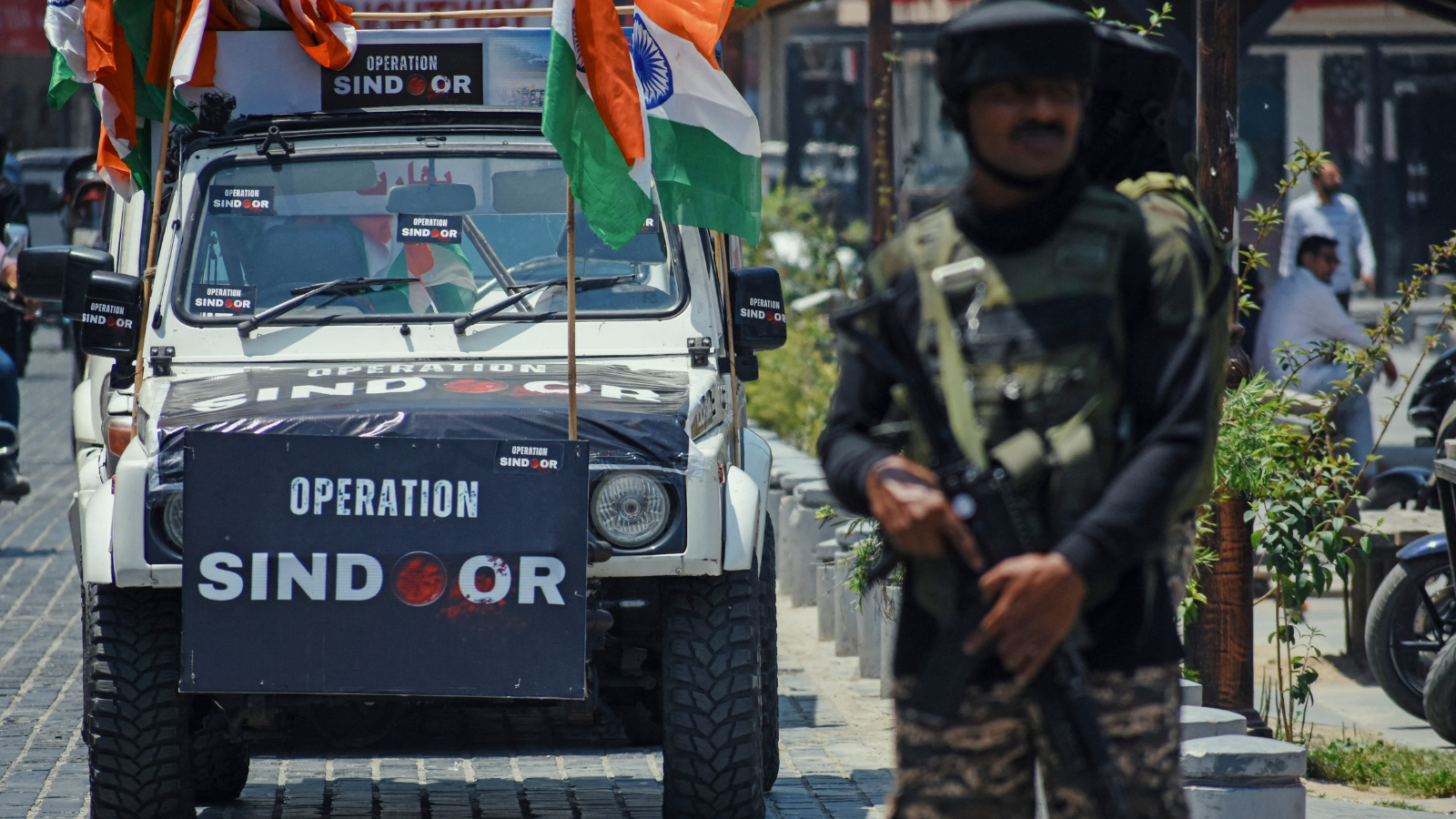
The India-Pakistan conflict that played out between May 6 and May 10, 2025, offers several military lessons. This article presents key takeaways from Operation Sindoor and breaks down how India’s preparations shaped the outcome and what more is needed to strengthen future readiness.

Dinakar Peri
This book offers a comprehensive analysis of India's evolving relationship with sovereignty in a complex global order. Moving beyond conventional narratives, it examines how the sovereignty principle shapes India's behavior across four critical domains—from traditional military power to contemporary data governance.

Rudra Chaudhuri, Nabarun Roy

This article examines the scale and impact of Chinese IUU fishing operations globally and identifies the nature of the challenge posed by IUU fishing in the Indian Ocean Region (IOR). It also investigates why existing maritime law and international frameworks have struggled to address this growing threat.


Ajay Kumar, Charukeshi Bhatt