

Commentary
Aron Lund
{
  "authors": [
    "Aron Lund"
  ],
  "type": "commentary",
  "blog": "Diwan",
  "centerAffiliationAll": "",
  "centers": [
    "Carnegie Endowment for International Peace"
  ],
  "collections": [],
  "englishNewsletterAll": "",
  "nonEnglishNewsletterAll": "",
  "primaryCenter": "Carnegie Endowment for International Peace",
  "programAffiliation": "",
  "programs": [],
  "projects": [],
  "regions": [
    "Türkiye",
    "Syria"
  ],
  "topics": []
}
Source: Getty
It is the season of new governments in Syria. In addition to the government of Wael Halqi, appointed by President Bashar al-Assad last year, there’s also Abu Bakr al-Baghdadi’s Islamic State of Iraq and al-Sham, the jihadi group which conceives of itself as a proper Islamic government. There are ministers and all.
In exile, there’s also the fiction of an exile government set up by Noufal al-Dawalibi, a Saudi-Syrian businessman with a political pedigree; his father served as prime minister in Syria before the Baath Party takeover. But unlike the other two governments, which actually exist ground—albeit to varying degrees—Dawalibi’s “government” seems to consist only of a press statement. It was announced to great fanfare in April 2012, but nowadays not even he himself seems to be taking it seriously.
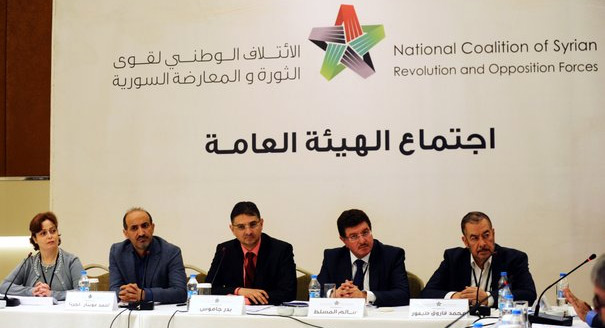
These past days, a new contender has stepped on the scene, as the National Coalition unveiled a list of ministers for its provisional government. Of prime minister Ahmed Toume’s cabinet nominees, the following nine managed to gather the required 62 votes:
Ibrahim Miro (Finance & Economy, 72 votes)Three nominees failed to win election: The Malaysia-based Islamism researcher Abdulrahman Alhaj (Education, 59 votes), Dr. Mohammad Jamil Jarran (Health, 47 votes), and the human rights activist Ammar Qurabi (Interior, 30 votes), leaving their positions unfilled as of yet. Interestingly, that means that the National Coalition has turned down the interior minister proposed by its military wing, the Supreme Military Command of Brig. Gen. Salim Idriss.
For more on the Toume government, keep an eye open for Professor Samer Abboud’s analysis, which will be up on the blog soon.
That’s not the only new government coming to Syria. Just as the National Coalition cabinet was being unveiled, the Kurdish PYD party—which is a Syrian wing of the PKK—reaffirmed its plans to create an autonomous local government. An 82-member Constituent Assembly for Rojava (i.e. Western Kurdistan, i.e. Northern Syria) has been created and tasked with setting up the new institutions.
While it explicitly rules out Kurdish independence, the new PYD government will rule the areas of Syrian Kurdistan controlled by its YPG militia, ignoring the claims of all other contenders. This serves to undermine Ahmed Toume’s new National Coalition government, by shutting it out of a considerable part of northern Syria—and that was of course part of the plan. The National Coalition responded furiously, slamming the Rojava declaration as a “separatist” project and labeling the PYD a pro-Assad “counter-revolutionary organization.”
Turkey, the arch-enemy of the PKK, has intermittently negotiated with the PYD and backed Islamist attacks on it as a form of proxy warfare. It had previously signaled a willingness to work with the PYD— provided it respected Turkish red lines—but the declaration of the Rojava administration was apparently a step too far: “We told them to avoid a de facto administration that could divide Syria,” snapped Foreign Minister Ahmet Davutoglu in his first comment on the PYD’s announcement.
Which is, of course, a useful reminder of a grim reality: The governments declared by Syrians are no longer the ones that matter most in Syria.
Former Nonresident Fellow, Middle East Program
Aron Lund was a nonresident fellow in the Middle East Program and the author of several reports and books on the Syrian opposition movement.
Recent Work
Aron Lund
Aron Lund
In an interview, Sohaib Jawhar analyzes the profound changes in the ties between the neighboring countries.

Michael Young
Any move by the United States to make good on Trump’s suggestion that Washington persuade Damascus to confront Hezbollah militarily would have catastrophic consequences.
Kheder Khaddour
In an interview, Elizabeth Thompson recalls how the country formulated a liberal constitution in 1920, before being denied by France and Britain.
Michael Young

This will be the region’s most representative tournament, amid broad changes in its footballing landscape.

Issam Kayssi
Trade statistics show why Amman has more reason than Damascus to welcome the improvement in bilateral commerce.

Armenak Tokmajyan