

Commentary
This will be the region’s most representative tournament, amid broad changes in its footballing landscape.
Issam Kayssi
{
  "authors": [
    "Marwan Muasher",
    "Katie Bentivoglio"
  ],
  "type": "commentary",
  "blog": "Diwan",
  "centerAffiliationAll": "",
  "centers": [
    "Carnegie Endowment for International Peace"
  ],
  "collections": [],
  "englishNewsletterAll": "",
  "nonEnglishNewsletterAll": "",
  "primaryCenter": "Carnegie Endowment for International Peace",
  "programAffiliation": "",
  "programs": [],
  "projects": [
    "Tunisia Monitor"
  ],
  "regions": [
    "North Africa",
    "Tunisia"
  ],
  "topics": []
}
Source: Getty
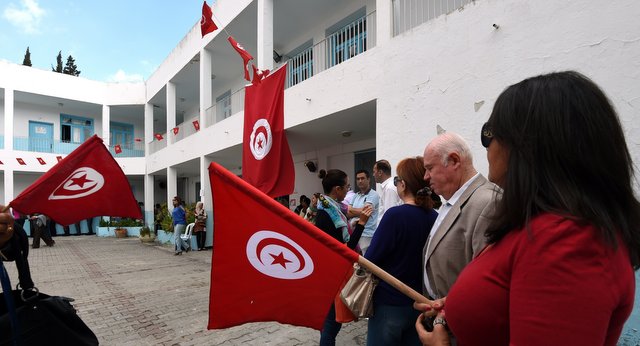
Nearly four years into its transition, Tunisia has successfully navigated multiple political crises, produced a constitution, and staged successful parliamentary elections. The country exemplifies that democracy can be successful in the Arab world.
When Tunisians cast their ballots in parliamentary elections on October 26, they shattered three misconceptions about democracy in the Arab world.
1. Islamists will use elections to come to power and then refuse to relinquish it.
For decades, authoritarian Arab leaders have characterized Islamists as political bogeymen, warning domestic constituents and foreign allies alike that, should Islamists be permitted to participate in politics, their electoral victory would be “one man, one vote, one time.” But in Tunisia, the Islamist Ennahda party has shown respect for the political process in times of victory and defeat.
In 2011, Ennahda gained 37 percent of the seats in the National Constituent Assembly (NCA), a transitional body charged with writing the new constitution and laying the foundations for Tunisia’s democratic system. Ennahda formed a power-sharing “Troika” government with two secular parties, Ettakatol and the Congress for the Republic (CPR), demonstrating its ability to compromise and work across ideological lines. Later, following the assassinations of two prominent opposition leaders and an ensuing backlash from secularists, Ennahda prioritized Tunisia’s fragile transition over its own partisan interests and transferred power to a caretaker government that would govern until the completion of parliamentary and presidential elections.
Finally, and most importantly, Ennahda has now proved willing to admit defeat at the ballot box. According to preliminary results following Sunday’s election, Ennahda gained only 26 percent of the vote, far below party president Rached al-Ghannouchi’s prediction of 41 percent. Instead of disputing the outcome, the party gracefully conceded its loss to Nidaa Tounes—a liberal, secular party founded in 2012 as a counterweight to Ennahda—even before official results were announced.
This makes Tunisia the only Arab country in which an Islamist party has come to power via the ballot box and subsequently been removed via the same mechanism—and it proves that Islamism can work within a democratic system.
2. Arabs vote based on ideology or loyalty, not on performance.
Political performance is beginning to shake the grip of ideology on voting patterns and political preference.
Over the Troika’s two-year tenure, it failed to address the underlying instigators of the revolution, such as staggering unemployment (particularly among youth), a lack of economic opportunities (especially in Tunisia’s neglected interior regions), and widespread political corruption. Consequently, all three parties performed poorly in the October 26 elections. Not only did Ennahda place second after Nidaa Tounes, the CPR gained a mere 1.8 percent of the vote and Ettakatol did not even figure into the initial election results. With no political record to judge, Nidaa Tounes has benefitted from its newness, voter disillusionment with the Troika, and the appeal of the party’s pro-reform, security-focused, and anti-Islamist message in the current political context. But should Nidaa Tounes also fail to deliver the demands of the revolution, it is likely to face the same electoral treatment as its Islamist rival.
This message is beginning to sink in. Aware of lingering resentment and continued mistrust of Islamists, Ennahda decided not to run a candidate in the November presidential elections. Although a temporary concession, Ennahda’s long-term interests may be best served by maintaining a low profile and allowing the blame for future political failures to fall on Nidaa Tounes, at least for a while.
In this regard, Nidaa Tounes would benefit from following Ennahda’s example. Though its anti-Islamist rhetoric proved an effective campaign technique, Nidaa Tounes and its octogenarian president, Beji Caid Essebsi, would be wise to scale back the party’s non-inclusive rhetoric and the rejection of Islamists. Despite its many shortcomings, Ennahda’s willingness to sacrifice immediate political gains for the sake of Tunisia’s democratic transition helped pave the way for the country’s most recent electoral success. Nidaa Tounes should be ready to do the same.
3. Democracy won’t work in the Arab world.
Finally, in the face of great pessimism, Tunisia exemplifies that democracy can be successful in the Arab world and that it can include Islamists. While democracy’s critics point to Egypt as an example of the system’s inability to take root in the Arab world, Tunisia now stands as a shining counterexample.
Nearly four years into its transition, the country has successfully navigated multiple political crises, produced a constitution, and staged successful parliamentary elections. Presidential elections on November 23 will bring Tunisia one step closer to becoming the Arab Spring’s one remaining success story.
Continued success will require patience and the acknowledgement that democratic ideals, let alone institutions, take time to develop and establish themselves within society. But it can be done—and Tunisia need not remain the only success story in the post-uprisings Arab world.
Katie Bentivoglio is a junior fellow in the Carnegie Middle East Program.
For more on the Tunisian election, see Intissar Fakir’s analysis of the strategic outlook of Ennahda and Nidaa Tounes.

Vice President for Studies
Marwan Muasher is vice president for studies at Carnegie, where he oversees research in Washington and Beirut on the Middle East. Muasher served as foreign minister (2002–2004) and deputy prime minister (2004–2005) of Jordan, and his career has spanned the areas of diplomacy, development, civil society, and communications.
Katie Bentivoglio
Former Junior Fellow, Middle East Program
Carnegie does not take institutional positions on public policy issues; the views represented herein are those of the author(s) and do not necessarily reflect the views of Carnegie, its staff, or its trustees.
This will be the region’s most representative tournament, amid broad changes in its footballing landscape.

Issam Kayssi
The recent African Cup of Nations tournament in Morocco touched on issues that largely transcended the sport.

Issam Kayssi, Yasmine Zarhloule
Mustaqbal Misr has expanded its portfolio with remarkable speed, but a lack of transparency remains.

Yezid Sayigh
The burden of environmental degradation is felt not only through physical labor but also emotional and social loss.
Yasmine Zarhloule, Ella Williams
The country’s youthful protest movement is seeking economic improvement, social justice, and just a little hope.
Yasmine Zarhloule