

Commentary
Aron Lund
{
  "authors": [
    "Aron Lund"
  ],
  "type": "commentary",
  "blog": "Diwan",
  "centerAffiliationAll": "",
  "centers": [
    "Carnegie Endowment for International Peace"
  ],
  "collections": [
    "Arab Awakening"
  ],
  "englishNewsletterAll": "",
  "nonEnglishNewsletterAll": "",
  "primaryCenter": "Carnegie Endowment for International Peace",
  "programAffiliation": "",
  "programs": [],
  "projects": [],
  "regions": [
    "Middle East",
    "Iran",
    "Syria"
  ],
  "topics": [
    "Political Reform",
    "Security",
    "Military"
  ]
}
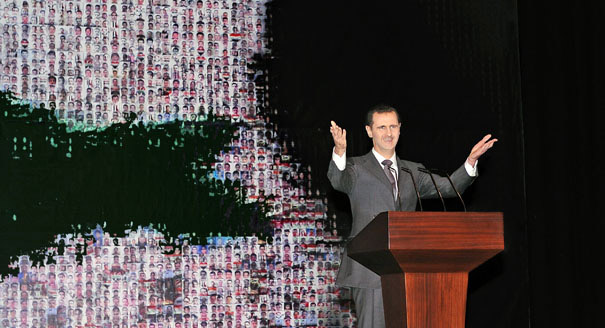
Source: Getty
Given the threats to his personal safety, Syrian President Bashar al-Assad has kept public appearances to a minimum during the war that began in 2011. He does attend the occasional propaganda event, of course, such as a foray to the Damascus front line or visiting the children of fallen soldiers. Media interviews are given in rapid bursts, followed by periods of renewed silence. And then there are the public speeches, often held on historical dates and formal occasions.
This time, however, the president appeared with no prior prompting. On July 26, Syrian public television interrupted its normal programming to broadcast a speech by the president. Held in the People’s Palace that overlooks Damascus, in front of an audience of loyal Baathists, it ran to more than one hour and it may have been Assad’s most overtly political and argumentative speech since the crisis began in spring 2011.
(If you know Arabic, you can watch the video recording or read the official transcript. There is also an official but not entirely complete English transcript.)
Much of it was the usual fare. The president portrayed the conflict in Syria as one between a people and its army (both led by him) against a foreign-instigated terrorist menace. His opponents will view this as an utter falsehood and even his supporters must consider it a simplification. But never mind. Baathist rhetoric was always short on nuance and, viewed from within a singularly authoritarian regime dug down in bunker mode, this probably is how the problem appears—it is at any rate no different from how the Syrian opposition habitually engages in its own forms of self-delusion.
The meat of the speech was neither the attempt to co-opt Western-inspired “antiterrorist” discourse nor the nationalist rah-rah. Far more interesting was Assad’s lengthy discussion of the recent setbacks suffered by his army. After advancing for much of 2014, the government ran out of steam over the winter, as the economy started to sputter and rebels received additional support. This spring, Assad’s fortunes took a sharp turn for the worse.
In March, Assad’s troops were forced to surrender the provincial capital of Idlib to Islamist rebels, as well as the southern city of Bosra al-Sham. In April, the army’s last real foothold in Idlib was lost with Ariha and Jisr al-Shughur. Then the last remaining border crossing into Jordan went the same way, which slashed overland trade. In May, the extremist group known as the Islamic State took Sukhna and the strategic city of Palmyra, isolating the city of Deir Ezzor. It then began to seize or destroy parts of Syria’s energy infrastructure. In June, more moderate rebels took out an important army base in the southern Daraa Governorate, although the ensuing offensive to capture Daraa City then seemed to stall. The Islamic State jihadists have also given Assad’s forces a bad bruising in Hasakah, although the army has so far held out thanks to an alliance of convenience with local Kurdish fighters.
The government has advanced in the Syrian-Lebanese border region of Zabadani, where it is backed by the Lebanese Shia militia Hezbollah, but the situation now looks quite grim for Assad. Much of the official Syrian Arab Army has been supplemented or replaced by militias, but even then, pro-Assad forces are spread dangerously thin on the ground. Iran, now flush with confidence after its nuclear deal, recently signed on to a $ 1 billion credit deal to aid the Syrian economy—but as things stand, Assad simply seems to be trying to hold more territory than he can defend.
After the fall of Idlib in March this year, reports multiplied about internal and/or Iranian pressure on Assad to cut his losses, shorten the front, withdraw to defensible lines, or accept some form of de facto partition of Syria. Whichever way one phrased it, the idea was to abandon territory. What territory that would be was anyone’s guess. Would Assad do no more than accept the fall of Idlib, or would he withdraw completely from isolated eastern towns like Deir Ezzor or Hasakah, or Daraa in the south? Some even speculated that the regime might be pondering a retreat from the big prize of the north, Aleppo (without which Assad would have a hard time convincing even the most charitable audience that he is the president of all of Syria).
When addressing these issues, Assad had to tread cautiously for fear of sowing panic or alienating some local constituency. “Each part of Syria is precious and invaluable and each spot equals in its demographic and geographic importance all other spots,” he said in his speech , only to smoothly walk that back: “However, war has its conditions, strategies, and priorities.”
The Syrian leader went on to explain that the military is forced to prioritize “vital areas that must be held as to prevent other areas from falling,” hinting that this could include places of military-strategic importance, politically symbolic cities, or regions housing infrastructure and institutions that offer key services.
According to a source with high-level connections in the Syrian government, the speech on July 26 had been long in coming. It represented an attempt to climb down from past rhetoric about defending all of Syria after new realities have dawned on even the most hawkish leaders within the regime. “There were two camps after Idlib,” explained the source. “One wanted to get it back and one did not. Then came the loss of Jisr al-Shughur, that was the real blow. When they were about to attack Jisr al-Shughur to take it back, Palmyra fell. It was then that the totality of it all became obvious.”
Unlike in previous speeches during the conflict, Assad was not content to state his opinions and condemn the opposition. He seemed to be trying to make a case, carefully arguing and working to convince his supporters. Of what? The gist of it seemed to be the grim message that territorial losses will continue to occur, that the military leadership will have to make some hard choices, and that now, citizens must step up their support for the army.
For the first time, Assad publicly admitted to the manpower problem that his army faces, although he claimed that it is overstated in pro-opposition propaganda (which is surely true). He sought to convince citizens to get off the fence and join in the battle, because “the army’s energy is manpower, and if we want the army to give its best, then we need to give it our best.” Having recently signed an amnesty decree for deserters and draft dodgers in the hope of getting “a few thousand” of them back, the president declared that “when the state shifts to a state of war, the numbers must be increased and this is by calling in the reserves as well as conscripts and volunteers.”
Earlier this year, rumors circulated that Assad would declare a general mobilization, activating all army reservists and drawing more civilians into the war effort. The rumors were denied at the time, as they have been before. However, Assad now explicitly referenced qanoun al-taabia, the mobilization law that regulates draft and mobilization rules, which he issued in early 2011 . He explained that the situation might require that “civilian resources” like “cars, machinery, and facilities” are placed “at the disposal of the armed forces” since “the war is waged by the entire country and all of society.”
The 2011 decree on popular mobilization gives Assad the legal tools for putting society on a full war footing, but his government has stumbled quite far down that path already. It is doubtful whether the regime could actually mobilize any significant number of additional soldiers without having to resort to violent coercion against its own popular base.
But there seems to be no doubt about Assad’s own determination to fight on. In his speech, he hardly mentioned the idea of ultimate victory over his opponents. Yet, he spoke time and again of sumoud, the Arabic term for perseverance and struggling on against the odds, as if this was not only a glorious undertaking but also the best his citizens could hope for. Victory for Syrian loyalists has been redefined as thwarting their opponents and thereby, Assad claimed, keeping themselves and their nation alive. “The price is high because the scheme is formidable. The war is a war of existence; to be or not to be,” he said.
If accounts from those in touch with Assad’s associates can be relied on, that is indeed the mood in the regime’s core. Assad may finally have accepted that he will have to relinquish parts of Syria, tactically settling in behind the lines that he thinks that he can hold—but he’s not about to surrender.
Former Nonresident Fellow, Middle East Program
Aron Lund was a nonresident fellow in the Middle East Program and the author of several reports and books on the Syrian opposition movement.
Recent Work
Aron Lund
Aron Lund
Carnegie does not take institutional positions on public policy issues; the views represented herein are those of the author(s) and do not necessarily reflect the views of Carnegie, its staff, or its trustees.
This will be the region’s most representative tournament, amid broad changes in its footballing landscape.

Issam Kayssi
Trade statistics show why Amman has more reason than Damascus to welcome the improvement in bilateral commerce.

Armenak Tokmajyan
In an interview, Marc Lynch discusses his new book decrying the post-1990 U.S.-dominated order in the Middle East.

Michael Young

Because perpetual conflict enhances control, offers economic benefits, and allows leaders to ignore popular preferences.

Angie Omar
In an interview, Jim Lamson discusses the ongoing regional conflict and sees an unclear picture when it comes to winners and losers.
Michael Young