

Commentary
Michael Young
{
  "authors": [
    "Michael Young"
  ],
  "type": "commentary",
  "blog": "Diwan",
  "centerAffiliationAll": "dc",
  "centers": [
    "Carnegie Endowment for International Peace",
    "Malcolm H. Kerr Carnegie Middle East Center"
  ],
  "collections": [
    "Inquiring Minds"
  ],
  "englishNewsletterAll": "menaTransitions",
  "nonEnglishNewsletterAll": "",
  "primaryCenter": "Malcolm H. Kerr Carnegie Middle East Center",
  "programAffiliation": "MEP",
  "programs": [
    "Middle East"
  ],
  "projects": [],
  "regions": [
    "Levant",
    "Israel",
    "Lebanon",
    "Middle East",
    "Palestine"
  ],
  "topics": [
    "Political Reform"
  ]
}
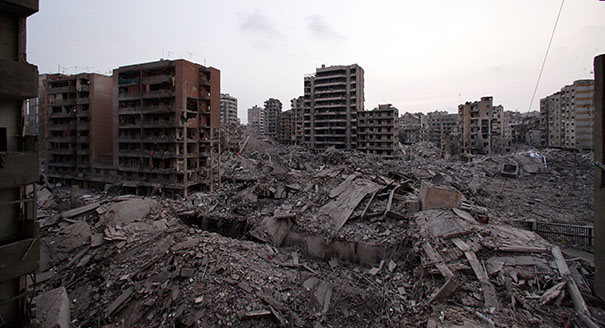
Source: Getty
A regular survey of experts on matters relating to Middle Eastern and North African politics and security.
Basem Shabb | Member of Lebanon’s parliament, where he serves on the Defense Committee
Although there has been considerable speculation about a possible war between Hezbollah and Israel, this seems unlikely in the coming year. In fact, a low intensity conflict has been brewing in Syria for several years with more than 100 air raids conducted by the Israelis there, with no credible response. Time and again Hezbollah has relayed a defensive message threatening retaliation against any Israeli aggression, in effect reassuring Israel that the party will not itself initiate hostilities across the Lebanese-Israeli border. Given Hezbollah’s involvement in Syria, starting an armed conflict seems ill advised and would have disastrous consequences for the Shi‘a community as well as for Lebanon, in which Hezbollah is a major stakeholder. Additionally, unlike 2006, Syria can no longer be counted on as a strategic partner.
For Israel in turn, there is little to gain from waging all-out war. Lebanon is fairly neutral ground, with the United Nations Interim Force in Lebanon and an ascending Lebanese Army limiting Hezbollah’s margin of maneuver. Syria, which was a Hezbollah sanctuary in 2006, is no longer immune to frequent Israeli airstrikes. In addition, with a Russian presence in a secure buffer zone in southern Syria, a large-scale conflict seems remote.
Elliott Abrams | Senior fellow for Middle East at the Council on Foreign Relations, former special assistant to the president and senior director on the National Security Council for Near East and North African Affairs
In the coming year Hezbollah and its sponsors in Tehran will primarily be occupied with Syria. A major war with Israel is risky for them. While they could inflict very serious damage on Israel, such a war would evoke a fierce Israeli response that could decimate Hezbollah. It might spread to Syria and undermine Iran’s efforts there. Why would they take that risk deliberately? Even frequent Israeli bombings have not elicited much of a Hezbollah response.
Hezbollah plays many roles for Iran nowadays, which is why it is less important merely as Iran’s second-strike capability. If Israel were to bomb Iran’s nuclear weapons sites, Iran could “unleash” Hezbollah and order it to do its utmost to damage Israel. But today the chances of such an Israeli strike appear low. Hezbollah has become a key part of the new Iranian empire in the region, fighting in Syria and training Shi‘a militias alongside Iran’s Revolutionary Guards. So Hezbollah is not expendable.
As in 2006, war can come unexpectedly. Back then, Hezbollah attacked Israel, killed and kidnapped soldiers, and thought there would be only a minor Israeli reaction. Presumably, Hezbollah will not make that same mistake again. An unexpected escalation is still possible, but the lessons of 2006 should make Hezbollah more careful.
Hanin Ghaddar | Inaugural Friedmann visiting fellow at The Washington Institute
A war between Hezbollah and Israel might be inevitable, but it is not necessarily imminent. A great deal can happen during a year—including mistakes and miscalculations from both sides—but looking at recent developments in Syria and Lebanon, it doesn’t seem that Israel and Hezbollah are interested in starting a war.
Israel is aware that Hezbollah’s new entanglements in the region have gained it more advanced weapons and experienced fighters. In case of a war, Hezbollah will have access to 150,000 rockets—compared to the 33,000 it had in 2006. But more significantly for Israel, Hezbollah now has factories in Lebanon and Syria that can convert rockets to missiles—meaning they have guidance systems—a development that could mean serious damage to Israeli towns and cities. In addition, Hezbollah is now part of an army of 200,000 Shi‘a fighters from Lebanon, Iraq, Pakistan, and Afghanistan, under the command of the Quds Force of Iran’s Revolutionary Guards. An Israeli war with Hezbollah, therefore, could mean a war with Iran’s foreign legion.
Hezbollah also knows that Israel has been developing its military capabilities since 2006 and readying itself for the next war, in which it is determined to be victorious. For Israel, victory means that Hezbollah will not survive to fight another day. That is precisely why Israel is waiting, and won’t rush into a war that Hezbollah might survive. Meanwhile, Hezbollah is stretched thin in more than three countries, and a war with Israel could jeopardize Hezbollah’s and Iran’s recent gains in Syria, Lebanon, and Iraq.
Until this war becomes a necessity, Israel will continue its targeted attacks on Hezbollah’s weapons convoys and depots, as protection of its borders are the only priority for now. And Hezbollah won’t look south unless its victory in Syria is acknowledged and established, which might take a long time.
Ali Hashem | Columnist for Al-Mayadeen and for Al-Monitor
Given the current circumstances, I think that a war between Hezbollah and Israel is very unlikely in the coming year. The war in Syria helped Hezbollah enhance its deterrence capabilities and fighting skills, and gave it the chance to stockpile quality weapons that could make any new war very costly for Israel. Israel would only fight a war to weaken Hezbollah or to end it, but such a goal doesn’t seem to be feasible. On the contrary, as in 2006, Hezbollah might emerge stronger in terms of its popularity and gain back all the reputation it lost in the war in Syria.
I believe Hezbollah is keen to preserve stability on the southern Lebanese border for as long as possible. First, it understands well that the Israel of 2006 isn’t the same Israel as today. Its Iron Dome air defense network is more sophisticated than it was, and this means the efficiency of Hezbollah’s rockets is questionable. Besides, regional conflicts and sectarian rifts would make it difficult for supporters of the party to seek refuge in other areas whenever a war would kick off.
Still, I wouldn’t rule out war in case of a major incident on the borders that could be regarded by any of the two sides as a game changing or equation breaking.

Editor, Diwan, Senior Editor, Malcolm H. Kerr Carnegie Middle East Center
Michael Young is the editor of Diwan and a senior editor at the Malcolm H. Kerr Carnegie Middle East Center.
Recent Work
Michael Young
Michael Young
Carnegie does not take institutional positions on public policy issues; the views represented herein are those of the author(s) and do not necessarily reflect the views of Carnegie, its staff, or its trustees.

It is improbable that Israel’s forthcoming elections will alter much in terms of how the country thinks about security.

Nathan J. Brown

Huawei pushed hard to enter the Egyptian data centers market, until the Americans made a better offer.

Angie Omar

The accord represents a pivotal moment in the region to avert a security vacuum in the Gulf.


Azeema Cheema, Mohanad Hage Ali

In an interview, Jason Burke discusses his sweeping account of the “revolutionists” who so shaped the 1970s and early 1980s.
Michael Young
Lying at the heart of Lebanon’s dysfunction is an inability to secure accountability and institutional legitimacy.

Maha Yahya