

Commentary
Azeema Cheema, Mohanad Hage Ali
{
  "authors": [
    "Mohanad Hage Ali"
  ],
  "type": "commentary",
  "blog": "Diwan",
  "centerAffiliationAll": "dc",
  "centers": [
    "Carnegie Endowment for International Peace",
    "Malcolm H. Kerr Carnegie Middle East Center"
  ],
  "collections": [
    "Three Question Time"
  ],
  "englishNewsletterAll": "menaTransitions",
  "nonEnglishNewsletterAll": "",
  "primaryCenter": "Malcolm H. Kerr Carnegie Middle East Center",
  "programAffiliation": "MEP",
  "programs": [
    "Middle East"
  ],
  "projects": [],
  "regions": [
    "Middle East",
    "North Africa",
    "Iraq",
    "Egypt",
    "Syria"
  ],
  "topics": [
    "Political Reform"
  ]
}
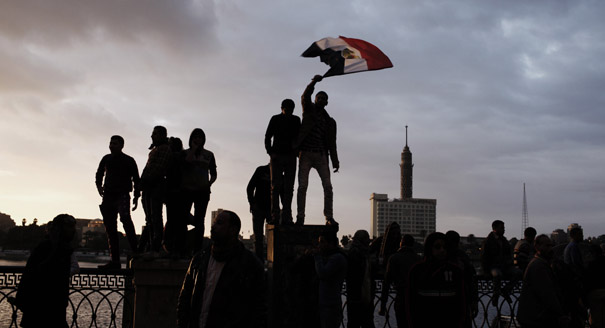
Source: Getty
Marc Lynch discusses the Arab uprisings, how they might be viewed by historians, as well as the future of the Middle East.
Marc Lynch is a nonresident senior fellow in the Carnegie Middle East program, and a professor of political science at George Washington University, where he recently completed a six-year term as director of the Institute for Middle East Studies. Lynch is also director of the Project on Middle East Political Science, an international network of scholars, and a contributing editor of the Washington Post’s Monkey Cage blog.
Lynch’s most recent book, The New Arab Wars: Uprisings and Anarchy in the Middle East, was published by Public Affairs in 2016. His other books include The Arab Uprising: The Unfinished Revolutions of the New Middle East (Public Affairs, 2012), and The Arab Uprisings Explained (Columbia University Press, 2014). In early February, Diwan caught up with Lynch in Beirut to discuss the Arab uprisings and ask him about the U.S. role in the Middle East as well as the region’s future.

Deputy Director for Research, Malcolm H. Kerr Carnegie Middle East Center
Mohanad Hage Ali is the deputy director for research at the Malcolm H. Kerr Carnegie Middle East Center.
Recent Work

Azeema Cheema, Mohanad Hage Ali
Mohanad Hage Ali
Carnegie does not take institutional positions on public policy issues; the views represented herein are those of the author(s) and do not necessarily reflect the views of Carnegie, its staff, or its trustees.

Huawei pushed hard to enter the Egyptian data centers market, until the Americans made a better offer.

Angie Omar

The accord represents a pivotal moment in the region to avert a security vacuum in the Gulf.
Azeema Cheema, Mohanad Hage Ali
In an interview, Jason Burke discusses his sweeping account of the “revolutionists” who so shaped the 1970s and early 1980s.

Michael Young
In an interview, Sohaib Jawhar analyzes the profound changes in the ties between the neighboring countries.
Michael Young
Following its deal with the United States, Iran may act against Iraq-based dissidents.
Wladimir van Wilgenburg