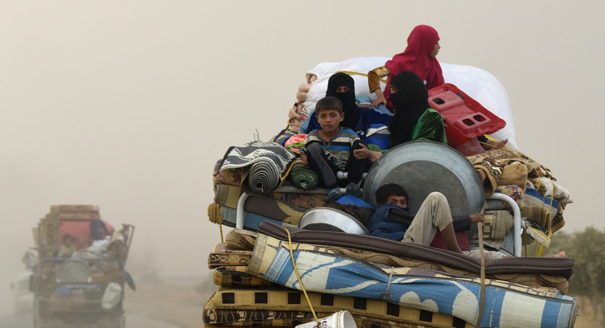
Kheder Khaddour is a nonresident scholar at the Carnegie Middle East Center in Beirut. Khaddour, a Syrian national, has done much research on the conflict in Syria, often analyzing issues that fall outside the boundaries of mainstream coverage of the country. In January, he published a paper on the potential return of Syria’s displaced to the governorates of Raqqa and Deir Ezzor, titled “Back to What Future? What Remains for Syria’s Displaced People.” It is to discuss his recent paper that Khaddour talked with Diwan in January 2018.
Michael Young: You recently published a Carnegie paper, titled “Back to What Future? What Remains for Syria’s Displaced People.” What do you argue in the paper?
Kheder Khaddour: While focusing on eastern Syria, the paper argues that no return to Syria is foreseeable without a political settlement in the country. A political settlement and a return should be not be dealt with as separate issues. The end of hostilities does not in itself create the conditions for return if the actors on the ground are still involved in forging new realities on the ground.
The return of refugees can be misused as a card by those involved in the Syrian conflict to create a new political order that consolidates their military gains and allows them to acquire international legitimacy. This is particularly likely in the battlefield of eastern Syria, where both the Syrian regime and the Kurdish-dominated Syrian Democratic Forces (SDF) are competing. The regime is striving to reimpose its control over territory lost during the conflict, while the SDF seeks to consolidate the territorial gains it made during the fighting against the Islamic State. Both actors seek international recognition and they may exploit the card of the refugees’ return to fulfill their objectives. Yet if such a return is guided by the political objectives of actors involved in the conflict, it will only consolidate the conditions that led many people to leave in the first place, therefore allowing only a selective return of refugees.
MY: What are the main obstacles preventing a return of refugees to Raqqa and Deir Ezzor Governorates in Syria’s east?
KK: There are several factors, of a diverse nature. The most apparent is that for as long as the conflict continues, the return of refugees hinges on those military actors in control of different portions of eastern Syria. As it unfolded, the conflict not only forced people out, but also created new realities in the refugees’ places of origin. Today, for example, Raqqa’s urban middle class strives to imagine a return to a city that is both destroyed and managed by a new leadership in Raqqa’s local governing council that is supported by the SDF.
Deir Ezzor Governorate, in turn, is fragmented into islands under the control of the regime and the SDF, each dragging tribal and local leaders to their side. Beside shifting local power dynamics, the unprecedented territorial expansion of the Kurdish forces of the People’s Protection Units* (YPG), who dominate the SDF, has fuelled Arab suspicions of the Kurds, discouraging many refugees from going back. The gap is psychological too, as refugees can hardly imagine returning to, and building a future in, their areas of origin, which have so changed that these people feel they would be unable to adapt.
MY: How did the defeat of the Islamic State affect the situation in Deir Ezzor Governorate? How would you describe the reality there today?
KK: The battle against the Islamic State has led the regime and the SDF and their respective allies into a standoff. Deir Ezzor is similar to other areas on the Iraqi-Syrian border, such as Sinjar on the Iraqi side, where despite the defeat of the Islamic State, regional and international agendas are being played out. Deir Ezzor is located at the crossroad between Syria and Iraq, and like many other areas along the border between the two countries it risks remaining a militarized zone where regional and international actors have a vested interest in maintaining a presence and proxies.
The SDF controls areas north of the Euphrates River. Deir Ezzor is key for the SDF to preserve its partnership with the United States after the defeat of the Islamic State, and therefore to enhance its chances of gaining* political legitimacy in a post-conflict scenario. Though U.S. plans in eastern Syria remain unclear, Washington’s presence and military support for the SDF continue in this strategic swath of land, where it is possible to oppose a perceived Iranian land bridge between Iran and the Levant. Syrian regime forces, deployed south of the Euphrates, have a shared interest with Iran and Russia in preventing U.S. entrenchment in eastern Syria.
MY: How do you see the Turkish offensive in northern Syria affecting the situation in Raqqa, particularly with regard to refugees?
KK: The Turkish offensive against the YPG in northern Syria has consolidated the regional standoff in Deir Ezzor. It reinforces the conundrum that began with U.S. support for the YPG, a Syrian Kurdish military force that is closely aligned with the Kurdistan Workers Party (PKK), which has fought the Turkish government for decades. It also places two NATO allies—Turkey and the U.S.—in an uncomfortable rivalry, creates an ad hoc alignment between Turkey and Russia, and polarizes relations between the U.S. and Russia in Syria. The Turkish conflict with the PKK and the YPG in northern Syria has repercussions in the east of the country, because the ensuing polarization makes it more likely that the U.S. and Russia will back their respective allies there—the SDF and the regime, respectively—further exacerbating tensions in that part of Syria.
MY: From what you are hearing, what will it take for Syrian refugees to return to Raqqa and Deir Ezzor Governorates, and how likely is this?
KK: The challenge is political as much as psychological. Ask Syrian refugees whether they intend to return to those areas and they will reply, “Return to where?” Leaving was an abrupt rupture that scattered families across different countries, undermined existing social structures, and created new ones on the ground. The paramount condition for a return, therefore, is to allow refugees to, at least partially, recompose those fractured structures and be able to readapt to a new reality on the ground. There is no return to prewar Syria. That is why only a political settlement can create the conditions for refugees to return, by bridging the gap between the old Syria and the postwar Syria to which refuges could imagine returning.
* These passages have been modified to insert corrections.