

Article
Mohanad Hage Ali
{
  "authors": [
    "Mohanad Hage Ali"
  ],
  "type": "commentary",
  "blog": "Diwan",
  "centerAffiliationAll": "dc",
  "centers": [
    "Carnegie Endowment for International Peace",
    "Malcolm H. Kerr Carnegie Middle East Center"
  ],
  "collections": [],
  "englishNewsletterAll": "menaTransitions",
  "nonEnglishNewsletterAll": "",
  "primaryCenter": "Malcolm H. Kerr Carnegie Middle East Center",
  "programAffiliation": "MEP",
  "programs": [
    "Middle East"
  ],
  "projects": [
    "The Return of Global Russia: A Reassessment of the Kremlin’s International Agenda"
  ],
  "regions": [
    "Levant",
    "Lebanon",
    "Middle East",
    "Russia",
    "Caucasus"
  ],
  "topics": [
    "Political Reform"
  ]
}
Source: Getty
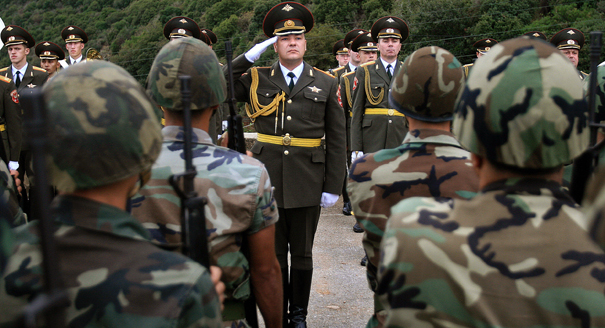
Russian ‘soft power’ has been expanding in Lebanon, and a number of recent developments prove it.
In March, the Lebanese government was expected to approve a Lebanese-Russian military cooperation agreement. However, at the last minute Western diplomatic pressure, particularly by the United States, forced Lebanese Prime Minister Saad Hariri, an ally of Washington and the European Union, to postpone the deal. However, the whole episode lifted the veil on growing Russian influence in Lebanon.
The military cooperation agreement hinted at the breadth of Russian ambitions. Although Lebanon has previously received Russian military aid, the agreement would have substantially upgraded military relations by granting Russian forces access to Lebanese military bases, though this was described as temporary. In return, Russia would have supplied the Lebanese armed forces with weapons worth an estimated $1 billion, to be paid without interest within fifteen years. The favorable terms were a way of facilitating a greater Russian say in Lebanon. Russian Prime Minister Dmitry Medvedev had already signed the agreement, instructing his Defense Ministry to persuade the Lebanese to do the same.
There are a number of reasons for enhanced Russian influence in Lebanon. Foremost among them is a growing belief among Lebanon’s political elite that it needs to adapt to Moscow’s emergence as a major power broker in the region, especially in light of U.S. disengagement. This not only pertains to Hezbollah and its allies, whose enmity toward the United States induces them to support such a relationship, it also extends to those such as Hariri, who believe that ties with Russia can open up economic opportunities.
Where do the Lebanese believe Russia can play a role in their country? Russia’s relative success in Syria has fed into a belief in Lebanon that Russian companies are among the few who will dare invest in the country’s offshore gas fields along the disputed maritime border with Israel. Indeed, a French-Italian-Russian consortium won contracts for exploration of two blocs, one of them contested by both the Lebanese and Israelis.
For Lebanese businessmen and politicians who oppose Syrian President Bashar al-Assad’s regime, Russia may help guarantee them a role in the expected bonanza of Syria’s reconstruction. And at a time when minorities have suffered throughout the Middle East, leaders of some Christian communities regard Russia as a potential protector. A number of Lebanese media reports have even suggested that the defense agreement with Russia was at least partly motivated by the fact that Defense Minister Ya‘qoub Sarraf is from the Greek Orthodox community, of which Russia has traditionally been a protector.
During the past few years, there have been a record number of visits to Russia by Lebanese officials. Hariri has visited Moscow once a year since 2015, while Sarraf has visited Moscow twice in the past eight months. Foreign Minister Gebran Bassil, leader of Lebanon’s largest Christian party, the Free Patriotic Movement, visited the Russian capital in November.
Perhaps the most telling of these visits came last year, when the Druze leader Walid Joumblatt, once a close ally of the Soviet Union, took his son Taymour to Moscow. He did so to introduce Taymour to Russian officials, with his son currently preparing to take over the leadership of the Druze community following parliamentary elections on May 6. Taymour later returned on his own to Russia, meeting with Deputy Foreign Minister Mikhail Bogdanov, a specialist on the Middle East who is a fluent Arabic speaker. The newspaper of Joumblatt’s party quoted Taymour as praising the “pivotal role played by Russia in today’s world,” and describing Moscow as “a significant element of balance and stability, on which we wager to help Lebanon.”
To cement relations with Russia, Lebanon’s major political blocs have established links in Moscow, often through Lebanese living in the Russian capital or well-connected businessmen. Hariri’s man in Moscow is his Russian affairs advisor George Sha‘ban, who attended all of Hariri’s meetings with Russian President Vladimir Putin. Lebanese President Michel Aoun’s man in Moscow is arguably the most influential player in Lebanese-Russian relations. He is Amal Abou Zeid, a London-educated millionaire, and currently a parliamentarian from Aoun’s Change and Reform bloc. In a newspaper interview, Abou Zeid, a frequent traveler to Russia, discussed his vital role in reviving Beirut’s relations with Moscow after the fall of the Soviet Union. As a token of appreciation, in 2015 the Institute of Oriental Studies of the Russian Academy of Sciences granted him an honorary doctorate for his efforts in strengthening Lebanese-Russian relations.
During the past decade, Russia has also revived ties that existed between Lebanese and the former Soviet Union. This mostly involves graduates from Soviet, then Russian, universities, a figure estimated at some 14,000 people. Following the assassination of Lebanon’s former prime minister, Rafik al-Hariri, in 2005, and the ensuing polarization in the country, the single alumni association existing at the time split into two rival groups. Later, a third association representing the alumni of Patrice Lumumba University, today the People’s Friendship University of Russia, was established.
These alumni associations, while divided, have proven useful in contributing to Russian cultural expansion, or soft power. The Russian Cultural Center, previously confined to a barricaded building in western Beirut, has opened branches in main towns around Lebanon, drawing on a large pool of Russophiles throughout the country. In addition to offering Russian language courses and cultural and educational programs, these centers host political events and are also voting centers for Russian citizens. The most visible demonstration of this occurred during Russia’s recent presidential election, when billboards of Putin were posted in various regions.
In addition to this cultural network are other institutions, such as the Lebanese-Russian Friendship Association and the Russian-Lebanese Business Council. Jacques Sarraf, a prominent businessman, is president of both bodies, as well as being Russia’s honorary consul in Lebanon. Sarraf, like Abou Zeid, has been essential in cementing relations with Russia.
In parallel to the growing influence of this network, the staff of the Russian embassy in Beirut has increased during the past decade to include a relatively large military section. Historically, the Lebanese military has received U.S. training and equipment. Consequently, relations with Moscow suffered, especially after Lebanese military intelligence foiled a KGB plot to illegally obtain a French fighter jet in 1969. This changed after a Russian offer to give Lebanon ten MIG-29s in 2008. However, then-defense minister Elias Murr reportedly hesitated to go through with the deal, fearing U.S. reprisals.
The recent military cooperation agreement with Russia may have been postponed, but it remains on the table. If the upcoming parliamentary elections favor Moscow’s friends in Beirut, the agreement might find itself on the agenda of the new government sooner than expected.
* Changes have been introduced in the paragraph on Walid Joumblatt, as the original contained an inaccuracy.

Deputy Director for Research, Malcolm H. Kerr Carnegie Middle East Center
Mohanad Hage Ali is the deputy director for research at the Malcolm H. Kerr Carnegie Middle East Center.
Recent Work
Mohanad Hage Ali
Mohanad Hage Ali
Carnegie does not take institutional positions on public policy issues; the views represented herein are those of the author(s) and do not necessarily reflect the views of Carnegie, its staff, or its trustees.
In an interview, Elizabeth Thompson recalls how the country formulated a liberal constitution in 1920, before being denied by France and Britain.

Michael Young
As negotiations with Iran and Lebanon continue, chaos is at the heart of the Netanyahu government’s calculations.
Michael Young
Trade statistics show why Amman has more reason than Damascus to welcome the improvement in bilateral commerce.

Armenak Tokmajyan
Adversaries are to be degraded so deeply, that reconstitution becomes difficult or impossible.

Nathan J. Brown
Israel is encroaching on the country’s territory, while the Lebanese look askance at one another.

Issam Kayssi