

Commentary
Azeema Cheema, Mohanad Hage Ali
{
  "authors": [
    "Mohanad Hage Ali"
  ],
  "type": "commentary",
  "blog": "Diwan",
  "centerAffiliationAll": "dc",
  "centers": [
    "Carnegie Endowment for International Peace",
    "Malcolm H. Kerr Carnegie Middle East Center",
    "Carnegie Russia Eurasia Center"
  ],
  "collections": [],
  "englishNewsletterAll": "menaTransitions",
  "nonEnglishNewsletterAll": "",
  "primaryCenter": "Malcolm H. Kerr Carnegie Middle East Center",
  "programAffiliation": "MEP",
  "programs": [
    "Middle East"
  ],
  "projects": [
    "The Return of Global Russia: A Reassessment of the Kremlin’s International Agenda"
  ],
  "regions": [
    "Levant",
    "Lebanon",
    "Middle East",
    "Russia",
    "Caucasus"
  ],
  "topics": [
    "Political Reform"
  ]
}
Source: Getty
Russia continues to play a larger role in Lebanon as the conflict in Syria enters a new phase.
Russian influence in Lebanon has continued to expand in recent months, and has been tied to key developments in the country. These include the Syrian refugee crisis and, it has been said, the deployment of Russian military police along the Lebanese-Syrian border, as well as the formation of a new Lebanese government.
In July, Russia’s Defense Ministry announced that it had sent a proposal to Washington to jointly organize the return home of millions of Syrian refugees now living in Lebanon, Jordan, and Turkey. The reaction from the international community and experts was skepticism, and indeed the Russians have yet to put forward a convincing plan of return. Nevertheless, the initiative provoked a positive reaction from the Lebanese, so that meetings on the matter between Lebanese and Russian officials in Beirut and Moscow have since become commonplace.
The reason for the Lebanese attitude lies partly in the country’s near-obsession with the Syrian refugees. Lebanese officials, notorious for their inefficiency, corruption, and divisive politics, have sought to detract from their shortcomings by blaming all national problems on the presence of refugees. The claims have reached ridiculous proportions. A recent television report, for example, quoted a medical professional as saying that Syrian refugees were behind the rise of cancer cases in the country, as they had brought with them harmful bacteria.
The United States and European countries have managed to obstruct Russian efforts to conclude a military cooperation agreement with Lebanon. However, any successful Russian role in helping to resolve the refugee crisis is paving the way for regular security and military coordination between Lebanon and Russia. On a weekly basis, hundreds of Syrian refugees are returning to Syria, after receiving guarantees from the Syrian side. Russian military officials are playing a role in the coordination process, given that this was originally a Defense Ministry initiative. Reportedly, the Russians have facilitated the conditions of return, specifically exempting returnees from military service and security vetting.
The numbers of returnees remain relatively low, given the enormous size of the Syrian refugee population. If the current numbers are sustained, with only a few hundred people returning weekly, the process could take years, if not decades. For the time being the timeframe for a return of Syrian refugees is open-ended, providing opportunities for further collaboration between Lebanon and Russia, the consolidation of mutual ties, and greater leverage for Russian diplomacy.
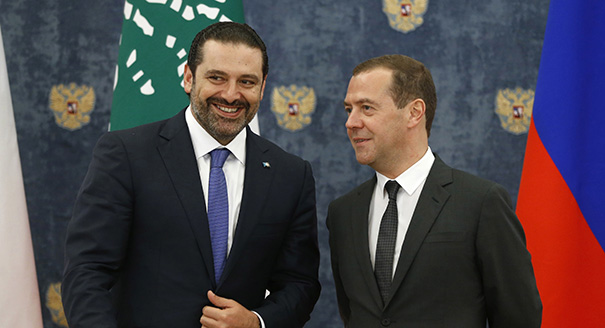
This effort has been accompanied by an increase in the number of Lebanese officials visiting the Russian capital. As the Syrian regime and its allies have consolidated their control over most of Syria, with the exception of areas in the east and north, Lebanese officials and politicians, including those supportive of the Syrian uprising, have been flocking to Moscow. Lebanese Prime Minister Saad Hariri has bluntly discussed his rationale for a greater Russian role. When asked in a Euronews interview about dealing with Syrian President Bashar al-Assad, Hariri said he would rather deal with Russian President Vladimir Putin. His reasoning was simple: “Russia controls Syria. So we will deal with the Russians.”
Hariri went on to speak of his “very good relationship with Russia,” adding “I have a good relationship with President Putin [whom] I respect very much. And I believe he is somebody we can work with.” For Hariri and others, Russia is a powerful mediator capable of providing an indirect channel between the Syrian regime and its Lebanese adversaries.
Yet this position does not capture the full scale of the growing Russian role in Lebanon. Moscow has recently been thrust into a contentious quarrel within the country’s Druze community. Walid Joumblatt, the Druze leader, opposes the appointment of a rival pro-Syrian Druze politician, Talal Arslan, in any new government. This has become a major obstacle in the cabinet formation process four months after parliamentary elections in May.
During the past few months, Joumblatt’s son and political heir, Taymour, has visited Moscow twice to meet Russian officials, including the special presidential representative to the Middle East and deputy foreign minister, Mikhail Bogdanov. To the dismay of both Joumblatts, the Russian Defense Ministry and Foreign Ministry received Arslan in Moscow, where he met senior officials including Bogdanov. Arslan sought exploit the visit and strengthen his ties with Moscow. He praised “the wise, firm, and clear policy of His Excellency President Vladimir Putin and his distinguished administration to achieve world peace and fight against [jihadi] terrorism in all its aspects, and those who stand behind it on the regional and international levels.” Arslan added that “with the balance imposed by President Putin on the world, Russia has thus became the protector of the world’s weakest and [most] vulnerable peoples.”
The Lebanese perception of Russian power in the region is only growing. Last month, a Lebanese official told the Kuwaiti Al-Anba’ newspaper that Russian national security officials had proposed to their U.S. counterparts in a meeting last month in Geneva that Russia deploy a brigade of military police 20 kilometers inside Lebanon to facilitate the return of Syrian refugees. U.S. National Security Advisor John Bolton reportedly rejected the proposal, but that a Lebanese official highlighted how Russia was seeking an expanded role in the country and region was revelatory.
Whether the proposal to return Syrian refugees succeeds or not, the Russian military presence in and influence over Syria is destined to affect Lebanese politics for the foreseeable future. Moscow has revealed not only an eagerness to assume such a leading role, but also a willingness to invest time and resources in the effort. In that way, after having saved the Assad regime, it may claim Lebanon as another prize of the Syrian conflict.

Deputy Director for Research, Malcolm H. Kerr Carnegie Middle East Center
Mohanad Hage Ali is the deputy director for research at the Malcolm H. Kerr Carnegie Middle East Center.
Recent Work

Azeema Cheema, Mohanad Hage Ali
Mohanad Hage Ali
Carnegie does not take institutional positions on public policy issues; the views represented herein are those of the author(s) and do not necessarily reflect the views of Carnegie, its staff, or its trustees.
Reconciliation councils are emerging throughout the country to mediate in intracommunal disputes, many from the war years.
Natacha Danon
As the U.S.-led Coalition withdraws, the Kurds’ reliance on Baghdad, and on themselves, will only increase.
Wladimir van Wilgenburg

As the U.S. stumbles in its war with Iran, we are likely to see an acceleration of its disengagement from the region.

Michael Young

The Zaidi government’s objective to collect weapons is constrained by regional conflict, but it can take certain measures at home.
Ali Al-Mawlawi

The accord represents a pivotal moment in the region to avert a security vacuum in the Gulf.
Azeema Cheema, Mohanad Hage Ali