

Commentary
Michael Young
{
  "authors": [
    "Michael Young"
  ],
  "type": "commentary",
  "blog": "Diwan",
  "centerAffiliationAll": "dc",
  "centers": [
    "Carnegie Endowment for International Peace",
    "Malcolm H. Kerr Carnegie Middle East Center"
  ],
  "collections": [
    "Inquiring Minds"
  ],
  "englishNewsletterAll": "menaTransitions",
  "nonEnglishNewsletterAll": "",
  "primaryCenter": "Malcolm H. Kerr Carnegie Middle East Center",
  "programAffiliation": "MEP",
  "programs": [
    "Middle East"
  ],
  "projects": [],
  "regions": [
    "Levant",
    "Syria",
    "Middle East",
    "Türkiye",
    "Caucasus",
    "Russia",
    "Western Europe",
    "France",
    "Germany"
  ],
  "topics": [
    "Political Reform"
  ]
}
Source: Getty
A regular survey of experts on matters relating to Middle Eastern and North African politics and security.
Kristina Kausch | Senior resident fellow at the German Marshall Fund of the United States
The Istanbul summit was only marginally about a political solution in Syria (on which no new breakthroughs were achieved), and was, instead, focused largely on enforcing the Sochi agreement over Idlib. The Europeans have a strong interest in its implementation in order to prevent a further exodus of refugees.
Throughout the Syrian conflict, Europe has seen its interests frustrated and its influence sidelined. By joining an ongoing conversation between Russia and Turkey, German Chancellor Angela Merkel and French President Emmanuel Macron indirectly acknowledged the weight and recent diplomatic achievements of the Astana powers—Russia, Turkey, and Iran. By effectively signing up to an agenda already set by Russian President Vladimir Putin and Turkish President Recep Tayyip Erdoğan, the Europeans sought to preserve some influence.
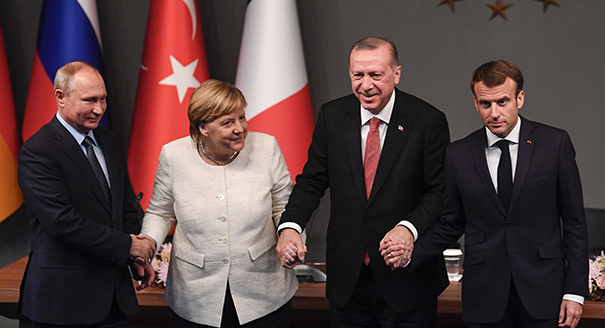
Politically, this is painful, as was plainly visible in the grotesque picture of Putin, Erdogan, Merkel, and Macron holding hands. Europe’s main bargaining chip remains its economic power. If the Assad regime regains full control of Syria and keeps refusing to comply with the political inclusion conditions set by the Europeans as a precondition for reconstruction aid and sanctions removal, an already marginal Europe could be pushed entirely to the sidelines by losing its most important lever of influence.
Bakr Sidqi | Syrian freelance journalist, writer, and Turkish-Arabic translator living in Turkey
When it comes to the Istanbul summit, we should look at who was absent in Istanbul rather than the participants. I’m referring mainly to the United States, which occupies more than 20 percent of Syria. It’s difficult to reach a final resolution of the complicated Syrian conflict without Washington’s approval.
The four leaders in Istanbul came with different objectives. Turkish President Recep Tayyip Erdoğan, who proposed the summit, sought to strengthen Turkey’s side in the Sochi agreement over Idlib agreed with Russia, and to gain support for a possible Turkish intervention east of the Euphrates River against Syrian Kurdish forces. Russian President Vladimir Putin was looking for European financing for Syria’s reconstruction and the repatriation of refugees. Germany was and remains afraid that fresh clashes in Idlib may cause a new wave of refugees seeking asylum in Europe. As for French President Emmanuel Macron, he sought to pursue the illusion that France has its own vision about Syria’s future and can make a difference in any likely outcome.
Other than this, the summit offered nothing new, nor were the parties able to do so.
Richard Youngs | Senior fellow in the Democracy, Conflict, and Governance Program at the Carnegie Endowment for International Peace
Few European Union policymakers believe that a wholesale, fully inclusive political settlement in Syria is at all realistic in the foreseeable future. Yet they are likely to continue pressing in a more oblique way for arrangements that offer at least some protection and autonomous governance capacity for what remains of the Syrian opposition. While many observers insist that even this slimmed-down ambition is now highly improbable, EU policymakers do not seem ready to conclude that the door for positive influence has shut entirely. But they also want to maintain a modicum of diplomatic leverage in Syria with the regime and Russia. This goal may mean European governments end up accepting relatively minor concessions from the Assad regime and Russia as preconditions for lifting sanctions and offering aid—the subject of some internal EU debate, as member states hold slightly different views on the right strategy in this regard. The main significance of the Istanbul summit from a European perspective was that France and Germany appeared to be prioritizing diplomatic involvement on a bilateral basis, which may undercut joint EU influence in the future.

Editor, Diwan, Senior Editor, Malcolm H. Kerr Carnegie Middle East Center
Michael Young is the editor of Diwan and a senior editor at the Malcolm H. Kerr Carnegie Middle East Center.
Recent Work
Michael Young
Michael Young
Carnegie does not take institutional positions on public policy issues; the views represented herein are those of the author(s) and do not necessarily reflect the views of Carnegie, its staff, or its trustees.

As the U.S. stumbles in its war with Iran, we are likely to see an acceleration of its disengagement from the region.
Michael Young

The Zaidi government’s objective to collect weapons is constrained by regional conflict, but it can take certain measures at home.
Ali Al-Mawlawi

Huawei pushed hard to enter the Egyptian data centers market, until the Americans made a better offer.

Angie Omar

The accord represents a pivotal moment in the region to avert a security vacuum in the Gulf.


Azeema Cheema, Mohanad Hage Ali
In an interview, Jason Burke discusses his sweeping account of the “revolutionists” who so shaped the 1970s and early 1980s.
Michael Young