

Commentary
Michael Young
{
  "authors": [
    "Michael Young"
  ],
  "type": "commentary",
  "blog": "Diwan",
  "centerAffiliationAll": "dc",
  "centers": [
    "Carnegie Endowment for International Peace",
    "Malcolm H. Kerr Carnegie Middle East Center"
  ],
  "collections": [
    "Inquiring Minds"
  ],
  "englishNewsletterAll": "menaTransitions",
  "nonEnglishNewsletterAll": "",
  "primaryCenter": "Malcolm H. Kerr Carnegie Middle East Center",
  "programAffiliation": "MEP",
  "programs": [
    "Middle East"
  ],
  "projects": [],
  "regions": [
    "Egypt",
    "North Africa",
    "Middle East"
  ],
  "topics": [
    "Political Reform"
  ]
}
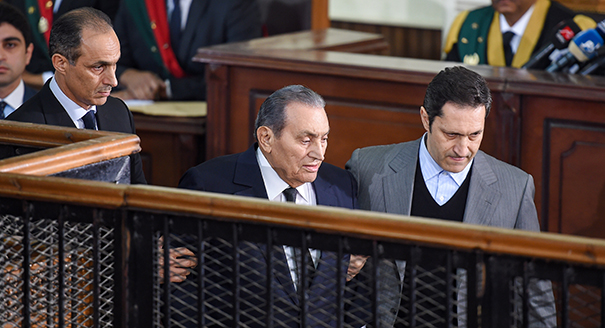
Source: Getty
A regular survey of experts on matters relating to Middle Eastern and North African politics and security.
Dina al-Khawaga | Director of the Asfari Institute for Civil Society and Citizenship at the American University of Beirut
Eight years after Hosni Mubarak’s departure, I am inclined to think that most Egyptians miss the days of the former president’s rule. This does not mean that a majority favors his return as president, nor does it mean that anti-revolutionary sentiments prevail among Egyptians. If anything, it means that with time the public anger that translated into protests that led to Mubarak’s ouster has faded away, to be replaced by new types of frustrations.
Nowadays, Egyptians miss Mubarak because the country finds itself in a much direr situation than the one in 2011. Citizens have lost a considerable part of their purchasing power, the government has adopted an unprecedented currency devaluation, and the gap between rich and poor (or between social classes) has widened immeasurably.
Additionally, no one can turn a blind eye to the fact that Egypt’s Decade of Anger, which corresponds to the period between 2000 and 2010, was one in which citizens enjoyed a wider margin of civil and political rights, despite the heavy hand of the security forces in dealing with the regime’s political opponents. Nevertheless, the Mubarak regime respected its international public image and was committed, at least nominally, to international law and governance norms—presidential elections, no military trials, a clear process for constitutional amendments, and respect for judicial autonomy. Unfortunately, none of these apply in today’s Egypt, so there is fear that more authoritarian measures are yet to come.
Sherif Mohyeldeen | Nonresident scholar at the Carnegie Middle East Center in Beirut
Unfortunately, at present many Egyptians miss the days of former president Hosni Mubarak, not because he was democratic, fair, or honest. But simply because the current situation is far worse than that of any previous period of rule by military officers after Egypt’s first coup in July 1952.
The economic situation and livelihood for millions of Egyptians have crumbled like no time before, after the decision of the government to devaluate the Egyptian pound in November 2016. Political space has been completely closed off, unlike the Mubarak era when there were limited margins for political action. President Abdel-Fattah al-Sisi is seeking to extend his presidential mandate, which ends in 2022. An initiative in parliament to amend the constitution would allow him to remain in office until 2032. Who knows if his mind is set on beating Mubarak’s record of ruling Egypt for 30 years?
Tamer Badawi | Policy leader fellow at the School of Transnational Governance of the European University Institute
Under the presidency of Abdel-Fattah al-Sisi, according to a Zogby Research Services poll in December 2018, 64 percent of Egyptians think their country is worse off than it how it was five years ago, with a significant 59 percent who do not have confidence in the military. Out of desperation, a share of these disenchanted Egyptians miss Hosni Mubarak’s era of comparably constrained repression and better economic conditions. Mubarak embarked on neoliberal economic reforms during the first decade of the century. While these mostly enriched the highest 10 percent of society and produced little gains for the population, they did also produce high levels of growth.
The revolutionary removal of the Mubarak regime shook the economically entrenched military-security apparatus. It also removed Mubarak’s son Gamal from power. His spearheading of privatization might have threatened the military’s economic interests. Overall, current political and social fault lines are rooted in the Mubarak era. His pro-American foreign policy obliged his regime to occasionally bend to Washington’s requests and introduce limited political reforms. However, it also empowered an unaccountable military establishment. Mubarak’s foreign policy orientation, coupled with untreated structural economic deficiencies, allowed countries of the Gulf Cooperation Council to gain leverage over Cairo, contributing later to the coup against president Mohammed Morsi.

Editor, Diwan, Senior Editor, Malcolm H. Kerr Carnegie Middle East Center
Michael Young is the editor of Diwan and a senior editor at the Malcolm H. Kerr Carnegie Middle East Center.
Recent Work
Michael Young
Michael Young
Carnegie does not take institutional positions on public policy issues; the views represented herein are those of the author(s) and do not necessarily reflect the views of Carnegie, its staff, or its trustees.

As the U.S. stumbles in its war with Iran, we are likely to see an acceleration of its disengagement from the region.
Michael Young

The accord represents a pivotal moment in the region to avert a security vacuum in the Gulf.


Azeema Cheema, Mohanad Hage Ali

In an interview, Jason Burke discusses his sweeping account of the “revolutionists” who so shaped the 1970s and early 1980s.
Michael Young
This will be the region’s most representative tournament, amid broad changes in its footballing landscape.

Issam Kayssi
As Iran defends its interests in the region and its regime’s survival, it may push Hezbollah into the abyss.
Michael Young