

Article
Alejandro Martin Rodriguez, Joy Arkeh, Sarah Yerkes
{
  "authors": [
    "Sarah Yerkes"
  ],
  "type": "commentary",
  "blog": "Diwan",
  "centerAffiliationAll": "dc",
  "centers": [
    "Carnegie Endowment for International Peace",
    "Malcolm H. Kerr Carnegie Middle East Center"
  ],
  "collections": [
    "Reaction Shot"
  ],
  "englishNewsletterAll": "menaTransitions",
  "nonEnglishNewsletterAll": "",
  "primaryCenter": "Malcolm H. Kerr Carnegie Middle East Center",
  "programAffiliation": "MEP",
  "programs": [
    "Middle East"
  ],
  "projects": [
    "Tunisia Monitor"
  ],
  "regions": [
    "North Africa",
    "Tunisia",
    "Maghreb"
  ],
  "topics": []
}
Source: Getty
Spot analysis from Carnegie scholars on events relating to the Middle East and North Africa.
What Happened?
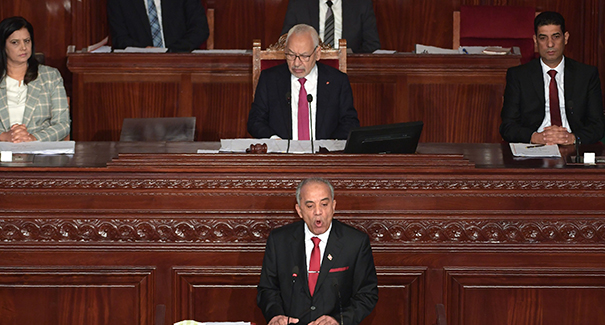
On January 10, Tunisia’s prime minister-designate Habib Jemli stepped down after failing to win a vote of confidence in his proposed government. Only 72 of the 217 members of parliament voted in favor of the government, far below the 109 votes meeded for it to win confidence. Tunisia has had ten governments in the first eight years since the 2010–2011 uprising, but this is the first time that parliament has failed to approve a proposed government.
President Qaïs Sa‘id now has ten days to consult with political parties and coalition and parliamentary groups to identify the person he deems “most capable” of forming a government, according to the constitution. That person will have one month to attempt to do so.
Why Does It Matter?
Without a government, Tunisia is in a holding pattern, unable to make progress on crucial economic reforms that could address rising inflation, high rates of unemployment, and lagging economic growth. And although parliament is in place and able to perform its normal duties, the government formation process is likely to consume much of the members’ time over the coming month, making it challenging to get any real legislative work done.
The no confidence vote also pushes Tunisia into untested waters—for Sa‘id and for parliament. It is not clear in which direction the president will go. He has no political party himself and therefore does not have a natural base within parliament. The party with the second highest number of seats and therefore Sa‘id’s natural choice is Nabil Qaraoui’s Heart of Tunisia party. Qaraoui, who was in jail during much of the electoral campaign on corruption charges, lost the presidential election to Sa‘id. Should Sa‘id appoint Qaraoui or one of his party’s other leaders to form a government, there would likely be a significant uproar among Tunisians, who overwhelmingly rejected Qaraoui during the presidential campaign.
Jemli’s experience showed that bringing in an independent to form a government may not work well either. While Jemli had previously served as a deputy minister of agriculture in the Ennahda government of 2011, he was billed as an independent and the government he proposed was sold to parliament as a government of independents and technocrats, to avoid political polarization and prevent parliamentarians from objecting to the government. However, almost no one seemed happy with Jemli’s choices, including Ennahda, the party that appointed him. Some in Ennahda were frustrated the government did not reflect its mandate, as the party with the most seats in parliament, to lead the government. Those outside Ennahda saw the party as devious by putting in place ministers who were presented as independents, but were actually Ennahda allies.
What Are the Implications for the Future?
If Sa‘id’s next choice also fails to form a government, Tunisia will be forced to hold new legislative elections, further delaying the governing process and taxing an already stressed national elections authority that has barely had time to recover from the 2019 presidential and parliamentary elections. Additionally, Tunisian voters have election fatigue, after turning out in dwindling numbers for three separate contests last September and October. They may not be interested in participating in another vote so soon.
Additionally, should the country be forced to hold another parliamentary election, it is not clear that the results would be all that different. This means it could be the start of a vicious cycle of snap elections. The county has no threshold for entry into parliament, which resulted in a parliament made up of 31 different political parties or lists after the last elections. Without a change to the electoral law to raise the threshold, Tunisia is likely to again have a very fractured legislature. It would likely suffer the same difficulties in finding consensus over the government, leaving any prime minister-designate with a nearly impossible task of creating a government able to win the approval of enough of parliament’s parties and lists.
Finally, Jemli’s failure has implications for Ennahda’s future. The party has been steadily losing power—from 89 seats in 2011 to 69 seats in 2014 to only 52 seats in 2019. The party’s inability to form a government now may lead some additional voters to lose confidence in Ennahda’s ability to govern. Should Sa‘id appoint someone from the anti-Ennahda camp to form the next government, it would put the party in the uncomfortable position of holding the most seats in parliament while simultaneously being relatively powerless.

Acting Co-Director and Senior Fellow, Middle East Program
Sarah Yerkes is acting co-director and a senior fellow in Carnegie’s Middle East Program, where her research focuses on Tunisia’s political, economic, and security developments as well as state-society relations in the Middle East and North Africa.
Recent Work

Alejandro Martin Rodriguez, Joy Arkeh, Sarah Yerkes
Alejandro Martin Rodriguez, Sarah Yerkes
Carnegie does not take institutional positions on public policy issues; the views represented herein are those of the author(s) and do not necessarily reflect the views of Carnegie, its staff, or its trustees.
In Egypt’s dense cities, the disappearance of foliage has health implications and punishes daily commuters.

Angie Omar

This will be the region’s most representative tournament, amid broad changes in its footballing landscape.

Issam Kayssi
The recent African Cup of Nations tournament in Morocco touched on issues that largely transcended the sport.

Issam Kayssi, Yasmine Zarhloule
Mustaqbal Misr has expanded its portfolio with remarkable speed, but a lack of transparency remains.

Yezid Sayigh
The burden of environmental degradation is felt not only through physical labor but also emotional and social loss.
Yasmine Zarhloule, Ella Williams