

Commentary
Michael Young
{
  "authors": [
    "Michael Young"
  ],
  "type": "commentary",
  "blog": "Diwan",
  "centerAffiliationAll": "dc",
  "centers": [
    "Carnegie Endowment for International Peace",
    "Malcolm H. Kerr Carnegie Middle East Center"
  ],
  "collections": [],
  "englishNewsletterAll": "menaTransitions",
  "nonEnglishNewsletterAll": "",
  "primaryCenter": "Malcolm H. Kerr Carnegie Middle East Center",
  "programAffiliation": "MEP",
  "programs": [
    "Middle East"
  ],
  "projects": [],
  "regions": [
    "Levant",
    "Israel",
    "Jordan",
    "Palestine",
    "North America",
    "United States",
    "Middle East"
  ],
  "topics": [
    "Political Reform"
  ]
}
Source: Getty
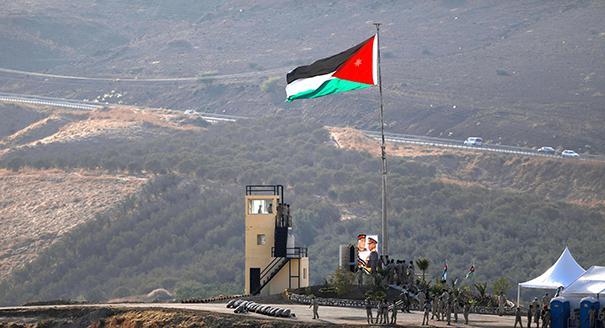
In an interview, Marwan Muasher outlines what scares Amman in the Trump peace plan for Palestinians and Israelis.
Marwan Muasher is vice president for studies at Carnegie, where he oversees research in Washington and Beirut on the Middle East. Muasher is a former Jordanian foreign minister (2002–2004) and deputy prime minister (2004–2005). He is the author of The Arab Center: The Promise of Moderation (Yale University Press, 2008) and The Second Arab Awakening and the Battle for Pluralism (Yale University Press, 2014). Diwan spoke with Muasher on January 30 to get his perspective on the Trump administration’s recent plan for peace between Israelis and Palestinians and ask, particularly, about how Jordan perceives it.
Michael Young: What is Jordan’s biggest fear about the Trump administration’s plan for peace between Israelis and Palestinians?
Marwan Muasher: Jordan believes that the death of the two-state solution might mean that Israel will seek a solution at Jordan’s expense. If there is no Palestinian state on Palestinian soil in the West Bank, East Jerusalem, and Gaza, and if on top of this Israel does not want to have a Palestinian majority in areas under its control (today there are 6.6 million Palestinian Arabs in Israel proper, the West Bank, East Jerusalem, and Gaza, alongside 6.5 million Israeli Jews), then Israel might attempt to negate that majority through a number of scenarios. It could either force a mass expulsion of Palestinians into Jordan, something that ceased to be improbable after the Syrian crisis, in which more than 6 million Syrians left their country. Or Jordan could be handed administrative control over those parts of the West Bank that Israel does not want to keep.
MY: Does the U.S. plan signal that Jordan no longer enjoys the privileged status it once did as an interlocutor of the United States on Palestinian issues?
MM: Yes, the U.S. plan seemed to ignore Jordan’s traditional role as an interlocutor. Amman was not consulted on the plan, and the only mention of Jordan was in regards to its continuing role as custodian of the Muslim holy places in Jerusalem. Through this plan, the Trump administration is effectively treating Jordan as “collateral damage.”
MY: For a long time politicians on the Israeli right tried to push an argument that “Jordan is Palestine.” Is there any way that this argument can make its way back into the discussion on the Israeli and even the U.S. side?
MM: With the U.S. plan, this argument has been revived among the Israeli right, which has now rejected a viable two-state solution, with the support of the United States. Whereas this argument had been limited to the Israeli radical fringe before, today it is being promoted by mainstream Israeli political leaders. The U.S. plan has only bolstered the thinking of the Israeli right on this issue.
MY: What are Jordan’s options in addressing the latest U.S. plan, all the more so as it was received with surprising ambiguity from a number of Arab countries?
MM: Jordan cannot commit political suicide by accepting a plan that falls far short of meeting the minimal needs of the Palestinians and Jordan, regardless of any threats or incentives. This is an existential issue for the country.
Jordan can rely on a large volume of international laws and the position of the vast majority of states in the international community, who are all against this plan. One option that Jordan is likely to undertake is engaging in a major diplomatic effort to garner support for ending the Israeli occupation and establishing a Palestinian state on Palestinian soil. Another option would be to gather international support, financial and otherwise, to help keep Palestinians on their land and prevent any mass expulsion of Palestinians by Israel.

Editor, Diwan, Senior Editor, Malcolm H. Kerr Carnegie Middle East Center
Michael Young is the editor of Diwan and a senior editor at the Malcolm H. Kerr Carnegie Middle East Center.
Recent Work
Michael Young
Michael Young
Carnegie does not take institutional positions on public policy issues; the views represented herein are those of the author(s) and do not necessarily reflect the views of Carnegie, its staff, or its trustees.

There is a disturbing structural parallel between the old global energy economy and the new green transition.

Angie Omar
Any move by the United States to make good on Trump’s suggestion that Washington persuade Damascus to confront Hezbollah militarily would have catastrophic consequences.
Kheder Khaddour
As talks begin between Washington and Tehran, Beirut has an opening to advance a regional plan for the party’s disarmament.
Michael Young
What is behind Marco Rubio’s announcement that the body is now an international nongovernmental organization?
Zaha Hassan
In an interview, Elizabeth Thompson recalls how the country formulated a liberal constitution in 1920, before being denied by France and Britain.
Michael Young