

Commentary
Azeema Cheema, Mohanad Hage Ali
{
  "authors": [
    "Mohanad Hage Ali"
  ],
  "type": "commentary",
  "blog": "Diwan",
  "centerAffiliationAll": "dc",
  "centers": [
    "Carnegie Endowment for International Peace",
    "Malcolm H. Kerr Carnegie Middle East Center"
  ],
  "collections": [],
  "englishNewsletterAll": "menaTransitions",
  "nonEnglishNewsletterAll": "",
  "primaryCenter": "Malcolm H. Kerr Carnegie Middle East Center",
  "programAffiliation": "MEP",
  "programs": [
    "Middle East"
  ],
  "projects": [],
  "regions": [
    "Türkiye",
    "Syria",
    "Middle East"
  ],
  "topics": [
    "Political Reform"
  ]
}
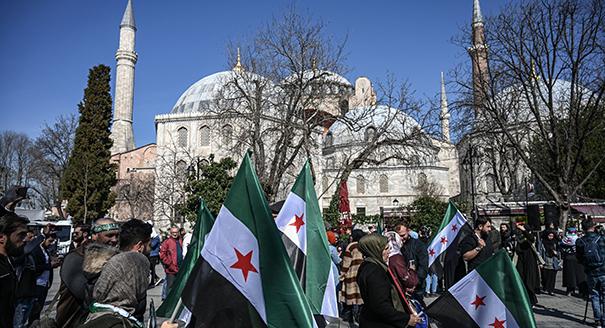
Source: Getty
Istanbul has become a refuge for many Arab communities, but the city’s cosmopolitan ways are also changing them.
“Istanbul Brings Together Arab Women to Celebrate International Women’s Day,” read the recent headline of an Anadolu Agency article on a recent meeting in the Turkish city that included dozens of Syrian, Palestinian, and Egyptian females.
The headline encapsulated Istanbul’s growing role on the Arab political and cultural scene. Since the 2011 Arab uprisings, the city has attracted large communities from major Arab countries who have left home because of repressive regimes or unstable political and economic environments. Istanbul offers an urban space for different forms of political activism and numerous examples of Arab interaction. Hundreds of thousands of Syrians, Iraqis, Yemenis, Libyans, Egyptians, and Lebanese are now part of the city’s social fabric. Istanbul hosts a pan-Arab existence with a life of its own.
According to one estimate, nearly 700,000 Iraqis live in Turkey, with Istanbul as their preferred destination. The city hosts five Iraqi schools, out of 27 across the country. Tens of thousands of Egyptians, Yemenis, and Libyans reside there, having established schools, media outlets, and publishing houses. Istanbul today is the Arab world’s largest population experiment, well beyond the role that Cairo played during the 1950s, and Beirut during the 1960s and 1970s.
For Arab states wary of Turkish influence, such as Egypt, Istanbul now serves as the headquarters of the various Arab branches of the Muslim Brotherhood and seeks to destabilize states opposing the organization, as well as the region as a whole. Yet such a view of the Arabs of Istanbul and their role in the political and cultural spheres of the region is only partly true and goes in one direction. In fact, the city’s cosmopolitan identity and diverse urban experiences are also shaping attitudes among the communities of Arabs residing there.
Istanbul today is indeed a Muslim Brotherhood hub. The Turkish state is investing and supporting the organization’s branches and, most importantly, facilitating efforts to organize and represent them. Dozens of television stations, mostly affiliated with Muslim Brotherhood branches, attest to Turkish encouragement of these groups. Even the important decisions within the organization’s branches are being taken in the Turkish city. Recently, for instance, Al-Islah, Yemen’s Muslim Brotherhood, voted in Istanbul for a new leader named Salah Batis. The Istanbul-based Batis has been criticized by those who oppose Turkish influence in the region for his connections with Turkey.
Istanbul embodies Turkey’s emerging regional role. This has been visible in its military interventions in Libya and Syria, as well as through its political clout across the region. From this lens, the Turkish government is seeking to shape attitudes in the Arab world through the communities it is hosting. Last year, Arabs in Turkey established a Union of Arab Communities, supportive of Turkey’s ruling Justice and Development Party (AKP). It is led by a Libyan Islamist who has described Turkish President Recep Tayyip Erdoğan as “the leader of the Muslim nation.” The union seeks to organize relations between Arabs and host communities, and to coordinate with the Turkish government.
Turkey’s expanding role in the region has also included cultural policies that have reconnected much of the region’s Turkmen minorities with their Turkish roots. At the heart of this effort was the transformation of Istanbul into an educational hub. The Turkish state has given thousands of scholarships to Turkmen from the Arab world, as well to Arabs in general, to encourage them to study in Turkey. Such efforts have had political consequences in the region. For instance, in Lebanon the revival of the Turkmen identity has exacerbated tensions with the country’s Armenian community. Today, whenever Armenians protest against Turkey’s role in their genocide, for example, Turkmen will publicly challenge them.
However, while the government has tried to facilitate the Muslim Brotherhood’s activism, Istanbul has pushed back against efforts to reinforce the presence of Arab Islamists. The city has at times changed the Arab exiles, particularly Islamists among them. The Arab population exceeds 1 million people, but they include more than Islamists. There are also Trotskyists, liberals, and people of other political persuasions, or none at all. For instance, Arab transsexuals can be spotted on Istanbul’s streets and in its bars. Such a spectrum of experiences has affected and sometimes disturbed Muslim Brotherhood groups, who operate in conservative, controlled settings.
In a new book titled Leaving the Muslim Brotherhood: Self, Society, and the State, Mustafa Menshawy cites anecdotes of members who have abandoned the group and its community after experiencing Istanbul’s social freedoms. Osama al-Sayyad, an Egyptian researcher based in Istanbul, is working on how the city has impacted the Muslim Brotherhood. While there are those who left the Brotherhood and became more secular, Sayyed examines a large undecided group that remains in a gray zone with regard to their position on the Brotherhood. The Istanbul effect has led the more committed members to isolate themselves. In other words, the city has put conservative religious elements on the defensive, as they try to avoid urban experiences often at odds with their preferences.
In parallel to Islamist and government-backed cultural efforts, Arab intellectuals, are translating Turkish literature. Among the works they are translating are novelist Orhan Pamuk’s books set in Istanbul, which are popular in Arabic. In these books, the city is a place of tolerance and self-discovery, important features for an Arab community that finds itself in a period of reflection and reassessment after the setbacks faced at home.
Initially, Istanbul’s appeal among Arabs was primarily the result of popular culture, namely successful Turkish television series that had been dubbed into Arabic. For many viewers, Istanbul’s landmarks and palaces quickly became synonymous with love stories. In the past two decades Arabs have flocked to the locations of these series. This influence has come at the expense of Egyptian cinema, which has suffered in recent years from unprecedented repression in Egypt and the closing off of many cultural spaces in the country.
Last July, a Turkish actor, Burak Özçivit, was invited by a store in a Lebanese shopping mall that had paid a hefty sum to bring him. He was surrounded by hundreds of fans. Some began to scream, while others fainted, and soon the crowd had destroyed the shop’s front window and interior. Soldiers managed to help the actor escape. In contrast, a cinema icon such as Hussein Fahmy, the Egyptian equivalent of Alain Delon during the 1980s and 1990s, could walk into a Lebanese mall today and invite little attention. Cairo no longer is the Arab world’s cultural beacon, Istanbul is.
The Özçivit case is symptomatic not only of Turkey’s growing cultural sway, but also the limitations of the Turkish government’s ability to control the Istanbul effect. The secular Özçivit is not exactly reflective of the Muslim Brotherhood or of Erdoğan’s conservative ideals. Istanbul’s cultural influence, while it benefits Turkey in general, is also leaving its own distinctive mark on its Arab inhabitants.

Deputy Director for Research, Malcolm H. Kerr Carnegie Middle East Center
Mohanad Hage Ali is the deputy director for research at the Malcolm H. Kerr Carnegie Middle East Center.
Recent Work

Azeema Cheema, Mohanad Hage Ali
Mohanad Hage Ali
Carnegie does not take institutional positions on public policy issues; the views represented herein are those of the author(s) and do not necessarily reflect the views of Carnegie, its staff, or its trustees.
Reconciliation councils are emerging throughout the country to mediate in intracommunal disputes, many from the war years.
Natacha Danon

As the U.S. stumbles in its war with Iran, we are likely to see an acceleration of its disengagement from the region.

Michael Young

The accord represents a pivotal moment in the region to avert a security vacuum in the Gulf.
Azeema Cheema, Mohanad Hage Ali

In an interview, Jason Burke discusses his sweeping account of the “revolutionists” who so shaped the 1970s and early 1980s.
Michael Young
In an interview, Sohaib Jawhar analyzes the profound changes in the ties between the neighboring countries.
Michael Young