

Commentary
Michael Young
{
  "authors": [
    "Michael Young"
  ],
  "type": "commentary",
  "blog": "Diwan",
  "centerAffiliationAll": "dc",
  "centers": [
    "Carnegie Endowment for International Peace",
    "Malcolm H. Kerr Carnegie Middle East Center"
  ],
  "collections": [
    "Inquiring Minds",
    "Coronavirus"
  ],
  "englishNewsletterAll": "menaTransitions",
  "nonEnglishNewsletterAll": "",
  "primaryCenter": "Malcolm H. Kerr Carnegie Middle East Center",
  "programAffiliation": "MEP",
  "programs": [
    "Middle East"
  ],
  "projects": [],
  "regions": [
    "Iran",
    "Gulf",
    "Saudi Arabia",
    "United Arab Emirates",
    "Kuwait",
    "North America",
    "United States",
    "Middle East",
    "Bahrain",
    "Qatar"
  ],
  "topics": [
    "Political Reform"
  ]
}
Source: Getty
A regular survey of experts on matters relating to Middle Eastern and North African politics and security.
Randa Slim | Senior fellow and director of the Conflict Resolution and Track II Dialogues Program at the Middle East Institute in Washington, D.C.
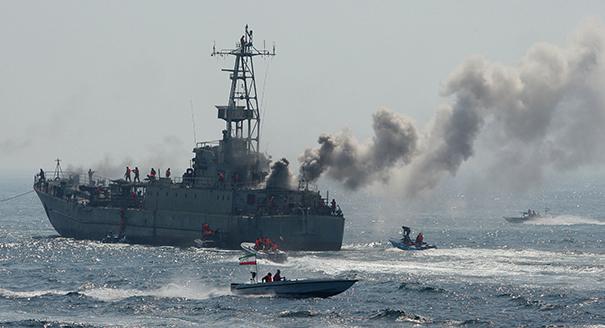
It is still not clear whether President Donald Trump’s April 22 tweet saying he had instructed the U.S. Navy to “shoot down and destroy” Iranian gunboats harassing U.S. naval vessels in the Persian Gulf meant a change in existing U.S. rules of engagement. These are guided by the inherent right of self-defense and determination of hostile intent and hostile act. To date, the U.S. Navy has responded to harassment by gunboats of Iran’s Islamic Revolutionary Guard Corps (IRGC) with escalating actions, including sending warnings by radio as well as firing warning shots. Decisions to escalate beyond warnings, including sinking Iranian gunboats, are usually left to a vessel’s commanding officer.
If such an escalation were to occur, it is unlikely to lead to an all-out war, primarily because the leaders in the United States and Iran do not want a war. There are senior officials in the Trump administration who argue that war with Iran could precipitate regime change in Tehran. There are IRGC officials who argue that a military confrontation would be very costly for the United States and would end its military presence in the Middle East.
While the Trump administration’s maximum pressure has not succeeded in deterring Iranian aggression, Tehran has so far calibrated its incremental escalation against U.S. assets and partners to avoid actions leading to a large military conflict with the U.S. If the U.S. killing of IRGC Major General Qassem Suleimani did not lead to an all-out war, the IRGC’s losing a few gunboats in the Persian Gulf would likely not do so either.
Richard A. Bitzinger | Visiting senior fellow at the S. Rajaratnam School of International Studies in Singapore
If the U.S. Navy, whether provoked or not, decides to attack Iranian gunboats, it could easily lead to an escalation of hostilities. At the moment, the Iranians have confined their actions to buzzing U.S. naval ships in relatively small and lightly armed vessels—mainly a nuisance, like gnats at a picnic. But if their gunboats were targeted, Iran could be prompted to counterattack with much greater force, using fast boats armed with anti-ship cruise missiles—such as the Chinese-made C-701—which can be fired from kilometers away.
Moreover, Iran could decide to attack in swarms of several such boats, which would make it much harder for U.S. naval forces to defend themselves. It is doubtful that the Iranian forces could sink a U.S. warship, but such attacks could cause considerable damage and probably loss of life. If the U.S. Navy then decides to up the ante—by targeting Iranian ports and naval facilities, for example—then the situation could deteriorate into even bloodier conflict.
Mara Karlin | Nonresident senior fellow with the Security and Strategy team at the Brookings Institution in Washington, D.C., associate professor at the Johns Hopkins School of Advanced International Studies
President Donald Trump’s declarative tweet that the U.S. Navy would “shoot down and destroy any and all Iranian gunboats if they harass our ships at sea” has thrust Gulf maritime security into the limelight. Putting aside the colossal and inevitable confusion that “policy by tweet” poses, it can most generously be understood as an effort to reestablish deterrence by reminding Tehran of the U.S. Navy’s outsized capabilities compared to its Iranian counterparts.
If the U.S. Navy is given clear rules of engagement and if the Iranian Navy takes significant, deliberate, and attributable steps to significantly harm U.S. assets and personnel at sea, U.S. naval and air assets could easily destroy Iranian ships and related radar systems. However, it would be shortsighted for the Iranian Navy to do so since both Iran’s military and its clients have operated most effectively and have masterfully flummoxed U.S. responses when they operate in the gray zone instead, thereby impeding and confusing meaningful U.S. military action.

Editor, Diwan, Senior Editor, Malcolm H. Kerr Carnegie Middle East Center
Michael Young is the editor of Diwan and a senior editor at the Malcolm H. Kerr Carnegie Middle East Center.
Recent Work
Michael Young
Michael Young
Carnegie does not take institutional positions on public policy issues; the views represented herein are those of the author(s) and do not necessarily reflect the views of Carnegie, its staff, or its trustees.

Middle Eastern states should welcome an accelerated U.S. disengagement from their region.
Michael Young

In an interview, former ambassador Charles Freeman assesses the Trump administration’s war against Iran.
Michael Young

The accord represents a pivotal moment in the region to avert a security vacuum in the Gulf.


Azeema Cheema, Mohanad Hage Ali

In an interview, Jason Burke discusses his sweeping account of the “revolutionists” who so shaped the 1970s and early 1980s.
Michael Young

By failing to address Palestinian representation, the current process is bound to lead to just another temporary arrangement.

Nathan J. Brown