

Commentary
Michael Young
{
  "authors": [
    "Michael Young"
  ],
  "type": "commentary",
  "blog": "Diwan",
  "centerAffiliationAll": "dc",
  "centers": [
    "Carnegie Endowment for International Peace",
    "Malcolm H. Kerr Carnegie Middle East Center"
  ],
  "collections": [
    "Reaction Shot",
    "Decoding Lebanon"
  ],
  "englishNewsletterAll": "menaTransitions",
  "nonEnglishNewsletterAll": "",
  "primaryCenter": "Malcolm H. Kerr Carnegie Middle East Center",
  "programAffiliation": "MEP",
  "programs": [
    "Middle East"
  ],
  "projects": [],
  "regions": [
    "Levant",
    "Lebanon",
    "North America",
    "United States",
    "Middle East"
  ],
  "topics": [
    "Political Reform",
    "Economy"
  ]
}
Source: Getty
Spot analysis from Carnegie scholars on events relating to the Middle East and North Africa.
What Happened?
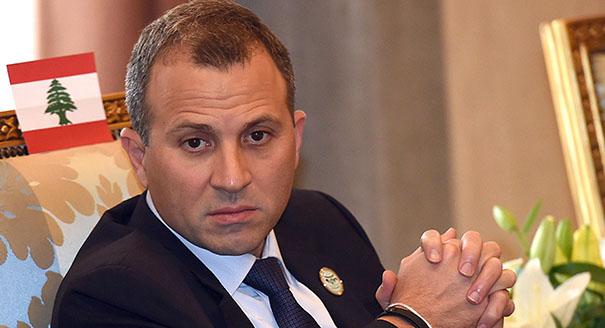
Gebran Bassil, the head of the Free Patriotic Movement (FPM) and son in law of President Michel ‘Aoun, has been sanctioned by the U.S. Treasury Department’s Office of Foreign Assets Control “for his role in corruption in Lebanon … which builds upon and implements the Global Magnitsky Human Rights Accountability Act.” This is the first designation under the act in Lebanon.
This comes after the Trump administration imposed sanctions last September on two politicians accused of assisting Hezbollah. They were ‘Ali Hassan al-Khalil, a Shi‘a former finance minister and senior aide to the speaker of parliament Nabih Berri; and Youssef Fenianos, a Christian former minister of public works and transportation, who is a member of Suleiman Franjieh’s Marada Party.
Why Is It Important?
Bassil is one of Lebanon’s most senior politicians and is the leader of Lebanon’s largest Christian party, with a very significant bloc in parliament. Bassil has long been on the United States’ target list for his party’s alliance with Hezbollah, so it is interesting that he was sanctioned under legislation designed primarily to highlight corruption. This was, partly, an effort to underline U.S. support for the popular uprising that began over a year ago in Lebanon, and that was directed against the systematic and widespread theft of state assets carried out by Lebanon’s political leadership.
However, Bassil’s relations with Hezbollah were also never far from U.S. thinking. To the Americans, the FPM provides valuable Christian cover for Hezbollah, which has sought to anchor its dominant role in Lebanon through cross-sectarian alliances such as the one with Aoun’s followers. The Trump administration seems to believe that by targeting Bassil, it might be able to peel him and his party away from Hezbollah, which will be gradually more isolated.
By going after Bassil, the Trump administration is also effectively going after Michel ‘Aoun. He was largely responsible for shepherding the political rise of his son in law, who has great influence over the president’s decisions. Indeed, ‘Aoun, who is in his mid-80s, has often acted as a substitute for Bassil in negotiations with other politicians over governmental matters. Sanctioning Bassil is a not-so-subtle way of implying that ‘Aoun has abetted his son in law’s abuses by placing him in ministries in which he could make money illegally.
What Are the Implications for the Future?
Bassil is currently negotiating with prime minister-designate Sa‘d Hariri over his share of portfolios in a new government. Many observers believe he wants to force Hariri into again giving the Energy Ministry to someone close to the FPM, with the financial rents accompanying it. But as Hariri has said his government will be focused on implementing a French plan to revitalize the collapsing economy, he is adamant that no one close to Bassil be named.
This is all the more vital as a large part of the government’s budget deficit comes from the notoriously inefficient and murky electricity sector. If Hariri wants to move forward on an International Monetary Fund package for Lebanon, he has to show a serious intention to reform the ministry. The U.S. sanctions may be aimed partly at forcing Bassil to surrender the energy portfolio. That said, it may have the contrary effect in pushing him to harden his position. Bassil, it seems, would ultimately like to use his control over the Energy Ministry as leverage to secure Hariri’s support for Bassil’s presidency when Michel ‘Aoun’s term ends.
The Energy Ministry is even more important for being, technically, in charge of the highly lucrative offshore natural gas file. Bassil has been flustered by the fact that his great political rival, Nabih Berri, has taken the de facto lead on this front, as he and Hezbollah have agreed to allow Lebanon to negotiate an agreement over its maritime borders with Israel. A successful conclusion would mean that drilling for gas could begin in Bloc 9, which is off southern Lebanon and would likely generate revenues for Berri and Hezbollah in Lebanon’s shady Balkanized patronage system. Bassil and ‘Aoun, in turn, reportedly view their loss of the ministry as tantamount to the end of ‘Aoun’s mandate. But if doing so offers Bassil a way out of his current predicament with Washington, it will be difficult for him to ignore.
Finally, a sanctioned Bassil will face a dilemma. His vulnerabilities could render him more dependent on Hezbollah, but reinforcing his ties with the party would only make it more difficult to break free of the noose the Americans have placed around his neck. Moreover, a sanctioned Bassil is of less use to Hezbollah. As the party looks for a major sectarian ally in Lebanon to help anchor its position locally and internationally, it has much greater interest now in reinforcing its ties with Hariri the Sunni than with Bassil the Christian. That could seriously weaken Bassil in the government formation process as well as undermine what remains of his presidential chances, which were already seriously compromised to begin with.
One thing is clear, however. Many Lebanese will have received news of Bassil’s designation with absolute delight. The FPM leader is one of Lebanon’s most despised politicians, to the extent that during protests last year a popular song directed against him, one of dubious taste, echoed throughout the streets of the country.

Editor, Diwan, Senior Editor, Malcolm H. Kerr Carnegie Middle East Center
Michael Young is the editor of Diwan and a senior editor at the Malcolm H. Kerr Carnegie Middle East Center.
Recent Work
Michael Young
Michael Young
Carnegie does not take institutional positions on public policy issues; the views represented herein are those of the author(s) and do not necessarily reflect the views of Carnegie, its staff, or its trustees.
Reconciliation councils are emerging throughout the country to mediate in intracommunal disputes, many from the war years.
Natacha Danon

In an interview, Rozina Ali discusses her new book on the rise and manifestations of Islamophobia in the United States.
Michael Young
As the U.S.-led Coalition withdraws, the Kurds’ reliance on Baghdad, and on themselves, will only increase.
Wladimir van Wilgenburg

In an interview, Ian Lustick and Eli Clifton discuss their new book on why a prominent ally has so much influence in America.
Michael Young

As the U.S. stumbles in its war with Iran, we are likely to see an acceleration of its disengagement from the region.
Michael Young