

Commentary
Michael Young
{
  "authors": [
    "Michael Young"
  ],
  "type": "commentary",
  "blog": "Diwan",
  "centerAffiliationAll": "dc",
  "centers": [
    "Carnegie Endowment for International Peace",
    "Malcolm H. Kerr Carnegie Middle East Center"
  ],
  "collections": [
    "Decoding Lebanon"
  ],
  "englishNewsletterAll": "menaTransitions",
  "nonEnglishNewsletterAll": "",
  "primaryCenter": "Malcolm H. Kerr Carnegie Middle East Center",
  "programAffiliation": "MEP",
  "programs": [
    "Middle East"
  ],
  "projects": [],
  "regions": [
    "Levant",
    "Lebanon",
    "Middle East"
  ],
  "topics": [
    "Political Reform"
  ]
}
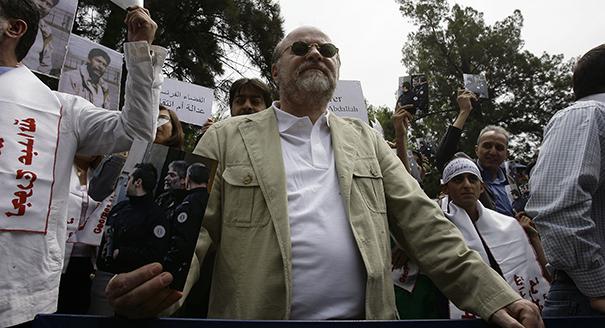
Source: Getty
Is Hezbollah undermining its resistance by failing to address Lebanon’s many crises, as the late Anis Naccash implied?
Often, the hardest truths come from those closest to you. After the recent death of Anis Naccash, a video of an interview with him (see below) circulated in Lebanon. Speaking with the pro-Iranian Mayadeen channel, Naccash was lucid about how Lebanon’s dire financial and economic crises were affecting the “resistance axis,” meaning primarily Hezbollah, but by implication also Syria and Iran.
In the interview, Naccash observed, “It is no longer acceptable at all to separate internal [Lebanese] files from the files of the resistance axis and the conflict with the Zionist enemy … It is no longer acceptable to say we didn’t know about the financial situation in Lebanon because this is not the concern of the resistance … [N]ational security is not limited to arms and armed defense … [it is tied to] education, the economy, agriculture, and health. Armed action is a part of this, but it is not enough to defend the nation.”
Naccash had a weighty past as someone who participated in taking oil ministers hostage at the OPEC meeting in Vienna in 1975, which was organized by Wadi‘ Haddad, the head of the Popular Front for the Liberation of Palestine-External Operations.* According to Naccash, in an interview with the journalist Ghassan Charbel in 2008, he later established ties with Iranians opposed to the shah’s regime while collaborating* with the late Palestine Liberation Organization official Khalil al-Wazir during the 1970s. Naccash claimed it was he who proposed establishing a Revolutionary Guard to protect the gains of Iran’s revolution against a potential counterrevolutionary coup by the country’s military. He did so after a conversation at his home with Jalal al-Din Farisi, later the Palestinian Fatah’s representative in Iran, someone from the Khomeinist wing of the Iranian opposition, and a presidential candidate in 1980, until his withdrawal.
In other words, Naccash’s remarks could not have been taken as less than the friendly advice of an ardent supporter of Hezbollah and Iran. And yet what he said was quite devastating. Naccash implied that amidst Lebanon’s economic breakdown, the idea of “resistance” had been undermined. Unless Hezbollah addressed the country’s economic collapse, he continued, as well as the political class’s corruption, and clarified how the Beirut Port explosion occurred in August 2020, the effectiveness of the resistance would be damaged.
Anyone living in Lebanon would agree with Naccash. Poverty in the country is so widespread, public discontent so profound, that it seems inconceivable that Hezbollah would risk a confrontation with Israel today. There is no question that Israel would engage in massive retaliation, destroying villages, urban areas, and economic targets. The Shi‘a community in particular would face harrowing displacement, with perhaps upwards of a million people seeking shelter in relatively safer areas. Once the war would end, there would be little outside financial assistance to rebuild the country, and even less so the ravaged towns and quarters in Shi‘a areas. Resentment against Hezbollah would rise dramatically across Lebanon, creating a backlash that the party would struggle to contain.
There are Hezbollah foes who fantasize about such an outcome. The problem is that the devastation and suffering in Lebanon would be so intense and pervasive that the country would very possibly not recover, creating a new catastrophe on the Mediterranean. The implications for regional stability cannot be underestimated. More seriously for Iran and Russia, Lebanon’s disintegration would accelerate that of Syria, where both countries have invested lives and money for years to preserve President Bashar al-Assad’s rule.
That was why Naccash’s comments were not merely a warning to Hezbollah, but were directed also, as he made clear, at the “resistance axis” in general. However, what are the chances that Hezbollah will actually listen to him? If its behavior in recent months is any indicator, the party seems to be trapped by two contradictory priorities, limiting its ability to engage with what Naccash said.
It has been obvious in recent months that Hezbollah has been unwilling to compel its allies Lebanese President Michel Aoun and his son in law Gebran Bassil to facilitate the formation of a new government under prime minister-designate Saad al-Hariri. Yet all the signs are that Hezbollah wants a government, for two reasons: Shi‘a discontent is rising as the economic crisis worsens under a caretaker government and as the value of the Lebanese pound tumbles; and the party’s ability to maintain security, even in areas it controls, is deteriorating. Crime is rising in Beirut’s southern suburbs, where the party dominates, while clashes between unruly tribal clans seem to be a weekly occurrence. Hezbollah has no solution for these problems.
At the same time, the regional context makes Hezbollah wary of taking steps domestically that may alienate its allies. Hezbollah’s reluctance to force Bassil and Aoun to end their obstruction of the government is based on a fear that if the regional situation deteriorates between Iran, on the one side, and Israel and the United States, on the other, a war with Israel may be inevitable. Hezbollah, therefore, needs to maintain its alliances to avoid being isolated and to retain the legitimizing sanction of Lebanon’s president.
Naccash’s warning remains valid: By failing to resolve its dilemma, Hezbollah is accelerating the degradation of the socioeconomic situation and making the very idea of “resistance” no longer meaningful. Therefore, the party either risks failing to fulfill its contract with Iran, or if it does go to war with Israel, it may ultimately provoke a domestic reaction that poses an existential threat to Hezbollah. Sometimes it merits listening to those who wish you well.
*These sentences were slightly altered for reasons of accuracy.

Editor, Diwan, Senior Editor, Malcolm H. Kerr Carnegie Middle East Center
Michael Young is the editor of Diwan and a senior editor at the Malcolm H. Kerr Carnegie Middle East Center.
Recent Work
Michael Young
Michael Young
Carnegie does not take institutional positions on public policy issues; the views represented herein are those of the author(s) and do not necessarily reflect the views of Carnegie, its staff, or its trustees.

The accord represents a pivotal moment in the region to avert a security vacuum in the Gulf.


Azeema Cheema, Mohanad Hage Ali

In an interview, Jason Burke discusses his sweeping account of the “revolutionists” who so shaped the 1970s and early 1980s.
Michael Young
Lying at the heart of Lebanon’s dysfunction is an inability to secure accountability and institutional legitimacy.

Maha Yahya
In an interview, Sohaib Jawhar analyzes the profound changes in the ties between the neighboring countries.
Michael Young

There is a disturbing structural parallel between the old global energy economy and the new green transition.

Angie Omar