

Commentary
Azeema Cheema, Mohanad Hage Ali
{
  "authors": [
    "Mohanad Hage Ali"
  ],
  "type": "commentary",
  "blog": "Diwan",
  "centerAffiliationAll": "dc",
  "centers": [
    "Carnegie Endowment for International Peace",
    "Malcolm H. Kerr Carnegie Middle East Center"
  ],
  "collections": [
    "Decoding Lebanon"
  ],
  "englishNewsletterAll": "menaTransitions",
  "nonEnglishNewsletterAll": "",
  "primaryCenter": "Malcolm H. Kerr Carnegie Middle East Center",
  "programAffiliation": "MEP",
  "programs": [
    "Middle East"
  ],
  "projects": [],
  "regions": [
    "Levant",
    "Lebanon",
    "Middle East"
  ],
  "topics": [
    "Political Reform"
  ]
}
Source: Getty
The country’s political leaders are hindering an investigation into the explosion at Beirut port, but that’s par for the course.
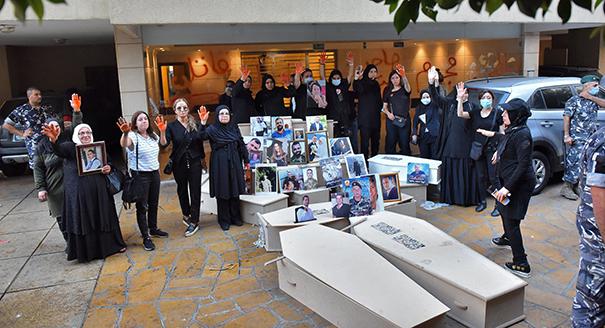
On July 13, three weeks before the first anniversary of the August 4 explosion last year in Beirut port, families of the more than 200 victims tried to storm the home of Lebanon’s caretaker interior minister, Mohammed Fahmi. They were angry that Fahmi had refused to lift the immunity of a senior general whom the judge investigating the explosion wanted to question. The families, holding empty coffins to commemorate their loved ones, were beaten back by police for demanding justice and accountability.
Fahmi’s refusal to allow General Abbas Ibrahim, the head of the General Security Directorate, to meet with the investigating judge, Tareq Bitar, was followed by the Lebanese parliament’s efforts to stall similar requests. Bitar wants to question a number of security chiefs as well as parliamentarians who held ministerial positions in governments that had allowed the 2,750 tons of ammonium nitrate, which caused the blast, to remain stocked in the port for years.
Lebanon’s political leadership is intent on blocking the investigation. Last February, a court removed the previous investigating judge, Fadi Sawan, after he accused two former ministers of negligence. This blatant denial of justice and the sheer magnitude of the August 4 bombing have turned the families of the victims into a determined pressure group. They have led protests and remained united in an unequal fight against a political class that remains above the law and is mostly composed of former warlords and corrupt businessmen.
Given Lebanon’s power-sharing system and the impact of this on political and administrative decisions, responsibility for the shipment of ammonium nitrate likely encompassed a wide cross-section of members of the political class. The chemical compound was stored in the port as of September 2013, and the fact that nothing was done to remove it epitomized the crimes of the political leadership in the three decades since the end of Lebanon’s civil war. The country’s politicians have ruled through a combination of greed, indifference to the public good, and a total absence of accountability. This governing mentality has placed the country on a path to self-destruction.
However, the victims of the port explosion were only the latest in a long line of victims, dating back to Lebanon’s fifteen-year-old civil war that began in April 1975. No one was ever held accountable for the crimes committed during the conflict, which led to the death of some 150,000 people, according to certain estimates. Indeed, a general amnesty law passed in 1991 prevented the prosecution of a large majority of those who had committed wartime crimes.
Only the families of those who disappeared during the war—a figure estimated anywhere between 5,000 and 17,000 people—protested against the implications of the amnesty law. Despite scant media coverage and little support from civil society, the families pursued their efforts, often at a high cost. Najat Hashisho, the wife of a communist high school teacher, took her husband’s case to court, identifying one of her neighbors as being among the militiamen who had abducted him. Her court case, filed on January 23, 1991, failed to advance for over 22 years as court sessions were repeatedly delayed, unjustifiably, until she lost. In a statement after the disappointing end of her court battle, Najat asked, “Is it fair that those who caused harm live in safety and stability, while the families of the kidnapped suffer from psychological torture and persistent anxiety?”
Her question has never been as timely as today. Lebanon’s tragedy continues, as its political class remains entirely unscathed by the suffering it has caused. In October 2019, following mass nation-wide demonstrations against the country’s political leadership, the Lebanese woke up to discover that their banks had frozen their accounts, the consequence of a growing financial crisis that had been brewing for some time. Yet these same banks, many of which have close ties to the country’s leaders, allowed politicians to transfer billions of dollars into their accounts overseas.
The fact that a majority of the Lebanese population has since fallen under the poverty line has not changed the behavior of the political class in any way. For the country’s politicians, it is business as usual. No one is held accountable, so no one cares, while the lavish weddings and foreign travels of the political elite continue. The politicians’ focus is now on the three elections scheduled for next year—municipal elections, parliamentary elections, and the presidential election. Their campaigning includes garnering support by heightening sectarian polarization and using fresh foreign currency brought back from abroad to buy political loyalty.
On August 4, the families of the victims of the port explosion and their supporters will be calling for accountability. The league of Lebanese victims is expanding—depositors who lost their life savings, employees whose salaries have evaporated because of the Lebanese pound’s collapse, and the families of the dead and disappeared from recent decades. One thing is clearer than ever, namely that Lebanon’s political class only brings misery to the population. The list of its victims is becoming too long for things to remain as they are.

Deputy Director for Research, Malcolm H. Kerr Carnegie Middle East Center
Mohanad Hage Ali is the deputy director for research at the Malcolm H. Kerr Carnegie Middle East Center.
Recent Work

Azeema Cheema, Mohanad Hage Ali
Mohanad Hage Ali
Carnegie does not take institutional positions on public policy issues; the views represented herein are those of the author(s) and do not necessarily reflect the views of Carnegie, its staff, or its trustees.

The accord represents a pivotal moment in the region to avert a security vacuum in the Gulf.
Azeema Cheema, Mohanad Hage Ali

In an interview, Jason Burke discusses his sweeping account of the “revolutionists” who so shaped the 1970s and early 1980s.

Michael Young
Lying at the heart of Lebanon’s dysfunction is an inability to secure accountability and institutional legitimacy.

Maha Yahya
In an interview, Sohaib Jawhar analyzes the profound changes in the ties between the neighboring countries.
Michael Young
There is a disturbing structural parallel between the old global energy economy and the new green transition.

Angie Omar