

Commentary
Michael Young
{
  "authors": [
    "Michael Young"
  ],
  "type": "commentary",
  "blog": "Diwan",
  "centerAffiliationAll": "dc",
  "centers": [
    "Carnegie Endowment for International Peace",
    "Malcolm H. Kerr Carnegie Middle East Center"
  ],
  "collections": [],
  "englishNewsletterAll": "menaTransitions",
  "nonEnglishNewsletterAll": "",
  "primaryCenter": "Malcolm H. Kerr Carnegie Middle East Center",
  "programAffiliation": "MEP",
  "programs": [
    "Middle East"
  ],
  "projects": [],
  "regions": [
    "Türkiye",
    "Levant",
    "Syria",
    "Middle East",
    "Russia",
    "Caucasus"
  ],
  "topics": [
    "Political Reform"
  ]
}
Source: Getty
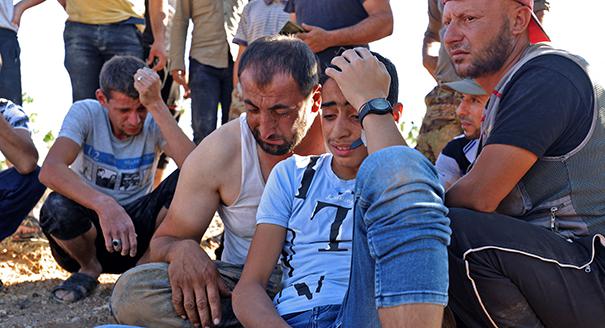
In an interview, Kheder Khaddour discusses the likely outcomes in Syria’s northwest, where Russian and Turkish aims clash.
Kheder Khaddour is a nonresident scholar at the Malcolm H. Kerr Carnegie Middle East Center in Beirut. His research focuses on Syria, as well as on civil-military relations and local identities in the Levant. In early October, Diwan interviewed Khaddour to get an update on the situation in the northwestern governorate of Idlib, where Russia and Syrian government forces have stepped up attacks against rebel forces concentrated in the area.
Michael Young: In the summit last week between Russian President Vladimir Putin and Turkish President Recep Tayyip Erdoğan, what was agreed on Syria?
Kheder Khaddour: The central discussion on Syria between Moscow and Ankara regards the border territories. Turkey’s goal is to secure its southern border regions, while Russia is trying to push rebel groups in northwestern Syria toward the Turkish border in order to secure a Russian presence in those regions. These conflicting goals mean that no agreement can be achieved in one meeting. Any agreement has to be the result of a process.
MY: How do you see the situation developing in the northwestern Syrian region of Idlib Governorate, where tens of thousands of anti-regime rebels remain holed up?
KK: What makes Idlib unique is its social, economic, and military mix. Rebels, including extremist groups, rely heavily on civilians, while the local power structure is largely family-based. Almost all of these families have become involved in the military and economic spheres, reflecting the socioeconomic order that has emerged from the war. The region and its dominant power, Hay’at Tahrir al-Sham, are in a dangerous position, in the sense that the Assad regime’s forces are well organized and have the simple goal of gaining territory, while the rebels have shifted from being antiregime to becoming defenders of the existing socioeconomic order. The rebels’ fragility compared to the relative coherence of the regime, as well as the unwillingness of international powers such as the United States to become involved in the region’s local affairs, means that it is only a matter of time before the regime is able to make more advances in Idlib.
MY: How have recent developments in Daraa, where the regime has regained control over areas in which it had not been present, affected what happens in northern Syria?
KK: There is no direct relation between what has taken place in Syria’s south and north, but they do reflect similar dynamics. Developments in Daraa demonstrated two facts. The first was that in the security sphere the Assad regime cannot, and will not, accept sharing power with armed groups or individuals. This was illustrated by the death of the 2018 agreements with local parties in the south, which were achieved thanks to Russian mediation and guarantees.
The second was the importance of Syria’s geographical location. The plan to send Egyptian gas to Lebanon via a pipeline passing through Jordan and Syria, for instance, could not take place if parts of southern Syria were to remain outside government control. The recent developments in the south will further strengthen the regime and give it confidence to advance in the north.
MY: What is the endgame for Turkey and Russia in Syria, and how do you see developments there shaping their bilateral relationship?
KK: By examining Russia’s presence on the ground, we can see that Russian soldiers are nearly in contact with Turkish soldiers. This means that both sides must face the reality of dealing with one another. The Russians are aiming to keep up the agreement they have had with the Assad government for nearly half a century, maintaining a long-term military and economic presence, most specifically along Syria’s coast. Russia’s ambitions are not limited to the coast, however, but also extend to the Jazira region in the northeast where the picture is more complex. The region is home to Kurdistan Workers’ Party cadres, American troops, and a Turkish military zone. More importantly, it is affected by border dynamics. Any American withdrawal from the region would put Russia and Turkey in direct contact with one another, similar to what happened after the Trump administration withdrew most U.S. troops from the area in 2019. The Syrian war is shaping Turkish-Russian relations, but it is too early to say whether these relations bring stability that helps end the conflict, or whether they will continue to be characterized by mistrust.

Editor, Diwan, Senior Editor, Malcolm H. Kerr Carnegie Middle East Center
Michael Young is the editor of Diwan and a senior editor at the Malcolm H. Kerr Carnegie Middle East Center.
Recent Work
Michael Young
Michael Young
Carnegie does not take institutional positions on public policy issues; the views represented herein are those of the author(s) and do not necessarily reflect the views of Carnegie, its staff, or its trustees.

Huawei pushed hard to enter the Egyptian data centers market, until the Americans made a better offer.

Angie Omar

The accord represents a pivotal moment in the region to avert a security vacuum in the Gulf.


Azeema Cheema, Mohanad Hage Ali

In an interview, Jason Burke discusses his sweeping account of the “revolutionists” who so shaped the 1970s and early 1980s.
Michael Young
In an interview, Sohaib Jawhar analyzes the profound changes in the ties between the neighboring countries.
Michael Young
There is a disturbing structural parallel between the old global energy economy and the new green transition.
Angie Omar