

Q&A
- +1
Amr Hamzawy, Andrew Leber, Eric Lob, …
{
  "authors": [
    "Marwan Muasher"
  ],
  "type": "commentary",
  "blog": "Diwan",
  "centerAffiliationAll": "dc",
  "centers": [
    "Carnegie Endowment for International Peace",
    "Malcolm H. Kerr Carnegie Middle East Center"
  ],
  "collections": [],
  "englishNewsletterAll": "menaTransitions",
  "nonEnglishNewsletterAll": "",
  "primaryCenter": "Malcolm H. Kerr Carnegie Middle East Center",
  "programAffiliation": "MEP",
  "programs": [
    "Middle East"
  ],
  "projects": [],
  "regions": [
    "North America",
    "United States",
    "Middle East",
    "Israel",
    "Jordan",
    "Palestine",
    "Levant"
  ],
  "topics": [
    "Political Reform"
  ]
}
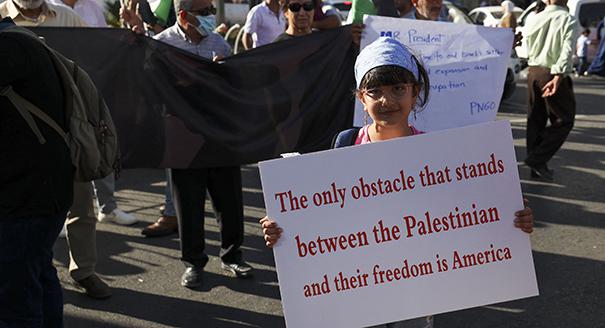
Source: Getty
The greatest casualty from President Joe Biden’s recent visit to the Middle East was peace.
During the four days that President Joe Biden spent in the Middle East earlier this month, he devoted only three hours to the Palestinians. This included visiting Palestinian Authority President Mahmoud Abbas and a hospital in Jerusalem.
Gone are the days when the peace process was the center of attention during U.S. presidential visits. Biden only made a meaningless commitment to a two-state solution for the Israeli-Palestinian conflict in the Jerusalem U.S.-Israel Strategic Partnership Joint Declaration issued with the Israelis—a document full of praise and assurances to Israel, but which made no mention of Israel’s human rights violations toward the Palestinians. There was also no Israeli commitment to a two-state solution in the document, while Biden noted, “I know [that such a solution is] not in the near term.” Washington’s support for the Abraham Accords, which are consolidating Israel’s integration into the region without the need to achieve peace with the Palestinians, will ensure that a two-state solution will not materialize in the long term either.
Biden’s failure to criticize, even mildly, the Israeli occupation, means that any hopes, particularly among Arab publics, that the United States would put its values on an equal footing with its interests have now been dashed. In a speech on America’s place in the world at the start of his administration in February 2021, Biden had stated, “[W]e must start with diplomacy rooted in America’s most cherished values: defending freedom, championing opportunity, upholding universal rights, respecting the rule of law, and treating every person with dignity.”
However, the Biden administration has not followed through on such principles in the Middle East. For most of the Palestinians, and for Arabs in general, the policy of the United States toward the Arab-Israeli conflict, beyond the rhetoric, has shown little change when compared to the previous Trump administration. If the United States is not even able to reopen its consulate in East Jerusalem, which the Trump administration closed in 2019, what hopes do Palestinians have that the Americans are serious about ever restarting a credible process leading to a two-state solution?
The sad reality today is that the two-state solution is dead. However, the United States and the international community for that matter refuse to acknowledge this fact. By repeating its commitment to such a solution without even attempting to revive a diplomatic process to make it possible, Washington is only giving Israel time to build more settlements and render a two-state solution impossible.
Is this wise? Does it achieve the declared objectives of the United States? Facts on the ground suggest otherwise. By kicking the process forward and hoping for better times, the United States is not only contributing to the death of the two-state solution, but also to a situation in areas under Israel’s control in which a Palestinian Arab majority is being ruled by an Israeli Jewish minority under two separate legal systems. That practice has already been labeled as “apartheid” by many Israeli and international human rights organizations, including B’Tselem, Human Rights Watch, and Amnesty International. The United States cannot indefinitely ignore a situation in which the human rights of Palestinians are being violated daily, on the assumption that a two-state solution will make this moot at some point. Neither normalization with the Arab world nor attempting to improve the economic conditions of Palestinians without offering them a political solution will succeed in concealing this stark reality.
The Arab-Israeli conflict today has gone back to its Palestinian-Israeli roots. The United States, the Arab world, and the broader international community are only paying the Palestinians lip service. And the Palestinians have little hope today other than to remain on their land and allow the effects of the demographic clock to kick in. The world will not be able to indefinitely deny Palestinians a state in the occupied territories and equal rights. Trying to do so, however, would mean justifying what is effectively a system of apartheid.
If the United States and the international community are to be serious about finding a solution to the Palestinian problem, they must abandon empty talk about a two-state solution and begin addressing the repercussions of Israel’s occupation. Only a rights-based approach to the conflict, in which the rights of both Palestinians and Israelis are treated equally, can offer a serious path forward.

Vice President for Studies
Marwan Muasher is vice president for studies at Carnegie, where he oversees research in Washington and Beirut on the Middle East. Muasher served as foreign minister (2002–2004) and deputy prime minister (2004–2005) of Jordan, and his career has spanned the areas of diplomacy, development, civil society, and communications.
Recent Work



Amr Hamzawy, Andrew Leber, Eric Lob, …
Marwan Muasher
Carnegie does not take institutional positions on public policy issues; the views represented herein are those of the author(s) and do not necessarily reflect the views of Carnegie, its staff, or its trustees.
Reconciliation councils are emerging throughout the country to mediate in intracommunal disputes, many from the war years.
Natacha Danon

In an interview, Rozina Ali discusses her new book on the rise and manifestations of Islamophobia in the United States.

Michael Young
As the U.S.-led Coalition withdraws, the Kurds’ reliance on Baghdad, and on themselves, will only increase.
Wladimir van Wilgenburg

In an interview, Ian Lustick and Eli Clifton discuss their new book on why a prominent ally has so much influence in America.
Michael Young

As the U.S. stumbles in its war with Iran, we are likely to see an acceleration of its disengagement from the region.
Michael Young