

Paper
Sarah Yerkes, Natalie Triche, Amr Hamzawy
{
  "authors": [
    "Sarah Yerkes"
  ],
  "type": "commentary",
  "blog": "Diwan",
  "centerAffiliationAll": "dc",
  "centers": [
    "Carnegie Endowment for International Peace",
    "Malcolm H. Kerr Carnegie Middle East Center"
  ],
  "collections": [],
  "englishNewsletterAll": "menaTransitions",
  "nonEnglishNewsletterAll": "",
  "primaryCenter": "Malcolm H. Kerr Carnegie Middle East Center",
  "programAffiliation": "MEP",
  "programs": [
    "Middle East"
  ],
  "projects": [
    "Tunisia Monitor"
  ],
  "regions": [
    "North America",
    "United States",
    "North Africa",
    "Tunisia",
    "Maghreb"
  ],
  "topics": [
    "Political Reform"
  ]
}
Source: Getty
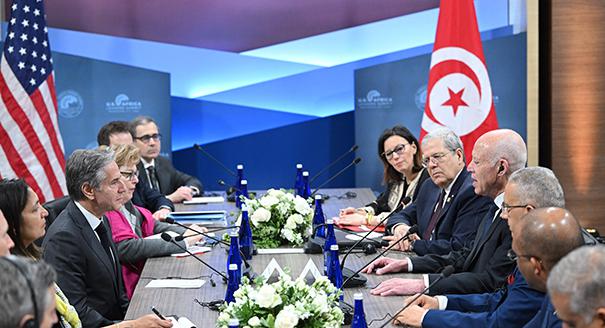
President Qaïs Saied’s visit to Washington this week is bound to have left him disappointed.
Tunisian President Qaïs Saied made his first trip to Washington as president on December 13–15 to attend the U.S.-Africa Leaders’ Summit. Saied’s decision to attend the summit was somewhat of a surprise. His preference to remain at home is well-known and he has made very few trips during his three years in office. Additionally, the U.S.-Tunisia relationship has been on ice as the Biden administration continues its criticism of Saied’s power grab of July 25, 2021.
Saied desperately needs U.S. support for Tunisia’s $1.9 billion deal with the International Monetary Fund (IMF), which is currently awaiting Executive Board approval, and for unlocking foreign financing to help Tunisia overcome its increasingly bleak economic situation. That is why much of Saied’s visit appeared aimed at revising the Washington narrative around Tunisia. The IMF reached a staff-level agreement with Tunisia in October and was scheduled to vote on the deal in December, but that vote was scrubbed from the IMF calendar.
Saied faces serious internal opposition to the IMF’s demands from the main labor representative, the Tunisian General Labor Union. His government has failed to pass a finance bill for 2023, which would need to address at least some of the IMF conditions, such as reforming the public-sector wage bill and subsidy regime and privatizing some state-owned enterprises. But if Saied thought a trip to Washington would help refurbish his image in the eyes of the West, he was proven wrong.
During his visit, Saied not only attended the broader summit with African leaders, but was also one of only around a dozen leaders who held a bilateral meeting with U.S. Secretary of State Antony Blinken. Saied also sat down with the editorial board of the Washington Post. In his discussion with Blinken, Saied lectured U.S. officials on Tunisian history and the American constitution, and spoke incoherently about the reasons for carrying out his effective coup last year. This messaging was in stark contrast to that of the United States, which focused on the “deep commitment to Tunisian democracy and supporting the aspirations of the Tunisian people for a democratic and prosperous future.”
Saied was naïve to expect that U.S. officials would welcome him with open arms. Rather, in a summit that included several democracy-challenged leaders, Tunisia’s situation provided an easy opportunity for U.S. officials to flex their democracy promotion muscles. In his meeting with Saied, Blinken was flanked not only by Assistant Secretary of State for Near Eastern Affairs Barbara Leaf, but also by the Undersecretary for Civilian Security, Democracy, and Human Rights Uzra Zeya and Deputy Assistant Secretary of State for Democracy, Human Rights, and Labor Christopher LeMon, both of whom visited Tunisia after the coup to emphasize the U.S. commitment to returning Tunisia to a democratic path. This sent a loud signal to the Tunisian side that democracy and human rights were front and center in the U.S.-Tunisia relationship, despite Saied’s protestations to the contrary.
Saied’s trip was also intended, in part, to counter what he describes as “fake news” coming out of the Western media outlets regarding his authoritarian crackdown. And in his meeting with Washington Post staff, Saied blamed unnamed “foreign forces” and “enemies of democracy in Tunisia” for the country’s woes. Rather than acknowledge his own failings in addressing Tunisia’s economic crisis and the growing protests against his actions, Saied doubled down on vague references to his enemies who are undermining the state.
The United States has long supported the Tunisian people and government in building a democratic future and in addressing their economic and security challenges. Yet after this performance, Saied returns to Tunis empty-handed, having only convinced his American interlocutors that his actions are guided by delusion and conspiracy theory. He failed to engage his American counterparts in a dialogue on a path forward that both protects the liberties of the Tunisian people and addresses the growing economic crisis. As a result, the United States will likely continue to vocally condemn Saied’s anti-democratic behavior and push for cuts in U.S. assistance to the Tunisian government.
On December 17, Tunisians will elect members of parliament to replace those whom Saied dismissed, unconstitutionally, in the wake of his coup. For Saied, this represents one more step forward on a path to remake the Tunisian political system, returning U.S.-Tunisian relations back to square one. However, following the president’s visit to Washington, the Biden administration is unlikely to give up on its efforts to assist the Tunisian people in returning the country to the democratic path they forged twelve years ago.

Acting Co-Director and Senior Fellow, Middle East Program
Sarah Yerkes is acting co-director and a senior fellow in the Middle East Program at the Carnegie Endowment for International Peace. Her research focuses on democracy and governance, U.S. foreign policy towards the Middle East and North Africa, and political and economic reform in Tunisia.
Recent Work

Sarah Yerkes, Natalie Triche, Amr Hamzawy
Carnegie does not take institutional positions on public policy issues; the views represented herein are those of the author(s) and do not necessarily reflect the views of Carnegie, its staff, or its trustees.

In an interview, Rozina Ali discusses her new book on the rise and manifestations of Islamophobia in the United States.

Michael Young

In an interview, Ian Lustick and Eli Clifton discuss their new book on why a prominent ally has so much influence in America.
Michael Young

As the U.S. stumbles in its war with Iran, we are likely to see an acceleration of its disengagement from the region.
Michael Young

Middle Eastern states should welcome an accelerated U.S. disengagement from their region.
Michael Young

In an interview, former ambassador Charles Freeman assesses the Trump administration’s war against Iran.
Michael Young