

Article
Nathan J. Brown
{
  "authors": [
    "Nathan J. Brown"
  ],
  "type": "commentary",
  "blog": "Diwan",
  "centerAffiliationAll": "",
  "centers": [
    "Carnegie Endowment for International Peace",
    "Malcolm H. Kerr Carnegie Middle East Center"
  ],
  "englishNewsletterAll": "",
  "nonEnglishNewsletterAll": "",
  "primaryCenter": "Malcolm H. Kerr Carnegie Middle East Center",
  "programAffiliation": "",
  "programs": [],
  "projects": [],
  "regions": [
    "Palestine",
    "Israel",
    "United States"
  ],
  "topics": []
}
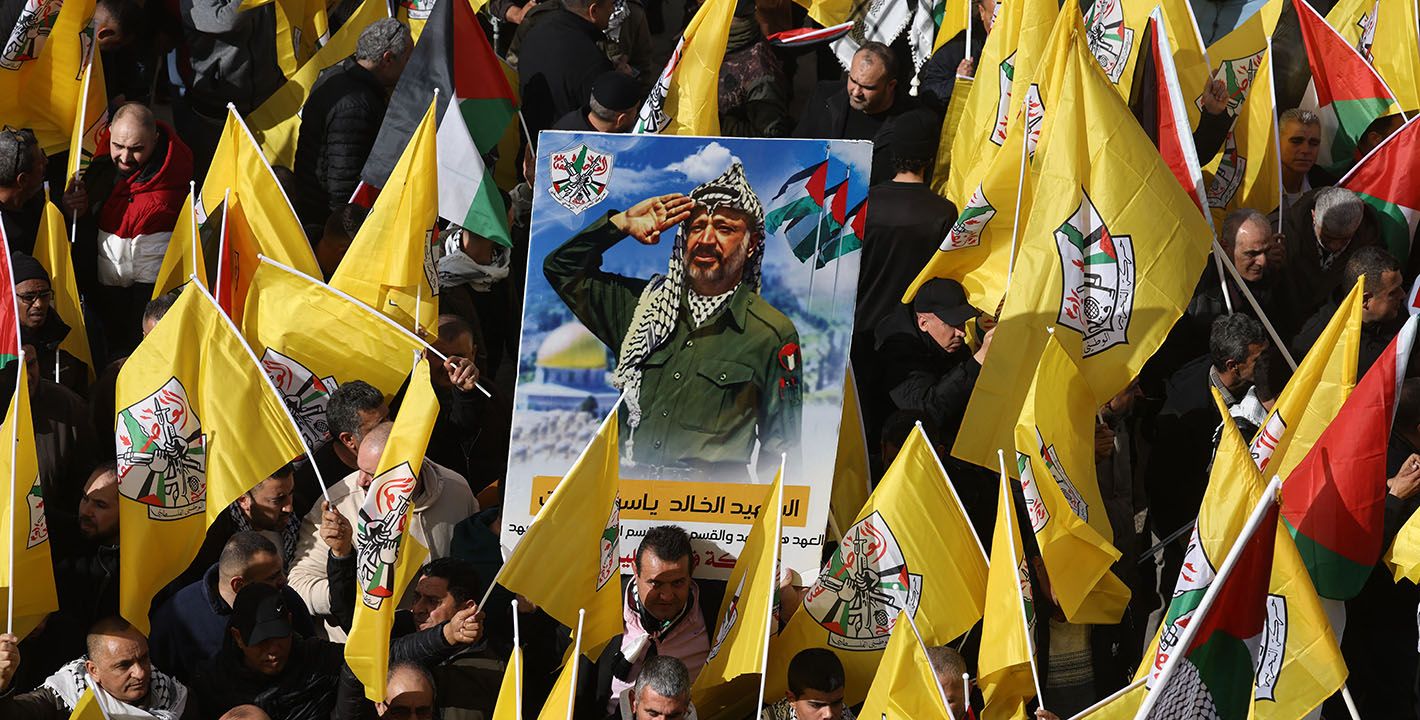
Source: Getty
The objective is to lock Hamas out of political life, but the net effect may be negative indeed.
While international journalists gape at fantastical plans for the reconstruction of Gaza, lawyers and diplomats in Ramallah are poring over plans for the “reform” of the Palestinian Authority. Sidestepping the utterly contradictory meanings of that term, the would-be reformers have moved from leadership succession to constitution writing and now to a political party law.
Or actually, they are waking up the idea from a three-decade-old slumber. When the Palestinian Authority (PA) was born in the 1990s, there was some discussion of legislating a basis for political parties. But it raised too many complicated issues, so the PA went into elections allowing ad hoc electoral lists, but not imposing any legal framework or formal status for political parties. Suddenly today, there is renewed interest in elections. While actual credible balloting still seems unlikely, preparations are taking place, this time with much stronger international interest from those who seek to support “reform” of the PA.
A law could indeed encourage and guide renewed democratic life in Palestine. However, that is not necessarily the agenda of those behind the effort. While the clear target of some of the cheerleaders for the law is to lock Hamas out of the PA (or, for some optimists, to lock it into abandoning armed action), much more might be caught up in the crossfire. A political party law is unlikely to accomplish what decades of security moves, fiscal pressure, constitutional shenanigans, diplomacy, and intermittent but horrifically severe military actions failed to achieve.
So, if some exclusionary drafting goes forward, the net effect on Palestinian politics will likely be negative indeed. Domestically, the law may be a way of solidifying a dominant party regime in a moribund political system. Such an outcome would hardly reverse the PA’s long slide into irrelevance. And internationally, an exclusionary law may support an effort not simply to confront the challenge of Hamas but to undermine already enfeebled Palestinian national institutions.
Those with legal eagle eyes are alert to some tell-tale signs of using a party law for such agendas. First, does the law register those parties if they meet the requirements? Or does it go much farther and license them, allowing officials far more discretion about what to accept and reject? Second, what are the precise formulas used to put ideological or programmatic limits on permitted parties?
And those two questions raise a third: Is implementation of the law in the hands of partisan institutions? The autonomy and professionalism of many PA bodies have always been an issue, but over the past decade and a half there have been steps taken to bring key freestanding bodies—including the judiciary and even the electoral commission itself—under individuals more likely to cooperate with the senior leadership.
The PA leadership and some international actors (including Israel) wish to exclude Hamas. Others wish to leave the door open to its participation—generally not out of admiration for Hamas, but resignation that the group is likely to be a continued presence in Palestinian society and that the Israeli attempt to destroy the group led not only to ghastly and unprecedented violence and destruction, but was ultimately unsuccessful. This inclusionary camp may hope to coax Hamas into transforming itself into a political party—a task that is not impossible but would require far stronger democratic institutions and much more time than Palestinians have right now.
The exclusionary camp seems dominant in many discussions, but its success would bring deep problems. First, the question is not only who would be locked out but who would be locked in. A restrictive law in the hands of partisan officials would have the effect of dousing any surviving democratic embers in Palestinian politics. It would ensure that rulers determine electoral results rather than the other way around.
Second, the electoral victors under any such law would not enjoy any democratic legitimacy. In fact, just the opposite: nobody is fooled that the aim of the effort is to bolster democracy. Proposed exclusionary rules are widely discussed in Palestinian public debates and generally criticized outside narrow official circles. In an atmosphere in which leaders enjoy little popularity, encouraging them to take such restrictive moves is likely to backfire.
Third, any new political actors—those perhaps leaving Hamas but still seeking to appeal to the Islamist camp; a new movement seeking to organize an utterly alienated younger generation of Palestinians; a dissident faction of Fatah—all might be barred by a law that grants existing leaders an effective veto over who can form a party.
Finally, it must be acknowledged that much of the international interest in barring Hamas comes as part of an effort to revive a diplomatic process between Israelis and Palestinians. Yet the Israeli leadership completely rejects such efforts. Trying to fine tune Palestinian law to meet Israeli concerns has always been a Sisyphean task, even under Israeli governments willing to deal with Palestinian leaders. And the current government has made it clear in the strongest possible terms that it equates the PA with Hamas, regards a Palestinian state as an existential threat, and is working to strangle the Palestinian leadership fiscally and diplomatically. When international diplomacy translates demands that are insatiable (in effect but increasingly by design) into new hoops for the Palestinian leadership to jump through, the effect is not only diversionary but also corrosive. It leads to the further isolation of senior officials from a population they are supposed to lead.
If the goal is to exclude Hamas, almost any legal mechanism placed in the party law is likely to be a blunt tool. Individuals associated with the movement may try to form a party to qualify, but it will be unclear what their relationship is with the movement. Are they splitting from Hamas, tolerated by it, or acting at its direction?
Expecting weak and partisan PA institutions to draw up formal rules for a movement that has no legal status is a quixotic task, but not an inconsequential one. Those interested in any serious meaning of “reform” should abandon the attempt to handle their Hamas problem through a party law.*
*This sentence was altered at the request of the author.

Nonresident Senior Fellow, Middle East Program
Nathan J. Brown, a professor of political science and international affairs at George Washington University, is a distinguished scholar and author of nine books on Arab politics and governance, as well as editor of five books.
Recent Work
Nathan J. Brown

Amr Hamzawy, Nathan J. Brown
Carnegie does not take institutional positions on public policy issues; the views represented herein are those of the author(s) and do not necessarily reflect the views of Carnegie, its staff, or its trustees.

As Iran defends its interests in the region and its regime’s survival, it may push Hezbollah into the abyss.

Michael Young
Because of this, the costs and risks of an attack merit far more public scrutiny than they are receiving.

Nicole Grajewski
The conflict did not reshape Arab foreign policy; on the contrary it exposed its limits.

Angie Omar

The organization is under U.S. sanctions, caught between a need to change and a refusal to do so.
Mohamad Fawaz
A coalition of states is seeking to avert a U.S. attack, and Israel is in the forefront of their mind.
Michael Young