

Commentary
As the U.S. stumbles in its war with Iran, we are likely to see an acceleration of its disengagement from the region.
Michael Young
{
  "authors": [
    "Wladimir van Wilgenburg"
  ],
  "type": "commentary",
  "blog": "Diwan",
  "centerAffiliationAll": "",
  "centers": [
    "Carnegie Endowment for International Peace",
    "Malcolm H. Kerr Carnegie Middle East Center"
  ],
  "collections": [
    "Diwan Dispatches"
  ],
  "englishNewsletterAll": "",
  "nonEnglishNewsletterAll": "",
  "primaryCenter": "Malcolm H. Kerr Carnegie Middle East Center",
  "programAffiliation": "",
  "programs": [],
  "projects": [],
  "regions": [
    "Iraq",
    "Levant",
    "Middle East"
  ],
  "topics": []
}
Source: Getty
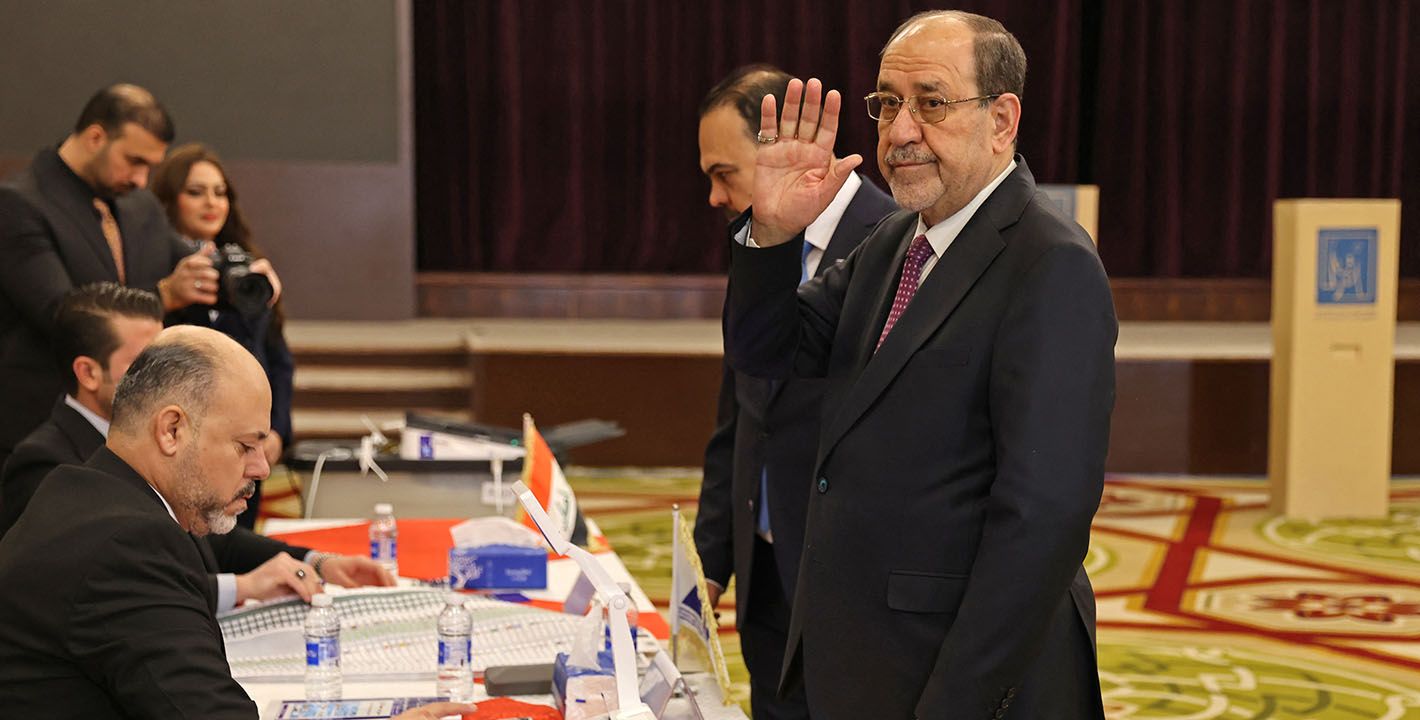
Recent election results have placed Nouri al-Maliki in a strong position to name the next prime minister.
The Iraqi Construction and Development Coalition, led by Prime Minister Mohammed Shia al-Sudani, emerged as the leading bloc in Iraq’s parliamentary elections on November 11, winning a plurality of 46 out of 329 seats. However, diplomatic sources say it is unlikely that Sudani will become the next prime minister, given that, among other factors, Iraq’s political system favors compromise candidates. Sudani has become too powerful to still be viewed as such.
On November 17–19, speaking at the Middle East Peace and Security Forum in Duhok, an annual summit hosted by the American University of Kurdistan, Sudani said that he was ready to seek a second term to carry through his ongoing projects and reforms. However, he acknowledged that election results have rarely determined government formation in Iraq.
This is largely due to a ruling by Iraq’s Federal Supreme Court in March 2010 that the parliamentary bloc that formed a new government need not be an electoral list that won the most seats; it could just as easily be a post-election alliance that commanded a parliamentary majority. The decision enabled Nouri al-Maliki to form a government and become prime minister despite Ayad Allawi’s Iraqiya List having won more seats in the elections that year.
On November 18, Iraq’s pro-Iran Coordination Framework alliance, which includes most Shiite parties, announced that it had formed the largest parliamentary bloc and would nominate the country’s next prime minister. The Framework has reportedly drawn up a list of 30 potential nominees, which includes both Maliki and Sudani, but also figures such as Iraqi National Intelligence Service chief Hamid al-Shatri, former sports minister Abdul-Hussein Abtan, the governor of oil-rich Basra Governorate Asaad al-Eidani, and Iraqi National Security Advisor Qasim al-Araji.
Sudani has also had to contend with developments that have worked against him and in favor of pro-Iran Shiite parties, with which he has often found himself at loggerheads, as well as Iran itself, a major power broker in Iraq. To begin with, Muqtada al-Sadr, who headed an independent Shiite bloc before his parliamentarians resigned en masse in June 2022 amid a government formation crisis, boycotted the elections. This benefited the pro-Iran Shiite parties, which consequently faced virtually no opposition in the Shiite political landscape. Indeed, parties directly linked to Iran-backed armed groups—though disparate and not constituting a single bloc—collectively won more than 50 seats in the latest elections.
More recently, Sudani has been embroiled in a scandal that has significantly eroded his standing among pro-Iran Shiite parties. On December 4, the official Iraqi gazette, which informs the public of new legislation, referred to Lebanon’s Hezbollah as well as Yemen’s Ansar Allah (the Houthis) as “terrorist organizations,” sparking an uproar. Sudani, who denied knowledge of how this came about and said that the language used did not reflect Iraq’s position, ordered an investigation and promised accountability for those responsible for the mistake.
President Donald Trump’s claim that Sudani nominated him for a peace prize has also damaged the prime minister’s reputation. The claim drew criticism from Iran-backed factions, given that Trump ordered the U.S. strike that killed the Iranian general Qassem Soleimani and Kataib Hezbollah leader Abou Mahdi al-Muhandis on January 3, 2020, an operation that prompted the issuance of an Iraqi arrest warrant against the U.S. president.
All this means that Maliki remains the key driver behind the selection of the next prime minister. The former premier has three elements working in his favor. The first is his enduring influence within the Coordination Framework. Although Iraq’s Channel 8 reported on November 29 that momentum was building within the Framework to nominate someone who has no political base, a move that would exclude both Sudani and Maliki, the latter would still have a major say in the nomination.
Second, Maliki’s State of Law coalition, a rival of Sudani’s bloc that is generally considered to lie within the pro-Iran Shiite orbit, secured 29 seats in the elections. State of Law has publicly stated that it is against a new term for Sudani.
Finally, Maliki, though out of office for years, retains control over several political and security networks in the country through his position as head of the State of Law Coalition, his ties to armed militias such as Kataib Sayyid al-Shuhada, and his connections to the judiciary, which include close links to Supreme Judicial Council President Faiq Zaidan.
Maliki has long been a powerful figure in Shiite political circles. He is the only Iraqi prime minister since the 2003 toppling of the country’s former leader Saddam Hussein to serve two terms (2006–2014 and 2016–2018). Though he lost his position as prime minister after the fall of Mosul to the Islamic State group, Maliki remained a major player in Shiite politics. In 2022, he successfully pushed for his then-close ally Sudani, a relatively unknown politician at the time, to become the new prime minister.
However, Maliki was not able to control Sudani, who had his own political ambitions. In 2024, he attempted to pressure Sudani to resign, blaming him for a wire-tapping scandal that targeted key members of the Coordination Framework, including Maliki himself and his son-in-law. Sudani refused to step down. And in May 2025, he formed his own political coalition, building an independent political base through alliances with the governors of Basra, Karbala, and Wasit, former Iraqi prime minister Iyad Allawi, Oil Minister Hayan Abdul Ghani, and prominent parliamentarian Alia Nassif. This further angered Maliki.
“For years, Maliki has perfected a political playbook: elevate a ‘manageable’ prime minister, then gradually weaken, isolate, or sideline him once he is powerful,” said Iraqi political analyst and writer Lawk Ghafuri in an interview. “He did that with [Haidar] Abadi, and now he is doing it with Sudani. Once he sees that the prime minister he has appointed is powerful and moving without his consent, he starts to sideline him and appoint another one from his circle to keep his power in Baghdad.”
Ghafuri pointed out that it will be more difficult for Maliki to do this now, since Sudani’s bloc has just won many seats in parliament. “But still,” he observed, “Maliki is engineering the whole process to corner Sudani, weaken him, and enhance the prospects of someone from Maliki’s own faction—including himself.”
At the end of the day, Maliki is undeniably well-positioned to influence the selection of Iraq’s prime minister. Yet he is not all-powerful. In fact, sidelining Sudani constitutes only half the equation. For his preferred candidate to take office, Maliki must navigate alliances with other Shiite actors, many of whom resent his outsized role, with Muqtada al-Sadr in particular unlikely to accept his return as prime minister. He must also secure the approval of both Iran and the United States. As a result of all this, a compromise candidate remains the most likely outcome.
Wladimir van Wilgenburg
Carnegie does not take institutional positions on public policy issues; the views represented herein are those of the author(s) and do not necessarily reflect the views of Carnegie, its staff, or its trustees.

As the U.S. stumbles in its war with Iran, we are likely to see an acceleration of its disengagement from the region.

Michael Young
The Zaidi government’s objective to collect weapons is constrained by regional conflict, but it can take certain measures at home.
Ali Al-Mawlawi

Huawei pushed hard to enter the Egyptian data centers market, until the Americans made a better offer.

Angie Omar

The accord represents a pivotal moment in the region to avert a security vacuum in the Gulf.


Azeema Cheema, Mohanad Hage Ali
In an interview, Jason Burke discusses his sweeping account of the “revolutionists” who so shaped the 1970s and early 1980s.
Michael Young