

Commentary
Because of this, the costs and risks of an attack merit far more public scrutiny than they are receiving.
Nicole Grajewski
{
  "authors": [
    "Michael Young"
  ],
  "type": "commentary",
  "blog": "Diwan",
  "centerAffiliationAll": "",
  "centers": [
    "Carnegie Endowment for International Peace",
    "Malcolm H. Kerr Carnegie Middle East Center"
  ],
  "englishNewsletterAll": "",
  "nonEnglishNewsletterAll": "",
  "primaryCenter": "Malcolm H. Kerr Carnegie Middle East Center",
  "programAffiliation": "",
  "programs": [],
  "projects": [],
  "regions": [
    "Israel",
    "United States",
    "Lebanon",
    "Syria",
    "Levant"
  ],
  "topics": []
}
Source: Getty
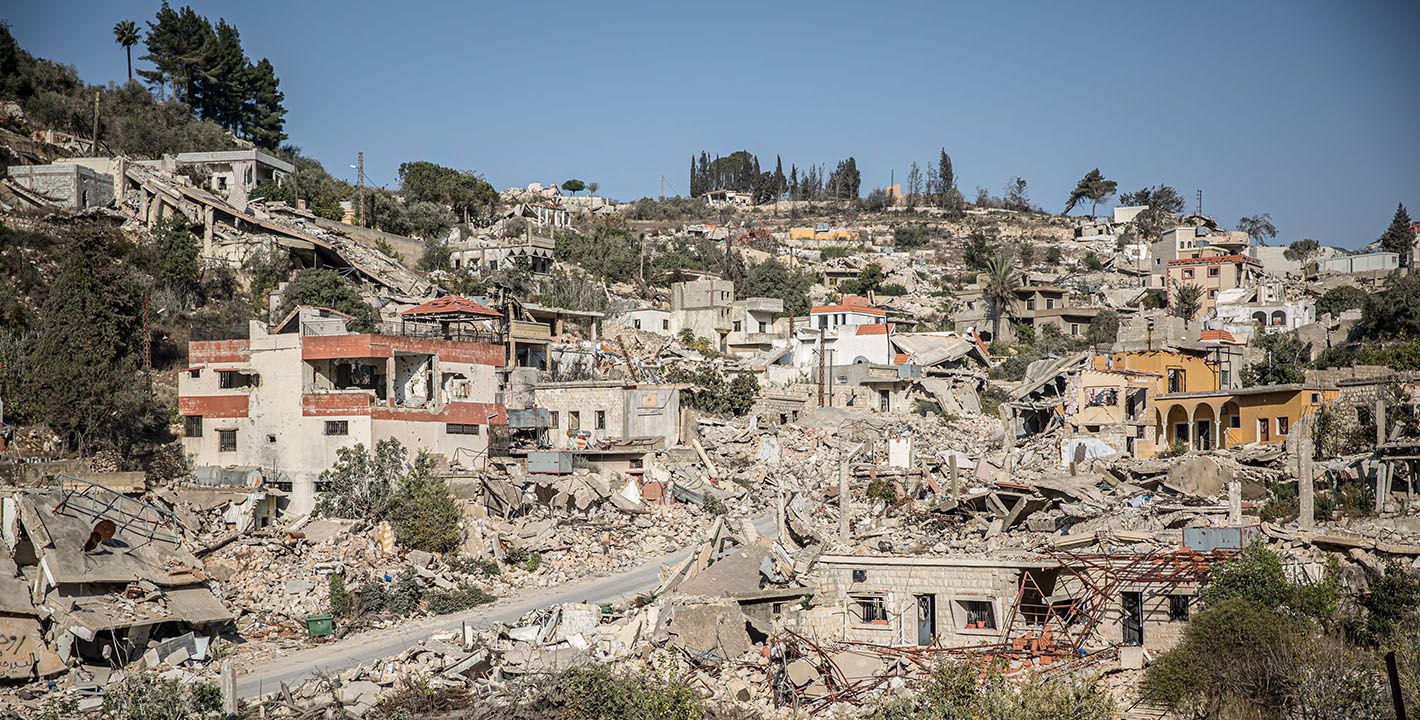
The U.S. is trying to force Lebanon and Syria to normalize with Israel, but neither country sees an advantage in this.
On January 6, the Israeli journalist Barak Ravid published an article at Axios, reporting that the United States had presented Syria and Israel “with a new proposal for a security pact between them that includes establishing a joint economic zone on both sides of the border …” This followed several hours of talks between the sides in Paris the same day, during which the Americans also proposed the establishment of a joint U.S.-Israeli-Syrian “fusion cell” in Amman “to oversee the security situation in Southern Syria and host further talks on demilitarization and the withdrawal of Israeli forces.”
This decision raised the pressure in Beirut, where the United States and Israel have been trying to push for a similar economic arrangement, against the wishes of senior Lebanese officials. Even the foreign minister, Youssef Rajji, who is close to the Lebanese Forces, which is openly hostile to Hezbollah, had to provide a corrective in a recent interview with the Washington Institute for Near East Policy, a think tank supportive of strong U.S. ties with Israel, after he was asked about normalization between Lebanon and Israel.
Rajji replied bluntly, “There is no way, currently … to talk about peace with Israel in Lebanon. It’s still a taboo … Honestly, I’m very surprised that the Israeli leadership [is] talking about economic negotiations … Regarding the Mechanism [the five-party committee expanded to monitor and discuss implementation of the ceasefire agreement reached between Israel and Lebanon in 2024], to be very honest, appointing a civilian [Simon Karam, to head the Lebanese delegation] was just cosmetics. It hasn’t changed anything, and it was clear, publicly, solemnly clear, that nothing has changed in the mission of the Lebanese delegation to the Mechanism.”
The Lebanese have, rightly, understood that there is no consensus in the country on normalization. Pursuing such a path would only divide society further. Moreover, normalizing with Israel is a cause no Lebanese official is willing to defend against domestic opponents, largely because it makes no sense to even discuss such a thing while Israel is occupying Lebanese land and there is no peace agreement between the two countries. Lebanon is still officially committed to the 2002 Arab Peace Initiative, which offers the Israelis peace if they withdraw from all Arab territories occupied in 1967 and allow the creation of a sovereign and independent Palestinian state in the West Bank, Gaza, and East Jerusalem, conditions the United States has completely disregarded.
But let’s assume global politics are about power and force, as some U.S. officials like to say. The Lebanese are aware of something else, which few outside the region appreciate. As the Americans try to strong-arm Beirut and Syria into normalization with Israel, they are ignoring the geopolitical implications of such a policy. Israel’s main rival in the Levant is Türkiye, which has expanded its zone of influence into Syria. From the Turkish perspective, allowing Syria to be absorbed into an Israeli sphere of influence is menacing, while Lebanon is seen as a strategic extension of Syria. Syria’s stability partly requires stability in Lebanon. For Ankara, a Lebanon forced into an Israeli sphere could give Israel the means to shape outcomes in Syria, which the Turks will not allow.
That is why Türkiye reacted with such hostility to Lebanon’s recent conclusion of a maritime demarcation agreement with Cyprus. This not only impacts the maritime borders of the Turkish Republic of Northern Cyprus, but also could lock Lebanon into an eventual arrangement to export its offshore oil and gas reserves with the two countries with which it has agreed maritime borders—Israel and Cyprus. A pipeline serving these three countries could then extend to Europe via Greece, competing with the Turkish TurkStream pipeline transporting gas to Bulgaria. Ankara would like to see Levant hydrocarbons feed into TurkStream, which would consolidate Türkiye’s status as a main hub for regional energy—linking Central Asia, certain Gulf states, and the Levant with Europe.
Therefore, it is unlikely that Türkiye would remain idle if Lebanon risked becoming part of an Israeli-dominated space. What might it do in such a case? It could mobilize its supporters in the Lebanese Sunni community against normalization, and it’s entirely possible it would collaborate with Iran and Hezbollah (despite their disagreements over Syria) to derail such an endeavor. From the Lebanese perspective, then, it makes no sense to tear Lebanon apart over an arrangement that enjoys little appeal in Beirut, and that would only reinforce Lebanon’s vulnerabilities in the face of a predatory Israel.
There is, however, a consensus in Lebanon around disarming all nonstate actors and neutralizing the southern border. It’s fair to say that most Lebanese disapproved of Hezbollah’s participation in the Gaza war, and welcome a state monopoly over weapons. Why can’t the United States simply accept this and advance on border security guarantees with Israel, rather than foisting a broader, divisive arrangement on Lebanon?
The answer must be sought in Venezuela. What recent U.S. actions there tell us is that Washington is fostering a world in which powers can intervene in what they consider to be their vital space. Russia did this in Ukraine, and soon China may do so in Taiwan. It’s evident today that the United States is helping Israel to consolidate a zone of its own in the Levant. But reconstituting a world in which establishing and defending spheres of interest is the operating rule will mean a much more volatile global environment. In the Middle East it will lead to years of tension, with little probability that countries will soon reach agreement on a Mideastern version of the Congress of Vienna.
What is interesting in all this is that Donald Trump’s thinking is not so very different than that of Barack Obama, whom the current president loathes. In a now-famous interview with the Atlantic’s Jeffrey Goldberg in 2016, Obama regretted that the “competition between the Saudis and the Iranians—which has helped to feed proxy wars and chaos in Syria and Iraq and Yemen—requires us to say to our friends as well as to the Iranians that they need to find an effective way to share the neighborhood and institute some sort of cold peace.” Such thinking reflected very much a 19th-century outlook, in which the Saudis and Iranians had to find a way of coexisting in their respective spheres by bringing their dependents into line. Obama showed no more an understanding of national self-determination than Trump has, funneling all states into a binary Saudi-Iranian, Sunni-Shi’i structure—one totally at odds with the lessons of the 2010–2011 uprisings.
A larger problem is that, in a world of spheres of influence, why should countries like Lebanon and Syria want to be part of a U.S.-backed Israeli sphere? The United States is currently behaving like a lawless state, while Israel has engaged in mass murder in Gaza, which it would like to complete with the ethnic cleansing of the Palestinian population there and in the West Bank, so what do both offer to countries such as Lebanon and Syria? The Americans presented Lebanon with a ceasefire plan in November 2024, to which they appended a side letter allowing Israel to violate the agreement. Israel then ignored two deadlines for a withdrawal in January and February 2025. How can either country be trusted? While Lebanon and Syria cannot ignore the Americans and Israelis, and may indeed benefit from them on occasion, they gain no advantage whatsoever in tying their wagon to such politically and morally abusive nations and succumbing to a Pax Israelica. The multipolar regional order allows Beirut and Damascus to secure a margin of maneuver on this front.
In imposing a choice between normalization with Israel or conflict, the United States and Israel don’t seem to grasp that normalization will also bring conflict. We’re in a new Middle East, in which hegemony is contested. If Lebanon, and with it Syria, can successfully play the balance-of-power game and sidestep detrimental commitments, they will try to do so. This is all the more likely when they have no confidence that American and Israeli plans for them will bring much good.
Carnegie does not take institutional positions on public policy issues; the views represented herein are those of the author(s) and do not necessarily reflect the views of Carnegie, its staff, or its trustees.
Because of this, the costs and risks of an attack merit far more public scrutiny than they are receiving.

Nicole Grajewski

The organization is under U.S. sanctions, caught between a need to change and a refusal to do so.
Mohamad Fawaz

A coalition of states is seeking to avert a U.S. attack, and Israel is in the forefront of their mind.

Michael Young

A recent offensive by Damascus and the Kurds’ abandonment by Arab allies have left a sense of betrayal.
Wladimir van Wilgenburg
Implementing Phase 2 of Trump’s plan for the territory only makes sense if all in Phase 1 is implemented.

Yezid Sayigh