

Commentary
Maria Lipman
{
  "authors": [
    "Maria Lipman"
  ],
  "type": "legacyinthemedia",
  "centerAffiliationAll": "",
  "centers": [
    "Carnegie Endowment for International Peace",
    "Carnegie Russia Eurasia Center"
  ],
  "collections": [],
  "englishNewsletterAll": "",
  "nonEnglishNewsletterAll": "",
  "primaryCenter": "Carnegie Russia Eurasia Center",
  "programAffiliation": "",
  "programs": [],
  "projects": [],
  "regions": [
    "Caucasus",
    "Russia"
  ],
  "topics": []
}
Source: Getty
Source: Washington Post

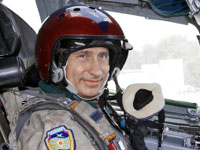
MOSCOW -- Last month President Vladimir Putin's broadly televised public activities included flying a strategic bomber, driving an old Soviet-era Volga automobile, overseeing naval maneuvers on board a nuclear missile cruiser, inaugurating a highway tunnel and visiting a children's cancer hospital, where he had a friendly meal with a sick boy and ordered that a new, state-of-the-art ward be constructed without delay. He listened to the defense minister's report on Russian-Chinese military maneuvers and presided over grand celebrations of the 1,000th anniversary of the city of Kazan, attended by Russian regional leaders and presidents of most of the former Soviet republics. Western political scholars and journalists who met with him during the first week of September were nearly unanimous in their favorable impression of the Russian leader: "Energetic" and "confident" were the most frequent assessments heard from those who attended.
He looks, in fact, like a man interested in reelection. So much so that political commentators are once again guessing about whether he will stay in power beyond 2008, when his second -- and last -- term expires. To be sure, several loyal officials have suggested ways to overcome the constitutional obstacle to a third term. But with the next election still 2 1/2 years away, the Kremlin appears to remain undecided as to how to preserve the political status quo in Russia in 2008. Putin's heightened activity may just be a way of demonstrating that he is fully in charge and that he remains the ultimate decision maker on all important national issues, including the "challenge of 2008."
With the Kremlin's control over politics and society having tightened this past year, there is little for Putin to worry about from parliamentary factions, the media or outside opponents. While public opinion polls show unrelenting discontent with government policies, Putin's own approval rating, which had dropped somewhat, popped back up to 70 percent in August.
Even the smoldering youth activism that had caused the Kremlin concern -- some of the more radical groups were harassed and even prosecuted -- doesn't seem to pose much of a threat to the ruling elite. According to an August poll, 82 percent of young people share none of the ideas of these youth groups -- an apparent indication of a widespread rejection of activism as such.
With oil revenue growing steadily, the public generally apathetic, and the elites bought or intimidated into submission, Putin and his inner circle have reason to feel confident and high-spirited. But the Kremlin is still apprehensive about autonomous civic activism and won't ease its efforts to preempt any kind of genuine public initiative.
Sometimes this leads to peculiar political innovations. Consider the newly introduced representative body known as the Public Chamber. It was described by Putin as a "channel of influence of civil societies, of the citizens of the Russian Federation on the decisions made in the country."
Under the terms of the law establishing it, the Public Chamber will consist of Russians who "have done great service to the society and state." And who is to decide which honorable citizens are to be recognized by a grateful nation? The political style of Putin's Russia suggests the answer: The members will be handpicked by Putin himself, or nearly so. He will appoint one-third of the 126 Public Chamber members, and these core members will be the dominant force in selecting the remaining 84.
Putin has said that these people should be "politically maximally unengaged." The nomination process has so far been strictly secret (like all Kremlin decisions), but leaks and rumors have brought forth about a dozen names. Their main defining features are -- not unexpectedly -- their loyalty and special favors done for the Kremlin. At least two of the rumored candidates -- a famous female gymnast and a highly popular theater director -- are signatories to a recent collective letter supporting the conviction of Mikhail Khodorkovsky, the oil tycoon and potential political rival prosecuted by Putin's government. Others include a female college student from a provincial city who's also a commissar of Nashi, a government-sponsored youth movement masterminded by the Kremlin, and an unknown functionary of a government-sponsored association of journalists.
These are only rumors, of course, but whoever is chosen for the Public Chamber, this is not a body that will be doing much to channel public influence. The Kremlin would never risk granting real authority to anyone who has not proved his or her loyalty. If it is indeed concerned about feedback from the public, the concern has been overwhelmed by a far more important priority: the urge to keep society under control. The only question is whether Putin's regained political confidence will cause him to mistake the obliging recommendations of his loyalists for the actual voice of the people.
Masha Lipman, editor of the Carnegie Moscow Center's Pro et Contra journal, writes a monthly column for The Post.
Former Scholar in Residence, Society and Regions Program, Editor in Chief, Pro et Contra, Moscow Center
Lipman was the editor in chief of the Pro et Contra journal, published by the Carnegie Moscow Center. She was also the expert of the Carnegie Moscow Center’s Society and Regions Program.
Recent Work
Maria Lipman
Maria Lipman
In an interview, Sergei Melkonian discusses Armenia’s and Azerbaijan’s careful balancing act among the United States, Israel, and Iran.

Armenak Tokmajyan
The country’s leadership is increasingly uneasy about multiple challenges from the Levant to the South Caucasus.
Armenak Tokmajyan
In an interview, Daniela Richterova speaks about her book on Czechoslovakia’s Cold War ties to Palestinian groups and others.

Michael Young
The downfall of the Assad regime represented a setback, but Russia’s primary focus remains Ukraine.
Sergei Melkonian
Why did Bashar al-Assad’s armed forces fail to act, unlike those in Egypt, Libya, Algeria, and Sudan?

Yezid Sayigh