


Paper
Ashley J. Tellis
{
  "authors": [
    "Ashley J. Tellis"
  ],
  "type": "legacyinthemedia",
  "centerAffiliationAll": "dc",
  "centers": [
    "Carnegie Endowment for International Peace"
  ],
  "collections": [],
  "englishNewsletterAll": "ctw",
  "nonEnglishNewsletterAll": "",
  "primaryCenter": "Carnegie Endowment for International Peace",
  "programAffiliation": "SAP",
  "programs": [
    "South Asia"
  ],
  "projects": [],
  "regions": [
    "South Asia",
    "Pakistan"
  ],
  "topics": [
    "Political Reform",
    "Democracy",
    "Security"
  ]
}
Source: Getty
Source: ADTV's Viewpoint
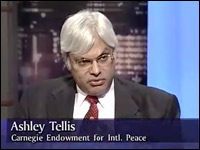
In an interview on Viewpoint, Ashley J. Tellis noted that although Musharraf has aggressively targeted some terrorist organizations within Pakistan, like Al Qaeda, he has conveniently ignored certain politically important organizations, like the Taliban and the Deobandi groups active in Kashmir.
Such inconsistency has been possible partially because U.S. attention and resources have been focused on Iraq, said Tellis. Furthermore, he argued, the war in Iraq stirred up anti-American sentiment in the tribal areas of Pakistan and the U.S. has not held Musharraf to his promise to move Pakistan toward democracy.
Tellis warned that bringing stability and democracy to Pakistan would likely take years, if not decades. But, he added, Pakistan does have a tradition of democratic and civilian rule in Pakistan.

 |
Former Senior Fellow
Ashley J. Tellis was a senior fellow at the Carnegie Endowment for International Peace.
Recent Work
Ashley J. Tellis
Ashley J. Tellis
Carnegie does not take institutional positions on public policy issues; the views represented herein are those of the author(s) and do not necessarily reflect the views of Carnegie, its staff, or its trustees.

Just look at Iraq in 1991.

Marwan Muasher

Baku may allow radical nationalists to publicly discuss “reunification” with Azeri Iranians, but the president and key officials prefer not to comment publicly on the protests in Iran.

Bashir Kitachaev
In addressing Hezbollah’s disarmament, the Lebanese state must start by increasing its own leverage.

Michael Young
The country’s political and military establishment is still debating how to interpret the recent war’s outcome.
Nicole Grajewski
Spot analysis from Carnegie scholars on events relating to the Middle East and North Africa.

Mohanad Hage Ali