

Commentary
In an interview, Ian Lustick and Eli Clifton discuss their new book on why a prominent ally has so much influence in America.
Michael Young
{
  "authors": [
    "James F. Collins",
    "Matthew Rojansky"
  ],
  "type": "legacyinthemedia",
  "centerAffiliationAll": "dc",
  "centers": [
    "Carnegie Endowment for International Peace",
    "Carnegie Russia Eurasia Center"
  ],
  "collections": [
    "U.S. Nuclear Policy"
  ],
  "englishNewsletterAll": "ctw",
  "nonEnglishNewsletterAll": "",
  "primaryCenter": "Carnegie Endowment for International Peace",
  "programAffiliation": "russia",
  "programs": [
    "Russia and Eurasia",
    "Nuclear Policy"
  ],
  "projects": [
    "U.S.-Russia Bilateral Presidential Commission"
  ],
  "regions": [
    "North America",
    "United States",
    "Caucasus",
    "Russia"
  ],
  "topics": [
    "Security",
    "Military",
    "Nuclear Policy",
    "Nuclear Energy"
  ]
}
Source: Getty
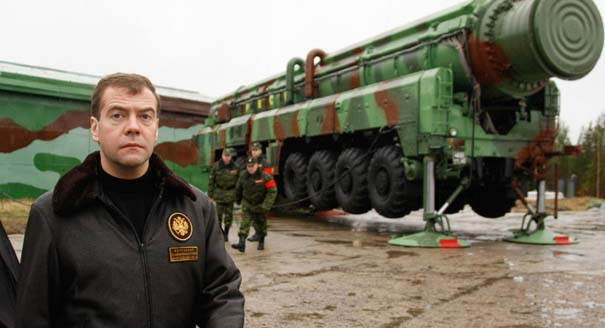
A treaty to replace the expired START agreement is an essential step not only toward global nuclear disarmament, but also toward managing the risks associated with Russia's nuclear arsenal, which still poses the single greatest existential threat to the United States.
Source: The Hill

With Presidents Barack Obama and Dmitry Medvedev expected to sign a final document within weeks, and ratification required to bring the treaty into force, the U.S. Senate is set to become ground zero in a contest between those on opposite sides of the administration’s broader nuclear agenda.
But arguments from both hawks and doves have missed an urgent point: that without a new treaty, Washington will be unable to manage the risks associated with Russia’s vast nuclear arsenal, which still poses the single greatest existential threat to the United States.
With around 4,000 deployed nuclear warheads, a staggering 1,000 tons of weapons-grade nuclear material, hundreds of deployed ballistic missiles and thousands of experts with the knowledge to construct such systems from scratch, Russia is still potentially the world’s nuclear supermarket. Agreements governing these arsenals are essential to preventing the many national security nightmares of nuclear proliferation to rogue states and terrorist groups from becoming realities. To protect America, we must agree to, and verify, limits on what the Russians have, know how they are using it, and take adequate steps to ensure that devastating weapons and dangerous materials remain safe from terrorist theft.
As of Dec. 5, 2009, when the 1991 START agreement expired, we lack any enforceable, verifiable treaty to provide that level of information. We need a new treaty in force not only to plug holes left gaping by the old treaty’s expiration, but also to increase our security by imposing further limits on what new nuclear weapons the Russians can develop and deploy.
A successor to START would likely lower the maximum number of deployed strategic nuclear warheads allowed to between 1,500 and 1,675 on each side — still enough to destroy the world many times over, but far below the 6,000 allowed under the old treaty. Strategic delivery vehicles — missiles, bombers and nuclear missile submarines — will be further cut from 1,600 to around 800. Reducing Russia’s nuclear arsenal and taking missile launchers in both countries off alert reduces the likelihood of accidental nuclear war, keeping Americans safer.
Verified and permanent reductions in the Russian nuclear arsenal will dramatically reduce the number of targets for potential theft or diversion of nuclear technology to terrorists. Over the past two decades, the U.S. has invested at least $10 billion to ensure security for Russian and former Soviet nuclear material, technologies, facilities, and individual experts under the auspices of the “Nunn-Lugar” Cooperative Threat Reduction and other bilateral and multilateral programs.
These programs have helped to deactivate over 7,500 former Soviet nuclear warheads, destroy over 2,000 missiles, and eliminate over 1,100 missile launchers. But without a comprehensive U.S.-Russian arms control agreement in place, steps like these could be totally nullified by production of new nuclear materials, weapons and launchers without any U.S. or international monitoring.
Even after a new treaty enters into force, the U.S. and Russia will possess the world’s largest nuclear arsenals by a wide margin. And as long as nuclear weapons exist, leaders across the political spectrum concur, the U.S. must maintain the world’s strongest, safest and most reliable arsenal. Yet in addition to reducing the size of the threat itself, a new agreement would be beneficial for increasing regular engagement between the U.S. and Russia on strategic issues, which will help build mutual understanding, and avert needless suspicion and conflict.
Two decades after the end of the Cold War, Americans and Russians are increasingly intertwined in global financial and energy markets, and we share immediate and vital national security interests in preventing terrorism, state failure and drug trafficking throughout the Eurasian region.
Yet our communication on security issues has been in dangerous decline for the past decade. In a sense, this should come as no surprise, since the most recent comprehensive U.S.-Russian security treaty was actually signed by the United States and the Soviet Union, which no longer exists.
Any “reset” that puts U.S.-Russian relations on a more productive footing will depend first and foremost on forging a durable bilateral agreement to replace START. Arms control is not in itself a solution to U.S.-Russian tensions, or a guarantee of security from the nuclear terror threat, but if history is any guide, it is where we must begin.
Nonresident Senior Fellow, Russia and Eurasia Program; Diplomat in Residence
Ambassador Collins was the U.S. ambassador to the Russian Federation from 1997 to 2001 and is an expert on the former Soviet Union, its successor states, and the Middle East.

Former Deputy Director, Russia and Eurasia Program
Rojansky, formerly executive director of the Partnership for a Secure America, is an expert on U.S. and Russian national security and nuclear-weapon policies.
Carnegie does not take institutional positions on public policy issues; the views represented herein are those of the author(s) and do not necessarily reflect the views of Carnegie, its staff, or its trustees.

In an interview, Ian Lustick and Eli Clifton discuss their new book on why a prominent ally has so much influence in America.

Michael Young

As the U.S. stumbles in its war with Iran, we are likely to see an acceleration of its disengagement from the region.
Michael Young

Middle Eastern states should welcome an accelerated U.S. disengagement from their region.
Michael Young

In an interview, former ambassador Charles Freeman assesses the Trump administration’s war against Iran.
Michael Young

By failing to address Palestinian representation, the current process is bound to lead to just another temporary arrangement.

Nathan J. Brown