

Commentary
Thomas de Waal
{
  "authors": [
    "Thomas de Waal"
  ],
  "type": "legacyinthemedia",
  "centerAffiliationAll": "dc",
  "centers": [
    "Carnegie Endowment for International Peace",
    "Carnegie Europe",
    "Carnegie Russia Eurasia Center"
  ],
  "collections": [],
  "englishNewsletterAll": "ctw",
  "nonEnglishNewsletterAll": "",
  "primaryCenter": "Carnegie Europe",
  "programAffiliation": "russia",
  "programs": [
    "Russia and Eurasia"
  ],
  "projects": [],
  "regions": [
    "Russia",
    "Eastern Europe",
    "Caucasus",
    "Georgia"
  ],
  "topics": [
    "Political Reform",
    "Democracy"
  ]
}
Source: Getty
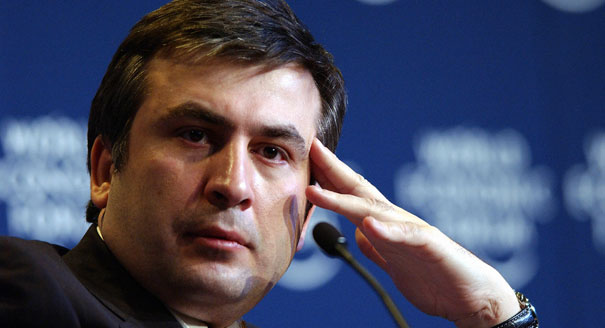
If Georgian President Saakashvili can leave the scene gracefully when his term ends and allow a more pluralistic politics to emerge in Georgia after him, he will set a good example to the rest of the former Soviet Union, Russia included.
Source: Washington Post

Saakashvili presides over a young, dynamic, Western-educated government that provides troops to the allied effort in Afghanistan and has undertaken some impressive reforms. Georgia’s crackdown on corruption in public bodies such as the police force and universities is an inspiring example to its post-Soviet neighbors.
For a long time after the 2008 war, the Georgian president was damaged goods — and not received at a high level in Western capitals. But he has worked hard to rehabilitate himself both domestically and abroad. He will be received in the Oval Office this week in large part as a token of gratitude for Georgia’s cooperative attitude in striking a deal with Moscow and waiving its right to veto Russia’s long-sought accession to the World Trade Organization.
For President Obama, the White House meeting will be an opportunity to speak to Saakashvili’s better angel and encourage him to behave responsibly in a year of political transition in Georgia.
Saakashvili’s Georgia could be described as a mix of non-Russia and anti-Russia. “Non-Russia” refers to the country’s public service reforms, its recent law on the tolerance of religious minorities and its persistent tradition of pluralism. “Anti-Russia” means behavior that, in its extreme defiance of Vladimir Putin and his rule, frequently ends up mirroring them. Such behavior includes inflammatory rhetoric toward Russia (Saakashvili last year described Georgia as “civilization” and Russia as “barbarism”) and a worrying concentration of power in a few hands.
Present-day Georgia, as with Russia, is basically a one-party state in which a small group of elites control the executive, parliament, all regional authorities and the three national television channels. The judiciary is less than free. The dark side of Georgia’s campaign against corruption and criminality is that it has empowered a large and unaccountable police force. The country’s prisons are bursting with many inmates who should not be there; in 2011, Georgia ranked fourth in the world in the number of prisoners per capita.
Until recently, the governing elite has not faced serious opposition and was cruising toward victory in parliamentary and presidential elections scheduled for later this year and next January, respectively. Last year, however, it faced an unexpected challenge when popular Georgian billionaire Bidzina Ivanishvili announced he was going into opposition politics. His demarche mobilized a large segment of Georgians who are tired of the current administration’s economic policies and domination of the political scene.
There are certainly question marks about Ivanishvili, an eccentric businessman who made his money in Russia in the 1990s and who is untested in politics. But the government’s reaction to him illustrated its ugliest instincts: Ivanishvili was stripped of his passport on a legal technicality, and the bank he owned was heavy-handedly raided over allegations of money-laundering. The pro-government media crudely portrayed Ivanishvili as a Russian stooge, which is unlikely to be true, given that he chose some of Georgia's most pro-Western opposition politicians as his main political allies.
Saakashvili has so far failed this democracy test. Soon he faces an even bigger one. In 2004, Saakashvili had Georgia's constitution changed to strengthen his own executive powers. Last year, with the end of his second presidential term approaching in early 2013, Saakashvili had the basic law amended again to ensure that, as soon as he leaves office, the presidency transfers most of its powers to a new, and strong, prime ministerial position. The presumption both in and outside Georgia was that Saakashvili was seeking to “pull a Putin” and take the prime minister’s job.
Saakashvili has been evasive as to whether he is indeed seeking to make that switch.
Georgia’s elite are modernizers, not democrats. They occasionally say that they cannot afford to allow more democracy in their country because that would “stop reforms,” opposition politicians would gain power and Georgia would slide backward. It is a seductive message — yet still wrong. Checks and balances and term limits exist to stop elites from putting themselves before their citizens.
So this is Georgia’s next big test. If Saakashvili can leave the scene gracefully when his term ends and allow a more pluralistic politics to emerge in Georgia after him, he will set a good example to the rest of the former Soviet Union, Russia included. If not, Washington will have a problematic partner in Georgia.
This article was originally published in the Washington Post.

Senior Fellow, Carnegie Europe
Thomas de Waal is a senior fellow at Carnegie Europe, specializing in Eastern Europe and the Caucasus.
Recent Work
Thomas de Waal
Thomas de Waal
Carnegie does not take institutional positions on public policy issues; the views represented herein are those of the author(s) and do not necessarily reflect the views of Carnegie, its staff, or its trustees.
In an interview, Sergei Melkonian discusses Armenia’s and Azerbaijan’s careful balancing act among the United States, Israel, and Iran.

Armenak Tokmajyan

The country’s leadership is increasingly uneasy about multiple challenges from the Levant to the South Caucasus.
Armenak Tokmajyan
In an interview, Daniela Richterova speaks about her book on Czechoslovakia’s Cold War ties to Palestinian groups and others.

Michael Young
The downfall of the Assad regime represented a setback, but Russia’s primary focus remains Ukraine.
Sergei Melkonian
To address the deepening climate crisis, climate activism is employing a wider variety of tactics and aiming at a broader set of goals. In response, the movement faces stronger repression and civic backlash against climate action.

Erin Jones, Richard Youngs