

Commentary
Judy Dempsey
{
  "authors": [
    "Judy Dempsey"
  ],
  "type": "legacyinthemedia",
  "centerAffiliationAll": "",
  "centers": [
    "Carnegie Endowment for International Peace",
    "Carnegie Europe",
    "Malcolm H. Kerr Carnegie Middle East Center"
  ],
  "collections": [],
  "englishNewsletterAll": "",
  "nonEnglishNewsletterAll": "",
  "primaryCenter": "Carnegie Europe",
  "programAffiliation": "",
  "programs": [],
  "projects": [],
  "regions": [
    "Middle East",
    "Europe",
    "Southern, Eastern, and Western Africa"
  ],
  "topics": [
    "Foreign Policy"
  ]
}
Source: Getty
The EU and its European External Action Service, led by Catherine Ashton, are particularly concerned about the activity of terrorist organizations such as Al-Qaeda in the Islamic Maghreb.
Source: New York Times

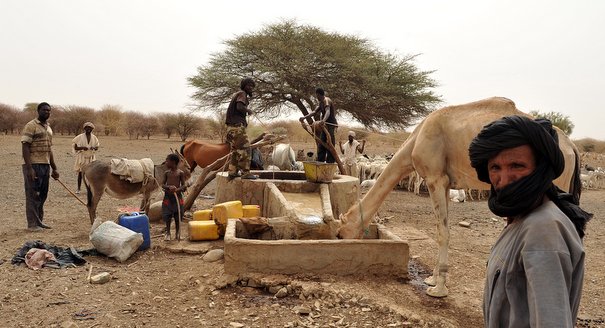
That might be changing as the European External Action Service, or E.E.A.S., an E.U. body led by Catherine Ashton, implements a new strategy toward, of all places, the Sahel, which includes Mali, Mauritania and Niger and is one of the poorest regions in the world. Drought and famine, drug and human trafficking, criminal gangs and weak states plague people there.
And to make matters worse, the expulsion of Al Qaeda from Afghanistan and the aftermath of the NATO operation against Libya last year have had a profoundly negative impact on the Sahel. “There is the possibility that Mali could become the next wellspring of instability and terrorist sanctuary in this part of Africa,” said Valentina Soria, a security expert at the Royal United Services Institute, an independent think tank in London. “The E.U. has a big stake in preventing this from happening.E.U. diplomats and regional experts also realize that if Al Qaeda and its offshoots establish footholds in the Sahel, they could use them as launch pads into Libya and other vulnerable post-Arab Spring countries. Eventually, the wave of terrorism could reach Europe.
The combination of these circumstances has forced the Union to think strategically about the Sahel. “What happens in the Sahel will have a huge impact on North African and Middle East countries,” said Barah Mikail, a regional expert at the Foundation for International Relations and Dialogue, an independent research center in Madrid. “It’s interesting how the E.U. is taking the Sahel very seriously.
When Al Qaeda was forced to leave Afghanistan in 2001 after the U.S. invasion, Western diplomats in the region have said, it relocated some operations to Yemen, but also to Mali, which analysts said was a strategic choice.
Ansar Dine, an Islamic fundamentalist group with close ties to Al Qaeda in the Islamic Maghreb, was quick to exploit the divisions inside the multiethnic country and the fallout from the Arab Spring. After the collapse of the Qaddafi regime in Libya, Tuareg mercenaries from northern Mali, Niger and Algeria, who had been in the pay of the late Muammar el-Qaddafi, returned home.
The influx of well-armed fighters into northern Mali gave the Tuareg separatist movement there such a lift that it managed to drive out the Malian military and, last month, proclaim an independent state called Azawad. The Tuareg nationalists, in spite of being a secular movement, then teamed up with the well-armed and well-financed Ansar Dine. This Islamist movement has since vowed to introduce Shariah law and ban all non-Muslim nongovernmental organizations.
Mali’s government has been unable to prevent the breakup of the country.
In March, the army staged a coup in the capital, Bamako, partly because it was frustrated that it had not been given sufficient resources to defeat the rebellion in the north. The military has since agreed to support an interim civilian government but is still very much in control, say E.U. diplomats.
No wonder that Mali’s neighbors — Mauritania to the west and Niger to the east — are extremely concerned about contagion, both by separatist movements and Ansar Dine.
Brigi Rafini, the prime minister of Niger, was in Brussels earlier this month to seek E.U. help. “Niger state institutions are simply not strong enough to cope with what is happening in Mali,” Mr. Mikail said.
France, the former colonial power in much of the Sahel, is deeply worried about the toxic mix of separatism and Islamic radicalization in the region.
In March, the French foreign minister at the time, Alain Juppé, was warned by Mali’s neighbors that the region risked becoming a “West African Afghanistan” if Ansar Dine gained control of the north.
With support from France, the Union has begun to look for ways to react to the events in Mali and prevent contagion.
It is trying to shore up the civilian government in southern Mali by distributing food and working with regional organizations like Ecowas, or the Economic Community of West African States, and the African Union. They are aghast at what is taking place in Mali and fear that it will spread, Mr. Mikail said.
E.E.A.S. diplomats say that distributing aid is only part of a longer-term strategy.
Only a regional, integrated and holistic strategy will enable us to make progress,” says the E.E.A.S. Strategy Report. But there is no quick fix, it acknowledges. It will need several years to tackle security and development and governance issues.
In the immediate future, beginning in August, the Union will establish a police training mission in Niger aimed at fighting terrorism and organized crime because Niger’s institutions are too weak.
Further steps will have to follow, analysts said. Europe cannot afford to ignore the new dangers of the Sahel or their implications for the wider world. At least, they add, the issue is finally getting some attention.
This article was originally published in the New York Times.

Nonresident Senior Fellow, Carnegie Europe
Judy Dempsey is a nonresident senior fellow at Carnegie Europe
Recent Work
Judy Dempsey
Judy Dempsey
Carnegie does not take institutional positions on public policy issues; the views represented herein are those of the author(s) and do not necessarily reflect the views of Carnegie, its staff, or its trustees.

The accord represents a pivotal moment in the region to avert a security vacuum in the Gulf.


Azeema Cheema, Mohanad Hage Ali

In an interview, Jason Burke discusses his sweeping account of the “revolutionists” who so shaped the 1970s and early 1980s.

Michael Young

By failing to address Palestinian representation, the current process is bound to lead to just another temporary arrangement.

Nathan J. Brown
There is a disturbing structural parallel between the old global energy economy and the new green transition.

Angie Omar

Just look at Iraq in 1991.

Marwan Muasher