• Research
  • Diwan
  • About
  • Experts
Carnegie Middle East logoCarnegie lettermark logo
LebanonIran
{
  "authors": [
    "Karim Sadjadpour"
  ],
  "type": "legacyinthemedia",
  "centerAffiliationAll": "dc",
  "centers": [
    "Carnegie Endowment for International Peace"
  ],
  "collections": [
    "Arab Awakening"
  ],
  "englishNewsletterAll": "menaTransitions",
  "nonEnglishNewsletterAll": "",
  "primaryCenter": "Carnegie Endowment for International Peace",
  "programAffiliation": "MEP",
  "programs": [
    "Middle East"
  ],
  "projects": [],
  "regions": [
    "Middle East",
    "Syria"
  ],
  "topics": [
    "Political Reform",
    "Foreign Policy"
  ]
}
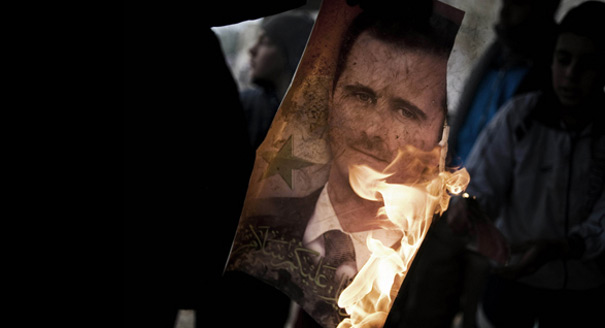
Source: Getty

In The Media

Chaos In Syria And Regional Implications

As violence continues to spiral out of control in Syria, the United States has begun to play a larger behind the scenes role in aiding the Syrian opposition.

Link Copied
By Karim Sadjadpour
Published on Jul 23, 2012

Source: NPR's Diane Rehm Show

As the battle for Aleppo becomes increasingly violent, government troops in Damascus have gone door to door in an effort to clear out the rebels in the capital. Violence continues to spiral out of control with the international community hesitating to take action, due to the complexity of the Syrian case. In recent days, rebels have stepped up guerrilla style attacks in urban areas and the Syrian army has responded with gunships and tanks. Speaking on the Diane Rehm Show, Carnegie's Karim Sadjadpour explained that over 3,000 people have been killed in July alone and the United States has begun working behind the scenes, along with Gulf States like Qatar and Saudi Arabia, to support the rebels.  Sadjadpour said “I think what the U.S. can do is to help the opposition help themselves, meaning helping them with ammunitions, with weapons, with information, with intelligence.” However, “there's very little appetite to have U.S. boots on the ground,” concluded Sadjadpour.

About the Author

Karim Sadjadpour

Senior Fellow, Middle East Program

Karim Sadjadpour is a senior fellow at the Carnegie Endowment for International Peace, where he focuses on Iran and U.S. foreign policy toward the Middle East.

    Recent Work
  • Q&A
    What’s Keeping the Iranian Regime in Power—for Now

      Aaron David Miller, Karim Sadjadpour, Robin Wright

  • Q&A
    How Washington and Tehran Are Assessing Their Next Steps

      Aaron David Miller, David Petraeus, Karim Sadjadpour

Karim Sadjadpour
Senior Fellow, Middle East Program
Karim Sadjadpour
Political ReformForeign PolicyMiddle EastSyria

Carnegie does not take institutional positions on public policy issues; the views represented herein are those of the author(s) and do not necessarily reflect the views of Carnegie, its staff, or its trustees.

More Work from Malcolm H. Kerr Carnegie Middle East Center

  • Commentary
    Diwan
    Syria Skirts the Conflict With Iran

    In an interview, Kheder Khaddour  explains that Damascus is trying to stabilize its borders, but avoiding war isn’t guaranteed. 

      Michael Young

  • people watching smoke rising at sunrise from rooftops
    Commentary
    Emissary
    Bombing Campaigns Do Not Bring About Democracy. Nor Does Regime Change Without a Plan.

    Just look at Iraq in 1991.

      Marwan Muasher

  • Commentary
    Diwan
    Axis of Resistance or Suicide?

    As Iran defends its interests in the region and its regime’s survival, it may push Hezbollah into the abyss.

      Michael Young

  • GCC foreign minister meeting in Kuwait City on June 2, 2025
    Article
    Can the Gulf Cooperation Council Transcend Its Divisions?

    Without structural reform, the organization, which is racked by internal rivalries, risks sliding into irrelevance.

      Hesham Alghannam

  • Commentary
    Diwan
    Iran and the New Geopolitical Moment

    A coalition of states is seeking to avert a U.S. attack, and Israel is in the forefront of their mind.

      Michael Young

Get more news and analysis from
Malcolm H. Kerr Carnegie Middle East Center
Carnegie Middle East logo, white
  • Research
  • Diwan
  • About
  • Experts
  • Projects
  • Events
  • Contact
  • Careers
  • Privacy
  • For Media
Get more news and analysis from
Malcolm H. Kerr Carnegie Middle East Center
© 2026 Carnegie Endowment for International Peace. All rights reserved.