

Commentary
Just look at Iraq in 1991.
Marwan Muasher
{
  "authors": [
    "Yan Xuetong"
  ],
  "type": "legacyinthemedia",
  "centerAffiliationAll": "",
  "centers": [
    "Carnegie Endowment for International Peace",
    "Carnegie China"
  ],
  "collections": [
    "U.S.-China Relations",
    "China’s Foreign Relations"
  ],
  "englishNewsletterAll": "",
  "nonEnglishNewsletterAll": "",
  "primaryCenter": "Carnegie China",
  "programAffiliation": "",
  "programs": [],
  "projects": [],
  "regions": [],
  "topics": [
    "Security"
  ]
}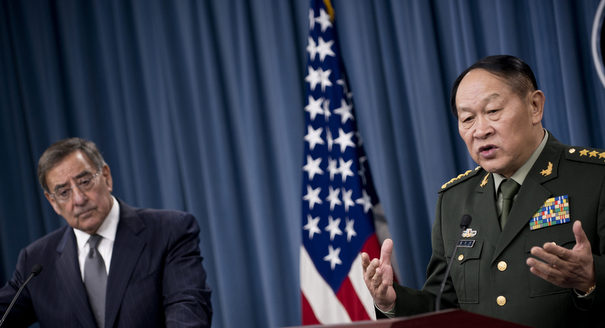
Source: Getty
In an effort to justify high defense budgets and military supremacy, the United States seems to be making an imaginary enemy out of China.
Source: CCTV
Speaking in Chinese on CCTV, Carnegie’s Yan Xuetong commented on the release of a report on the state of U.S. military power by the China Strategy Culture Promotion Association, the first time a Chinese NGO has issued a report on another country’s military power. Yan argued that the U.S. approach to security is through gaining a decided advantage in military power and that the U.S. Department of Defense needed to create an imaginary enemy in order to justify its proportionally high spending. The choice of China as an imaginary enemy, Yan added, can be seen as a reflection of the fact that China is indeed a rising power.

Yan Xuetong
Former President, Carnegie China Management Board, Carnegie-Tsinghua Center for Global Policy
Yan Xuetong was president of the Carnegie-Tsinghua Center Management Board until June 2020.
Carnegie does not take institutional positions on public policy issues; the views represented herein are those of the author(s) and do not necessarily reflect the views of Carnegie, its staff, or its trustees.

Just look at Iraq in 1991.

Marwan Muasher

Baku may allow radical nationalists to publicly discuss “reunification” with Azeri Iranians, but the president and key officials prefer not to comment publicly on the protests in Iran.

Bashir Kitachaev
In addressing Hezbollah’s disarmament, the Lebanese state must start by increasing its own leverage.

Michael Young
The country’s political and military establishment is still debating how to interpret the recent war’s outcome.

Nicole Grajewski
Spot analysis from Carnegie scholars on events relating to the Middle East and North Africa.

Mohanad Hage Ali