

Commentary
Nathan J. Brown
{
  "authors": [
    "Nathan J. Brown"
  ],
  "type": "legacyinthemedia",
  "centerAffiliationAll": "dc",
  "centers": [
    "Carnegie Endowment for International Peace",
    "Malcolm H. Kerr Carnegie Middle East Center"
  ],
  "collections": [
    "Arab Awakening"
  ],
  "englishNewsletterAll": "menaTransitions",
  "nonEnglishNewsletterAll": "",
  "primaryCenter": "Carnegie Endowment for International Peace",
  "programAffiliation": "MEP",
  "programs": [
    "Middle East"
  ],
  "projects": [],
  "regions": [
    "North Africa",
    "Egypt"
  ],
  "topics": [
    "Political Reform"
  ]
}
Source: Getty
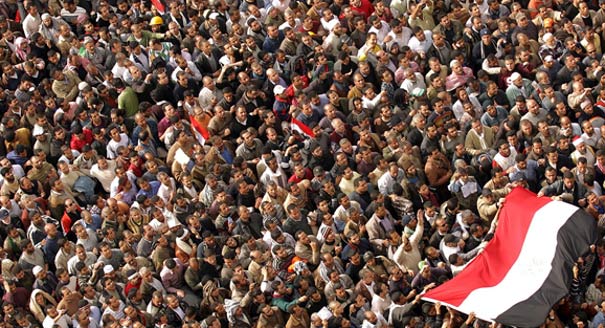
Constitutions are supposed to constitute political authority, but in Egypt, political authorities are helping draft the constitution from which they will draw their own future authority.
Source: Foreign Policy

But there has been another bargaining process that has drawn far less attention and commentary, even though much of it has been carried out in clear public view. Even those parts of this second process that have taken place behind closed doors still have left unmistakable footprints in the various drafts. And while not devoid of drama, the slightly quieter process seems more likely to produce successful outcomes. This is the bargaining among various structures of the Egyptian state.
The reason this second process -- every bit as important as the first -- has attracted less attention is because it cuts completely against the grain of most of our images of constitution writing. Few observers know to look for it. Constitutions are supposed to constitute political authority. They are written by the nation -- or at least by its representatives -- assembled; they are presented to the entire people for ratification. But in Egypt, political authorities are helping draft the constitution from which they will draw their own future authority.Of course, in the past, the reality in the Arab world has generally been that regimes have carefully written documents to serve their own purposes, mimicking only the forms of popular participation. In Egypt today, however, it is not the regime but significant and powerful state bodies -- often enjoying much more autonomy than they did under the old regime and partially freed of presidential domination -- that are stepping forward to instruct Egypt's drafters on what to say. Some such bodies (such as al-Azhar) have formal representatives in the Constituent Assembly, but others make their voices heard by directly negotiating with assembly leaders, airing their opinions in the press, issuing statements, and even occasionally suggesting that they might resort to strikes or demonstrations.
So the Egyptian Ministry of Defense has objected to a constitutional provision barring military trials of civilians. It remarkably described a draft clause as "unacceptable." The State Cases Authority -- a body that defends state agencies in litigation -- has noisily insisted on its designation as a judicial body. Senior military officers have resisted civilian oversight of the military budget; al-Azhar has informed the assembly that it wishes to have its independence guaranteed but does not wish to have its teachings and interpretations given more than moral force. The Supreme Constitutional Court has insisted that constitutional provisions not contradict the current law that makes the court a self-perpetuating body. Other judicial bodies have pressed their own demands. The Judges Club has threatened a strike unless it gets the clauses it wants.
It is as if the United States decided to write a new constitution and allowed the Federal Reserve Board, the FBI, the Joint Chiefs of Staff, the Government Printing Office, and the Federal Judicial Center all to draft provisions affecting their work.
What do these various state bodies want? They seek the first two thirds of what other Egyptians wanted when they demonstrated in the 2011 revolution for "Freedom, dignity, and social justice." The state actors want freedom or, more precisely, autonomy. They wish to know that they will be able to govern their own affairs, make their own judgments, appoint their own members, select their own leaders, and spend their budgets freed of the heavy hand of presidential control that weighed so much on them in the past. And they wish for autonomy from the parliament as well, mindful that the body will likely be a bit less pliable than the People's Assemblies that met under Mubarak and his predecessors.
The dignity that they seek is sometimes surprisingly important; it often takes the form of demanding a distinct constitutional article in an already busy and loquacious text. Sometimes the placement of a provision is important: military judges and members of the State Cases Authority wish to be mentioned in the chapter on the judiciary (with regular judges sometimes huffily insisting that such personnel are not their colleagues and belong elsewhere in the document). The Supreme Constitutional Court, by contrast, insists on maintaining the privilege it had in the 1971 constitution of having its own chapter, forcefully resisting inclusion in the judicial chapter.
The Constituent Assembly, named by an elected parliament and answering to the people (in the form of a referendum on its work), might be expected to dismiss such claims as chutzpahdik. But it does not, and that is not simply because the predominantly Islamist members do not know the word. The assembly in general, and the Muslim Brotherhood's Freedom and Justice Party (FJP) in particular, have found that reaching a bargain with such bodies is generally possible and the effects likely salutary.
Indeed, since Mohamed Morsi was elected in June, the president and the FJP have generally paid far more attention to their relations with important state actors than they have with the relatively feckless "civil" political forces who occupy a minority of seats in the Constituent Assembly. In August, Morsi found that he could carefully negotiate a relationship with senior generals; after overplaying his hand with some judicial actors he has generally backed off and opted for a similar approach.
The Brotherhood generally has no problem with these various bodies as institutions, though it is often very suspicious of leading individuals within their ranks (such as Prosecutor General Abd al-Magid Mahmud or Justice Tahaney al-Gabali of the Supreme Constitutional Court). Where full frontal confrontation does not work, therefore, time might be of assistance; the Brotherhood and the president likely hope that over the long term these institutions might gradually pass into more genial hands. Optimistic about how well politics has served them thus far, and sanguine about their electoral fortunes, Brotherhood leaders can easily see compromises with these state bodies as a small price to pay for a working constitution in which Islamists will play a leading role.
This is thus a cagey approach for the Brotherhood, but is it a good one for Egypt?
It may have some real short-term benefits, particularly given the untested nature of the coming constitutional order. In Egypt's emerging political system, the mechanisms of vertical accountability (popular oversight over officials through the electoral process) may provide only an Islamist echo, particularly if non-Islamists turn in another underwhelming performance in parliamentary balloting. Mechanisms of horizontal accountability -- in which various state bodies keep a check on each other -- might provide a good temporary stand-in to prevent presidential despotism.
But this is no long-term solution. It rests in part by awarding critical institutions more autonomy from external oversight than is appropriate in a democratic system. So the short-term problem may be too much autonomy for these bodies. Over the long-term, there may be the precise opposite problem: the autonomy of many bodies will rest on implementing legislation (for instance, the provisions for the Supreme Constitutional Court allow the current law to be maintained but do not prevent future changes in that law). A series of Islamist majorities might chip away at the freedom that state bodies now seem to think they may be achieving through the constitution.
So in the end, if things work badly, the result might look a bit more like the Mubarak regime than anyone now wants. Mubarak's authoritarianism was presidential and despotic to be sure, but it was not based on having the presidency micro-manage the affairs of various state bodies. Instead it was based on placing those bodies in reliable hands, coopting key members, and reining them in if they suddenly discovered ways to act too autonomously of presidential will.
If Egyptians are not careful they will slip back into that pattern. In the end, there is simply no substitute for healthy democratic competition.
This article originally appeared in Foreign Policy.

Nonresident Senior Fellow, Middle East Program
Nathan J. Brown, a professor of political science and international affairs at George Washington University, is a distinguished scholar and author of nine books on Arab politics and governance, as well as editor of five books.
Recent Work
Nathan J. Brown
Nathan J. Brown
Carnegie does not take institutional positions on public policy issues; the views represented herein are those of the author(s) and do not necessarily reflect the views of Carnegie, its staff, or its trustees.

The armed forces champion a form of capitalism that is generating revenue, but its reliance on rent faces diminishing returns, leaving the country with massive sunk costs and deferred returns, deepening dependency on external borrowing.

Yezid Sayigh

There is a disturbing structural parallel between the old global energy economy and the new green transition.

Angie Omar

This will be the region’s most representative tournament, amid broad changes in its footballing landscape.

Issam Kayssi
Understanding how farmers in the Oued Sahel-Soummam Valley grapple with climate change is essential for addressing the paradoxes through which adaptation, operating at both individual and institutional levels, deepens the region’s vulnerability and erodes the social fabric and agrarian identity that once defined life.
Ilyssa Yahmi
Cairo’s efforts send a message to the United States and the region that it still has a place at the diplomatic table.
Angie Omar