• Research
  • Diwan
  • About
  • Experts
Carnegie Middle East logoCarnegie lettermark logo
PalestineSyria
{
  "authors": [
    "Marina Ottaway"
  ],
  "type": "legacyinthemedia",
  "centerAffiliationAll": "dc",
  "centers": [
    "Carnegie Endowment for International Peace"
  ],
  "collections": [
    "Arab Awakening"
  ],
  "englishNewsletterAll": "menaTransitions",
  "nonEnglishNewsletterAll": "",
  "primaryCenter": "Carnegie Endowment for International Peace",
  "programAffiliation": "MEP",
  "programs": [
    "Middle East"
  ],
  "projects": [],
  "regions": [
    "Middle East",
    "Syria"
  ],
  "topics": [
    "Political Reform"
  ]
}
Source: Getty

In The Media

Syria Crisis: NATO Approves Patriot Missile Deployment

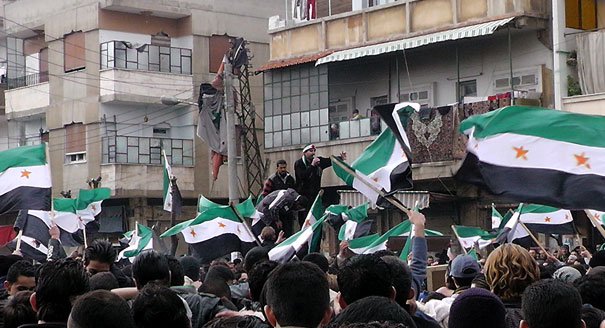
The recent NATO decision to deploy missiles along the Turkish-Syrian border has been framed in terms of a defense strategy for Turkey, but the same missiles could conceivably provide cover for refugees fleeing the violence.

Link Copied
By Marina Ottaway
Published on Dec 4, 2012

Source: BBC World News

The recent NATO decision to deploy missiles along the Turkish-Syrian border has been framed in terms of a defense strategy for Turkey. However, speaking with the BBC World News, Carnegie's Marina Ottaway noted that “as the situation worsens in Syria, these missiles could provide cover for refugees fleeing the violence.” While the Assad regime becomes increasingly threatened by the insurrection, it is difficult to judge what Assad will do. Many, including the Obama administration, are preparing for the possibility that the regime may use chemical weapons in some capacity. Despite the tenuous situation that the regime is in, the fractured nature of the opposition leaves the potential of a post-Assad era fraught with complications, Ottaway warned. “It is likely that we see a Libya-like situation with certain militias controlling certain areas, creating a situation where it is difficult to put together a cohesive political force,” concluded Ottaway.

About the Author

Marina Ottaway

Former Senior Associate, Middle East Program

Before joining the Endowment, Ottaway carried out research in Africa and in the Middle East for many years and taught at the University of Addis Ababa, the University of Zambia, the American University in Cairo, and the University of the Witwatersrand in South Africa.

    Recent Work

  • Article
    Reactions to the Syrian National Initiative

      Marina Ottaway, Omar Hossino

  • Article
    Slow Return to Normal Politics in Egypt

      Marina Ottaway

Marina Ottaway
Former Senior Associate, Middle East Program
Marina Ottaway
Political ReformMiddle EastSyria

Carnegie does not take institutional positions on public policy issues; the views represented herein are those of the author(s) and do not necessarily reflect the views of Carnegie, its staff, or its trustees.
More Work from Malcolm H. Kerr Carnegie Middle East Center

  • Commentary
    Diwan
    Axis of Resistance or Suicide?

    As Iran defends its interests in the region and its regime’s survival, it may push Hezbollah into the abyss.

      Michael Young

  • GCC foreign minister meeting in Kuwait City on June 2, 2025
    Article
    Can the Gulf Cooperation Council Transcend Its Divisions?

    Without structural reform, the organization, which is racked by internal rivalries, risks sliding into irrelevance.

      Hesham Alghannam

  • Commentary
    Diwan
    Kurdish Nationalism Rears its Head in Syria

    A recent offensive by Damascus and the Kurds’ abandonment by Arab allies have left a sense of betrayal.

      Wladimir van Wilgenburg

  • Commentary
    The Middle East’s Promising Gen Z

    Fifteen years after the Arab uprisings, a new generation is mobilizing behind an inclusive growth model, and has the technical savvy to lead an economic transformation that works for all.

      Jihad Azour

  • Commentary
    Carnegie Politika
    Baku Proceeds With Caution as Ethnic Azeris Join Protests in Neighboring Iran

    Baku may allow radical nationalists to publicly discuss “reunification” with Azeri Iranians, but the president and key officials prefer not to comment publicly on the protests in Iran.

      Bashir Kitachaev

Get more news and analysis from
Malcolm H. Kerr Carnegie Middle East Center
Carnegie Middle East logo, white
  • Research
  • Diwan
  • About
  • Experts
  • Projects
  • Events
  • Contact
  • Careers
  • Privacy
  • For Media
Get more news and analysis from
Malcolm H. Kerr Carnegie Middle East Center
© 2026 Carnegie Endowment for International Peace. All rights reserved.