

Commentary
Dmitri Trenin
{
  "authors": [
    "Dmitri Trenin"
  ],
  "type": "legacyinthemedia",
  "centerAffiliationAll": "",
  "centers": [
    "Carnegie Endowment for International Peace",
    "Carnegie Russia Eurasia Center"
  ],
  "collections": [],
  "englishNewsletterAll": "",
  "nonEnglishNewsletterAll": "",
  "primaryCenter": "Carnegie Russia Eurasia Center",
  "programAffiliation": "",
  "programs": [],
  "projects": [],
  "regions": [
    "Russia"
  ],
  "topics": [
    "Foreign Policy"
  ]
}
Source: Getty
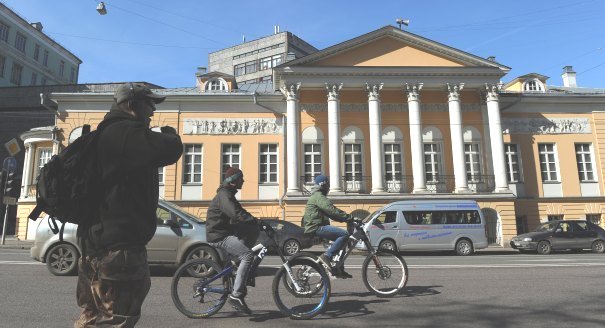
Enhancing Russia’s soft power is one of the Kremlin’s goals. However, Russia’s image in the world is often negative, and, to be really attractive, Russia will need to change.
Source: Global Times
For many Russians, the notion of soft power was once something of an oxymoron, like icy fire. Yet, watching the success of the US and the EU in getting others to want what the Americans and Europeans have to offer, they changed their minds and even sought to imitate their competitors' performance.
Now, enhancing Russia's soft power is one of the tasks the Kremlin has given to its Ministry of Foreign Affairs. In addition, a special agency for international cooperation has been created with the specific mission of reaching that goal.
The bitter irony is that despite all its efforts and the money spent, Russia's image in the world is currently much worse than the actual situation in the country warrants. In the West, this image is plainly disastrous.This was not always the case. Soviet Russia was once attractive to many Western left-leaning intellectuals, as well as social modernizers from the rest of the world. Post-Communist Russia, by contrast, inspired few admirers. Its 1991 democratic revolution first produced near-chaos, which earned Russia the sobriquet of the "wild East," and was later followed by stabilization along the lines of soft authoritarianism.
In the Western popular imagination, the Mafiosi of the Yeltsin eras were succeeded by the spooks of Vladimir Putin. Crucially, Russia has failed to develop its economy beyond natural resources, so even when it started to grow, thanks to the surge in energy prices in the 2000s, it was dismissed as "Nigeria with snow," hardly a significant improvement over its late-Cold War title of an "Upper Volta with missiles."
To fight that image, the Russian government used money, its preferred means of dealing with problems. It employed some Western PR firms, always open for business when someone is paying.
Russia has won the right to host a number of prestigious political and sports events: the G20 and the Universiade games in 2013, the Winter Olympics and the G8 in 2014, and the World Soccer Cup in 2018, to name but a few. Its TV channel, RT, has won a tiny niche on the Western news market.
Yet, Western opinion about Russia has grown even more negative. China at least is credited with some obvious successes; Russia is utterly discredited, even reviled.
In part, this is the result of Western disappointment with Russian domestic politics and Moscow's foreign policy.
Domestically, the Kremlin, under Putin, stubbornly insists on the continued need for a version of traditional Russian autocracy, and asserts itself in the face of disorganized, yet vocal Western-friendly opposition.
Internationally, the Russian government openly opposes a range of US-led policies on foreign intervention and is not shy to use its veto power at the UN.
Russia's problem is not only or even mainly that its soft power is peddled by the government. It is, more sadly, that there is just too little of it at the present moment. Russian values, once so eloquently and sincerely propagated by such titans as Tolstoy and Chekhov, are now largely quoted in dollars and cents.
Russia's universities, once famous for their science and engineering, are still struggling in the middle of an education reform, and rank poorly in global ratings. Russia's high culture finds it harder to compete in a world increasingly dominated by mass culture, and Russia's own efforts at mass culture mostly fall short of their US prototypes.
Yet Russian soft power does exist, even today. Millions of immigrant workers from Central Asia, the Caucasus and the new Eastern Europe flock to Russia, where they can find much better wages than at home. Most books sold in Kiev and Odessa are still in Russian, even though Ukrainian has been the only official language there for two decades.
In Estonia and Poland, two countries well outside the Kremlin's orbit, the demand for Russian speakers has been growing, in view of increasing business demand.
For those in the West willing to take risks and capable of using connections, Russia remains an attractive proposition for making money. Putin may have a hard time with Western leaders, but he visibly enjoys the company of top Western CEOs.
This is not enough, to be sure. To be really attractive, Russia will need to change. It would need to rediscover and then modernize its age-old values, such as a sense of justice and a feeling of solidarity, to complement the rule of law, which is yet to be built, and to rein in the asocial individualism of the recent years.
It would need to be what it preaches, and reduce corruption from its current pathological levels. It would need to use the talent of its people to innovate and come up with new ideas able to capture attention beyond its borders, but first it would need to unchain and promote that talent.
The Russian people are both freer and more affluent today than at any time in their long history. They also are gradually awakening, with happy and complacent consumers turning into angry and active citizens. Today's Russia is no match for the US and Europe in terms of soft power. But tomorrow is another day.
Former Director, Carnegie Moscow Center
Trenin was director of the Carnegie Moscow Center from 2008 to early 2022.
Recent Work
Dmitri Trenin
Dmitri Trenin
Carnegie does not take institutional positions on public policy issues; the views represented herein are those of the author(s) and do not necessarily reflect the views of Carnegie, its staff, or its trustees.

A coalition of states is seeking to avert a U.S. attack, and Israel is in the forefront of their mind.

Michael Young

Baku may allow radical nationalists to publicly discuss “reunification” with Azeri Iranians, but the president and key officials prefer not to comment publicly on the protests in Iran.

Bashir Kitachaev
The country’s leadership is increasingly uneasy about multiple challenges from the Levant to the South Caucasus.

Armenak Tokmajyan
The countries of the region have engaged in sustained competition that has tested their capacities and limitations, while resisting domination by rivals. Can a more stable order emerge from this maelstrom, and what would it require?

Hamza Meddeb, Mohamed Ali Adraoui
As Washington reduces its presence in the country, the success of its withdrawal and continued containment of the Islamic State will hinge on adopting an approach of flexible oversight built around three priorities, as well as balancing Turkish and Israeli red lines.


Kheder Khaddour, Issam Kayssi