

Research
- +5
Alper Coşkun, Fatih Ceylan, Tacan İldem, …
{
  "authors": [
    "Sinan Ülgen"
  ],
  "type": "legacyinthemedia",
  "centerAffiliationAll": "",
  "centers": [
    "Carnegie Endowment for International Peace",
    "Carnegie Europe",
    "Malcolm H. Kerr Carnegie Middle East Center"
  ],
  "collections": [
    "Turkey’s Transformation",
    "Arab Awakening"
  ],
  "englishNewsletterAll": "",
  "nonEnglishNewsletterAll": "",
  "primaryCenter": "Carnegie Europe",
  "programAffiliation": "",
  "programs": [],
  "projects": [],
  "regions": [
    "Middle East",
    "Europe",
    "Türkiye"
  ],
  "topics": [
    "Political Reform",
    "Civil Society"
  ]
}
Source: Getty
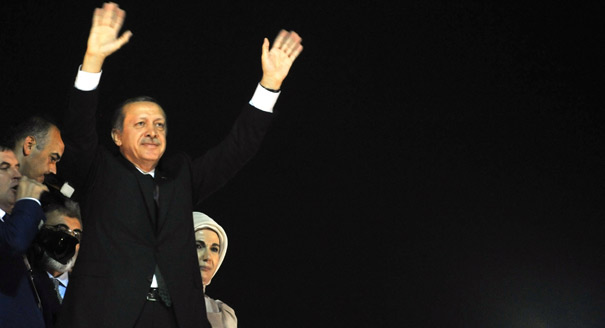
Turkish Prime Minister Erdogan's shallow interpretation of democracy is the root of his current problems.
Source: European voice
What started as a small and localized gathering to prevent a public park in the center of Istanbul from being turned into yet another shopping mall has now been transformed into the most widespread protest movement witnessed in Turkey. Within days, protests spread from Istanbul to many other Turkish provinces. The protesters represent a liberal coalition including NGO activists, seculars, Kurdish activists, university professors, opposition parties, youth and football club supporters. What unites them is not ideology but a common exasperation with the Turkish Prime Minister Recep Tayyip Erdogan's majority rule.
Over the past decade, Erdogan has overseen a radical transformation of Turkey. He has greatly extended Turkey's influence regionally and in global affairs based on the economy's sustainable and inclusive growth. He has also moved Turkey towards the norms of a better democracy by bringing the military under civilian control and by passing a series of democratic reforms that extended individual freedoms. Yet most of these accomplishments were in the first decade of the millenium.
After the 2011 elections, when he won almost 50% of the popular vote, Erdogan became increasingly authoritarian. He started to act as if this large popular mandate were sufficient for his government to adopt laws without giving any serious consideration to opposing views. This fetishism of the national will which tends to discount minority views, has come to characterise his style of governance. He has started to be viewed as a leader willing to impose his own stiflingly conservative world view on Turkish society.A case in point is a recent law that severely limits the sale and consumption of alcohol. The law was put forward and adopted within two weeks, allowing little room for a nationwide debate.
Erdogan defended these restrictions by referring to religious precepts, fuelling the angst of Turkey's secular constituency. He then stated that those who want to drink should do it at home.
At the core of the current tension is Erdogan's belief that in a country that has free and fair elections, any disaffection with the government's policies should be articulated through the ballot box. This rather shallow interpretation of democracy is problematic for a large section of Turkish society. For the Taksim protesters, the right to peaceful dissent is an inalienable part of any modern democracy. As important as elections may be, a democracy cannot be reduced to nothing more than elections.
Erdogan's political success has much to do with his pragmatism. He has demonstrated in the past that he can be pragmatic. He is currently the only person in Turkey that can defuse this conflict. He only needs to empathise with the core arguments of the protesters and state that he will be more inclusive in future policymaking. He has, however, opted for further polarisation, believing that he can subdue the protest movement.
With the imminent prospect of a chapter of the EU accession negotiations being opened after a hiatus of 36 months, the European Union is faced with a hard choice. An intergovernmental conference scheduled for 26 June is expected to give the go-ahead for the opening of the chapter on regional policy. That will be the 14th chapter to be opened for negotiations with a country that started talks on the same day as Croatia, which will join the EU on 1 July. Currently, no chapters can be closed because of differences over Cyprus.
Despite the prospect of a prolonged crisis between the Turkish government and a sizeable domestic constituency intent on safeguarding its right to peaceful dissent, the EU should open this new chapter. This elusive opportunity for a new momentum in the Turkey-EU relationship should not be squandered.
But at the same time, Brussels should make it clear that this decision is not to be construed as unconditional support for the Turkish government. In particular, EU leaders should stress that European democracies should consolidate the right to peaceful dissent as a core feature of their system of governance. That is likely to be a message that will resonate beyond the Bosphorus.
This article was originally published in the European Voice.

Senior Fellow, Carnegie Europe
Sinan Ülgen is a senior fellow at Carnegie Europe in Brussels, where his research focuses on Turkish foreign policy, transatlantic relations, international trade, economic security, and digital policy.
Recent Work

Alper Coşkun, Fatih Ceylan, Tacan İldem, …
Carnegie does not take institutional positions on public policy issues; the views represented herein are those of the author(s) and do not necessarily reflect the views of Carnegie, its staff, or its trustees.

As the U.S. stumbles in its war with Iran, we are likely to see an acceleration of its disengagement from the region.

Michael Young

The accord represents a pivotal moment in the region to avert a security vacuum in the Gulf.


Azeema Cheema, Mohanad Hage Ali

In an interview, Jason Burke discusses his sweeping account of the “revolutionists” who so shaped the 1970s and early 1980s.
Michael Young
This will be the region’s most representative tournament, amid broad changes in its footballing landscape.
Issam Kayssi

Just look at Iraq in 1991.

Marwan Muasher