

Commentary
Dmitri Trenin
{
  "authors": [
    "Dmitri Trenin"
  ],
  "type": "commentary",
  "centerAffiliationAll": "",
  "centers": [
    "Carnegie Endowment for International Peace",
    "Carnegie Russia Eurasia Center"
  ],
  "collections": [],
  "englishNewsletterAll": "",
  "nonEnglishNewsletterAll": "",
  "primaryCenter": "Carnegie Russia Eurasia Center",
  "programAffiliation": "",
  "programs": [],
  "projects": [],
  "regions": [],
  "topics": []
}
Source: Getty
Norwegians are anything but paranoid about Russia. Rather than dealing in stereotypes, they are engaged in deep and extensive research of their neighbor.
There are not so many countries in Europe where a strong interest in Russia survives. Norway is one of them. During the period of the Cold War, clearly, the Norwegians feared a Soviet invasion. They joined NATO immediately, but then did not allow permanent stationing of U.S. forces in their territory and did not hold military exercises close to the Soviet border. Like in neighboring Sweden, much of its foreign policy elite still speak Russian, having done compulsory military service and received excellent language training from the Army.
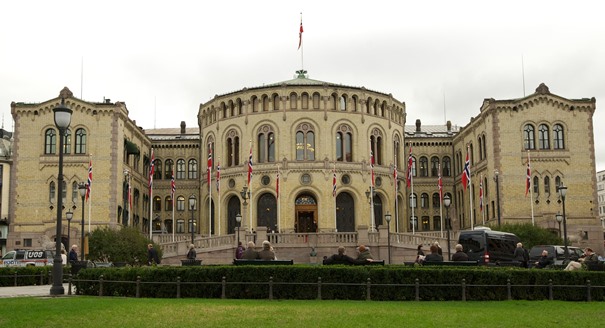
Since the end of the confrontation era, Norway has been a loyal and active NATO ally, participating in a number of out-of-area missions, including Afghanistan and Libya. Not only has conscription been maintained; last June, the Norwegian Parliament voted to extend draft to women: the first European country to do so. Even though the communist threat is no more, and the Russian military forces are dramatically reduced in comparison to the Cold War, old fears take a long time dying. A new ten-episode series, called “Occupied” and based on the original idea by Jo Nesbo, Norway’s top-selling author, would depict life in the country after Russia had invaded it to grab its oil. An ad poster has the Russian tricolor waving from atop the Royal palace in Oslo.
Yet, Norwegians are anything but paranoid about Russia. Rather than dealing in stereotypes, they are engaged in deep and extensive research of their neighbor. NUPI, the Norwegian Institute of International Affairs, has just held its 18th annual conference on Russia, attended by about 200 people, which would be huge for any world capital, not just for Oslo (pop.: 600,000). Obviously, Norway is most interested in the development of Russia’s north-western provinces, which, alongside Scandinavia, are part of Europe’s North. Its interest, however, does not stop there. It includes the Arctic; navigation prospects along the Northern Sea Route; and Russia’s relations with China.
Russian-Norwegian relations received a positive boost three years ago, when Moscow offered to end the 40-year-old dispute over part of the Barents Sea by dividing the area equally between the two countries. The Norwegians then followed with interest the evolving relationship between Rosneft and ExxonMobil in the Arctic, and hope that Statoil, too, can get into play. A senior Rosneft executive has just visited the country to discuss cooperation. Despite the fresh memories of disappointment over the gigantic Shtokman gas field, now put on hold, Statoil is eager to do business with the Russians.
At a more mundane level, Russia has become the biggest foreign market for Norwegian fish products, and Russian tourists come in droves to the Fram polar exploration ship museum. And the only foreign military personnel in uniform to be seen these days in Karl-Johan’s gate, Oslo’s elegant downtown boulevard, were Germans. The Royal palace overlooking the street was waving the King’s standard.
Former Director, Carnegie Moscow Center
Trenin was director of the Carnegie Moscow Center from 2008 to early 2022.
Recent Work
Dmitri Trenin
Dmitri Trenin
Carnegie does not take institutional positions on public policy issues; the views represented herein are those of the author(s) and do not necessarily reflect the views of Carnegie, its staff, or its trustees.