

Article
C. Raja Mohan, Darshana M. Baruah
{
  "authors": [
    "C. Raja Mohan"
  ],
  "type": "legacyinthemedia",
  "centerAffiliationAll": "dc",
  "centers": [
    "Carnegie Endowment for International Peace",
    "Carnegie India",
    "Malcolm H. Kerr Carnegie Middle East Center"
  ],
  "collections": [],
  "englishNewsletterAll": "ctw",
  "nonEnglishNewsletterAll": "",
  "primaryCenter": "Carnegie India",
  "programAffiliation": "SAP",
  "programs": [
    "South Asia"
  ],
  "projects": [],
  "regions": [
    "North America",
    "United States",
    "Middle East",
    "Iran",
    "South Asia",
    "India",
    "Pakistan"
  ],
  "topics": [
    "Foreign Policy",
    "Global Governance"
  ]
}
Source: Getty
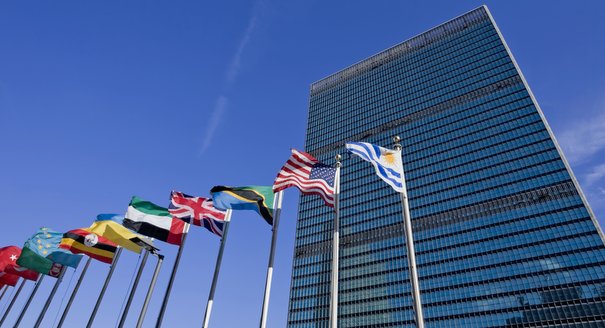
As the UN Security Council grapples with getting control of Syria’s chemical weapons, two meetings in New York will draw considerable attention in the subcontinent and around the world.
Source: Indian Express
What happens on the margins of the United Nations is often as important as the proceedings inside it. As the UN Security Council grapples with getting control of Syria's chemical weapons, two meetings in New York next week will draw considerable attention in the subcontinent and the world.
In India the focus will be on whether Prime Minister Manmohan Singh will sit down with his Pakistani counterpart, Nawaz Sharif on the sidelines of the annual jamboree of the UN General Assembly.The world beyond the subcontinent, however, is excited by the prospect of a diplomatic encounter between the U.S. President Barack Obama and the newly elected Iranian President Hassan Rouhani.
Although Delhi has not confirmed the meeting with Sharif, it is entirely reasonable to expect that it will take place; for Dr. Singh is so invested in the relationship with Pakistan since he became India's Prime Minister nearly a decade ago.
In contrast, there is still uncertainty over the meeting between Obama and Rouhani. There have been no face-to-face talks between the presidents of the two nations since Iran's Islamic Revolution in 1979.
Will it be a mere hand-shake and exchange of greetings in the corridor? Might Obama and Rouhani have a 'pull aside' conversation? Could there be a formal sit-down? That there is so much speculation, some of it encouraged by the White House, suggests some diplomatic spade work has already taken place.
It has now been confirmed that Obama and Rouhani have exchanged letters in the last few weeks. There have also been reports about Sultan Qaboos of Oman acting as a helpful communication channel between Washington and Tehran.
Early on in his first term, Obama said he is ready to extend a hand of friendship to Iran if Tehran had unclinched its fist. But political conditions in Washington and Tehran did not permit forward movement. The election of Rouhani has clearly changed the dynamics.
Rouhani has hinted at flexibility in Iran's position in the stalled nuclear negotiations with the international community. He apparently has the support of Iran's Supreme Leader, Ayatollah Ali Khamenei, to explore a potential nuclear accommodation with Washington.
It is widely held that America and Iran are locked in a 'permanent hostility' and a reconciliation is impossible. That is also the common perception of India-Pakistan relations.
Singh had boldly tried to break this paradigm, but appears to have lost his nerve in recent months and has tied himself into political knots on meeting Sharif, who had articulated a forward looking vision for relations with India.
No one expects that the meetings between the two sets of leaders will produce big political breakthroughs. But few will disagree with the proposition that even brief conversations between them two sets of leaders could be consequential.
Dr. Singh has an opportunity next week to explore, with Sharif, the prospects for ending the current stalemate in peace process. Obama could take the first step along with Rouhani in the long journey towards normalising U.S.-Iran relations.
But both Dr. Singh and Obama could yet be tripped up by conservatives in both capitals, who could either scuttle the meetings or significantly limit their scope.
This article was originally published in the Indian Express.
Former Nonresident Senior Fellow, Carnegie India
A leading analyst of India’s foreign policy, Mohan is also an expert on South Asian security, great-power relations in Asia, and arms control.
Recent Work

C. Raja Mohan, Darshana M. Baruah


Alexander Gabuev, Paul Haenle, C. Raja Mohan, …
Carnegie does not take institutional positions on public policy issues; the views represented herein are those of the author(s) and do not necessarily reflect the views of Carnegie, its staff, or its trustees.

Huawei pushed hard to enter the Egyptian data centers market, until the Americans made a better offer.

Angie Omar

Middle Eastern states should welcome an accelerated U.S. disengagement from their region.

Michael Young

In an interview, former ambassador Charles Freeman assesses the Trump administration’s war against Iran.
Michael Young

The accord represents a pivotal moment in the region to avert a security vacuum in the Gulf.


Azeema Cheema, Mohanad Hage Ali
In an interview, Jason Burke discusses his sweeping account of the “revolutionists” who so shaped the 1970s and early 1980s.
Michael Young