

In The Media
Lilia Shevtsova
{
  "authors": [
    "Lilia Shevtsova"
  ],
  "type": "commentary",
  "centerAffiliationAll": "",
  "centers": [
    "Carnegie Endowment for International Peace",
    "Carnegie Russia Eurasia Center"
  ],
  "collections": [],
  "englishNewsletterAll": "",
  "nonEnglishNewsletterAll": "",
  "primaryCenter": "Carnegie Russia Eurasia Center",
  "programAffiliation": "",
  "programs": [],
  "projects": [],
  "regions": [
    "Russia",
    "Eastern Europe",
    "Ukraine",
    "Western Europe"
  ],
  "topics": [
    "Foreign Policy"
  ]
}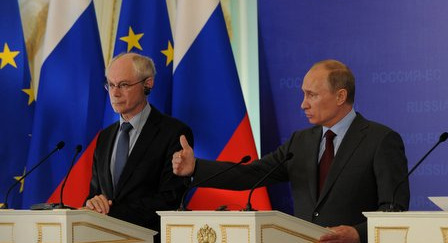
Source: Getty
The Russia-EU summits are basically a relic of the 1990’s when there was still hope to integrate Russia into Europe’s normative framework. Now it is high time to end the protocol routine and move on to expert negotiations on specific issues.
Some events conjure up an association with a suitcase that one does not want to carry but does not dare to put down either. The metaphor aptly describes the Russia-EU summit, as well G8 and G20 gatherings. I am not trying to say that there is no need for ongoing dialogue between the two entities whose total trade volume amounts to $92 billion. There are a lot of unresolved and even contentious issues in Russia-EU relations—energy, trade and visa regime are just some of them. But let the experts from both sides discuss these issues in their standing committees. Why make political circus with a lot of fanfare? Why should the European and Russian leaders gather twice a year, look at each other’s poker face and once again realize that they cannot come to any agreement, only irritating each other instead? Why every time before another summit begins—that is twice a year!—should they rack their brain in search of the summit’s agenda, trying to conceal from the world how much time they are wasting? After all, every recent summit has merely imitated tangible outcomes, getting worse with each imitation.
The Russia-EU summits are basically a relic of the 1990’s when there was still hope to integrate Russia into Europe’s normative framework. Brussels and Moscow have met numerous times, working on the roadmaps for Russia’s integration. But while the hopes for integrating Russia into Europe are long gone, the two bureaucratic machines keep on working. The Strategic Partnership model quietly disappeared; the same fate befell the Partnership for Modernization—the project Germany created specifically for the Medvedev presidency. Meanwhile, the summits endure, and their participants are facing an increasingly difficult task of proving their usefulness.
It is getting even harder today after the Kremlin proclaimed its doctrine of containing the West while promoting “traditional values” as an alternative to the rotten liberal democracy. Besides, the Kremlin is constructing its own integration model—the Eurasian Union, which will be another alternative to Europe. Moscow has demonstrated its intentions by its all-out struggle for Ukraine, demanding that Kiev refuse to sign the Association Agreements with the EU. Let us give the Kremlin its due—it has stopped pretending. But the European leaders still cannot stop their “Let’s pretend” game, making believe that there is no dispute with Russia, and Ukraine can join both integration formats. But didn’t Moscow clearly show them that this is wrong?!
In this context, continuing the tradition of biannual summits only demonstrates the pathetic state of the relationship.
And I am not even talking about tons of contentious issues between the two sides. One such an issue is the Third Energy Package, which in Europe’s view should apply to Gazprom—but Moscow thinks otherwise. Another contentious issue is the visa regime. Moscow hoped that the agreement on visa liberalization would be signed at the last year summit in Yekaterinburg, but the EU refused. Thus, the summit was a failure. There is no reason to believe that the new summit will somehow be more successful.
The Russia-EU summit scheduled for January 2014 was originally supposed to take place in December 2013. But it was postponed until the next year—I think, much to the joy of the European leadership. As if that changes anything! Perhaps it was done to give both sides a chance to think long and hard about the agenda that would justify the need for “carrying the suitcase.” And just to confirm that they have no more breakthrough ideas left, this summit will be themed around science. Looks like a worthy subject to discuss, doesn’t it? 440 Russian institutions participate in 264 grant agreements on technological cooperation totaling $60 million euro. But for some reason, the cooperation has yielded no results so far. Actually, where will these results come from when science and technology is such a marginal sphere in Russia that Russian scientists are well on their way to becoming extinct? Unless, of course, they work for the military-industrial complex. And how can Europe help Russia if the Russian regime is not interested in science? The Kremlin has recently driven the Russian Academy of Sciences to its grave. Not even communism could do that! Besides, as in other areas of cooperation between Russia and the EU, the main receivers of the science grants are institutions affiliated with the state. Just this fact makes scientific cooperation between Russia and the EU futile.
Of course, the agonizing discussions about visa exchange will continue at the summit as well. At some point, Moscow startled the EU by proposing visa-free travel between Russia and the EU countries. It seems like Russians should be happy that their government wants them to travel to Europe freely. But let us not jump to conclusions. The Kremlin asked for visa-free travel as it set out to contain the West and started building its own integration model. Moreover, the Kremlin asks that the visa requirement first be lifted for the so-called service passport holders, i.e. for the second echelon of the Russian elite. The Kremlin thinks that students and civil society representatives can wait, and there are no guarantees that the government will insist that the visa-free travel also apply to this category of Russian citizens. What for? God forbid they bring virulent ideology home from Europe. Actually, asking Brussels for visa-free travel after proclaiming that Russia is another civilization is an example of quite original thinking indeed. Anyway, there is no reason to believe that a compromise on this subject will be reached.
Clearly, no one at the summit will feel comfortable—especially following the struggle for Ukraine. Unless the EU leaders are secretly grateful to Moscow for sparing them Ukraine-related headaches that would have occurred if President Viktor Yanukovych had actually signed the agreement.
In any event, another Russia-EU summit will be an expensive spectacle with a predetermined finale. It is high time to end this routine and move on to expert negotiations on specific issues. These negotiations will be hard, and they are not very likely to succeed, considering the differences in Russian and European trajectories. However, they will cost less and spare us this humiliating act.
Former Senior Associate, Russian Domestic Politics and Political Institutions Program, Moscow Center
Shevtsova chaired the Russian Domestic Politics and Political Institutions Program at the Carnegie Moscow Center, dividing her time between Carnegie’s offices in Washington, DC, and Moscow. She had been with Carnegie since 1995.
Recent Work
Lilia Shevtsova
Lilia Shevtsova
Carnegie does not take institutional positions on public policy issues; the views represented herein are those of the author(s) and do not necessarily reflect the views of Carnegie, its staff, or its trustees.

By failing to address Palestinian representation, the current process is bound to lead to just another temporary arrangement.

Nathan J. Brown

Just look at Iraq in 1991.

Marwan Muasher

A coalition of states is seeking to avert a U.S. attack, and Israel is in the forefront of their mind.

Michael Young

Baku may allow radical nationalists to publicly discuss “reunification” with Azeri Iranians, but the president and key officials prefer not to comment publicly on the protests in Iran.

Bashir Kitachaev
The country’s leadership is increasingly uneasy about multiple challenges from the Levant to the South Caucasus.

Armenak Tokmajyan