

Article
Frederic Grare
{
  "authors": [
    "Frederic Grare"
  ],
  "type": "other",
  "centerAffiliationAll": "dc",
  "centers": [
    "Carnegie Endowment for International Peace"
  ],
  "collections": [],
  "englishNewsletterAll": "ctw",
  "nonEnglishNewsletterAll": "",
  "primaryCenter": "Carnegie Endowment for International Peace",
  "programAffiliation": "SAP",
  "programs": [
    "South Asia"
  ],
  "projects": [],
  "regions": [
    "South Asia",
    "Afghanistan"
  ],
  "topics": [
    "Security",
    "Military"
  ]
}
Source: Getty
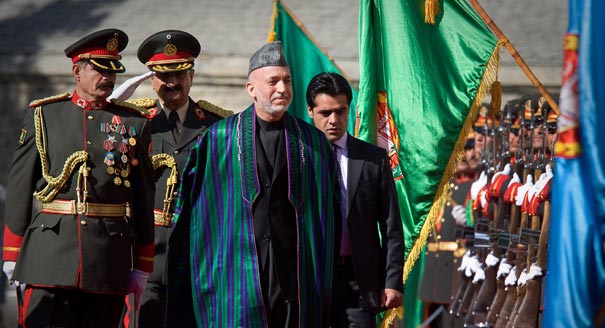
As the withdrawal of U.S. and NATO forces from Afghanistan approaches, anxieties about the future of the country have increased.
Source: The German Marshall Fund and the Foundation for Strategic Research
As the withdrawal of U.S. and NATO forces from Afghanistan approaches, anxieties about the future of the country have increased. A palpable sense of pessimism has come to characterize thinking about the Afghan situation in the West, as well as in Afghanistan and among its neighbors. What will happen in Afghanistan and the region when the transition is completed? How will the domestic situation evolve? How will the regional position themselves? What will the impact of the resulting outcome on Western security and solidarity be? These questions and others loom large in considering the future of Afghanistan and its potential impact on regional and international dynamics.
There are no simple answers to these questions; mapping the future of Afghanistan is indeed a complex task. The number of Afghan and non-Afghan actors, their competing interests and fluctuating alliances, and the lack of a cohesive vision for the country's political future makes it difficult, if not impossible, to predict clear scenarios beyond a certain level of generality.This paper analyzes the evolution of four main variables or categories of variables: 1) the readiness of the Afghan National Security Forces (ANSF) to assume responsibility for Afghanistan's security post-2014; 2) the policies of regional actors, especially Pakistan; 3) the role of the United States; a 4) Afghanistan's political system. The paper argues that the latter will ultimately be the decisive factor, as it will condition the sustainability of existing Afghan institutions, including the ANSF, or constrain the external factors. The paper concludes that the future of Afghanistan will likely fall between a "muddle through" scenario where a partly dysfunctional Afghan state will struggle to survive, and a situation of chaos in which all significant state authority will have disappeared and where Afghanistan as a nation is only a loose confederation of fiefdoms. It then examines the potential impact of these variables in the post-2014 era and concludes that Afghanistan is likely to remain a significant security concern for years.
Former Nonresident Senior Fellow, South Asia Program
Frédéric Grare was a nonresident senior fellow at the Carnegie Endowment for International Peace, where his research focuses on Indo-Pacific dynamics, the search for a security architecture, and South Asia Security issues.
Recent Work
Frederic Grare
Frederic Grare
Carnegie does not take institutional positions on public policy issues; the views represented herein are those of the author(s) and do not necessarily reflect the views of Carnegie, its staff, or its trustees.

The armed forces champion a form of capitalism that is generating revenue, but its reliance on rent faces diminishing returns, leaving the country with massive sunk costs and deferred returns, deepening dependency on external borrowing.

Yezid Sayigh

Just look at Iraq in 1991.

Marwan Muasher

Baku may allow radical nationalists to publicly discuss “reunification” with Azeri Iranians, but the president and key officials prefer not to comment publicly on the protests in Iran.

Bashir Kitachaev

In addressing Hezbollah’s disarmament, the Lebanese state must start by increasing its own leverage.

Michael Young
The country’s political and military establishment is still debating how to interpret the recent war’s outcome.

Nicole Grajewski