

Commentary
Dmitri Trenin
{
  "authors": [
    "Dmitri Trenin"
  ],
  "type": "legacyinthemedia",
  "centerAffiliationAll": "",
  "centers": [
    "Carnegie Endowment for International Peace",
    "Carnegie Russia Eurasia Center"
  ],
  "collections": [],
  "englishNewsletterAll": "",
  "nonEnglishNewsletterAll": "",
  "primaryCenter": "Carnegie Russia Eurasia Center",
  "programAffiliation": "",
  "programs": [],
  "projects": [],
  "regions": [
    "North America",
    "United States",
    "Russia",
    "Eastern Europe",
    "Ukraine",
    "Western Europe"
  ],
  "topics": [
    "Security",
    "Global Governance",
    "Foreign Policy"
  ]
}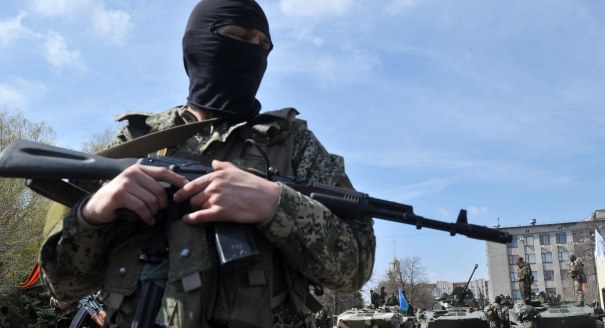
Source: Getty
If Ukraine is allowed to break up, or made to do so, Russia and the West will spin into a confrontation from which both will emerge the losers. Both sides need to keep Ukraine whole.
Source: Financial Times
Western suspicions that Russia is following the “Crimea playbook” in eastern Ukraine are way off the mark. To begin with, President Vladimir Putin never considered Crimea to be part of Ukraine. His mission there, as he saw it, was to reunify Russia and correct two historical injustices: Nikita Khrushchev’s transfer of the peninsula to Ukraine from Russia in 1954; and the break-up of the Soviet Union in 1991, which left Crimea in now independent Ukraine. That mission is now accomplished.
Eastern and southern Ukraine are different. Ethnic Russians are not in a majority there, and the sense of allegiance and attachment to the Russian state – which was so strong in, say, Sevastopol – is totally missing. And whereas the Black Sea Fleet was on hand in Crimea, there are no Russian forces stationed in eastern Ukraine. To understand Mr Putin’s motives, you have to see the world through his eyes. For the Russian president, civilisations are the main units of global politics. Sometimes they align and sometimes they clash. For him, the Russian state is inextricably entwined with Russian civilisation. And he sees Russians, Belarusians and Ukrainians as one people.
A century ago, this was the official view in St Petersburg. For Mr Putin, the natural line between the Russian civilisation and that of western Europe runs along the western borders of Belarus and the Russian Federation itself. Ukraine, however, is a cleft country, torn between Russia and Europe. It can be partitioned or, better, neutralised – becoming either a buffer or a bridge between Russia and the west.The US sees the world through a similar lens. In its eyes, allowing Kiev to fall into Moscow’s orbit would mean a resurgence of the Russian empire. A western-leaning and economically successful Ukraine would deny Moscow its historical domain and undermine the Russian autocracy. The EU is not designed to think geopolitically but, in its quest for a zone of comfort in the east, it has pursued association agreements and supported the “Euromaidan” movement in Ukraine – both of which play into Washington’s hands. The EU’s obvious inability to manage the aftermath of Viktor Yanukovich’s ouster has put it in the back seat. Moscow and Washington are the players on centre court.
Until Tuesday, when Kiev began a military operation in Ukraine’s east, the Kremlin neither needed nor intended to use military force there. Its army was lining up across the border to deter Kiev from using its own forces against pro-Russian activists, and to dissuade the US and Nato from meddling. A Russian intervention becomes more likely if there is a full-blown civil war.
The Kremlin is often accused of fomenting instability in Ukraine as a pretext for invasion. In reality, Russia’s main objective is to help the country’s Russophile southeast to assert itself and create a new political balance within Ukraine. It wants acceptance for official use of the Russian language where it is spoken; direct election of governors, which would create regional elites accountable to their Russian-speaking constituencies and form a counterweight to the pro-western elites in Kiev; continuing economic relations with Russia, especially in the defence industrial area; and, lastly, for Ukraine to maintain a neutral relationship with Nato.
Ukraine is a large and complex country. Ukrainians are not Russians, as Mr Putin will have to admit. They are not “one people”, even among themselves. But equally, not all those who reject a narrow version of Ukrainian nationalism are Russian agents.
Moscow’s recent actions, from Crimea on, have released a historical paranoia in eastern Europe. Elsewhere, they have revived ideological clichés that date from the battle against Soviet communism, and helped fuel a still older fear that the west will for ever try to hold Russia down. Ukraine is a test.
If it is allowed to break up – or made to do so – Russia and the west will spin into a confrontation from which both will emerge the losers. Both sides need to keep Ukraine whole. They cannot allow a clash of civilisations to become a self-realising fantasy.
This article was originally published in the Financial Times.
Former Director, Carnegie Moscow Center
Trenin was director of the Carnegie Moscow Center from 2008 to early 2022.
Recent Work
Dmitri Trenin
Dmitri Trenin
Carnegie does not take institutional positions on public policy issues; the views represented herein are those of the author(s) and do not necessarily reflect the views of Carnegie, its staff, or its trustees.

By failing to address Palestinian representation, the current process is bound to lead to just another temporary arrangement.

Nathan J. Brown

Morocco and Algeria, each in its own way, are having to navigate the global economic fallout of the U.S.-Israeli military campaign against Iran.

Yasmine Zarhloule
Any move by the United States to make good on Trump’s suggestion that Washington persuade Damascus to confront Hezbollah militarily would have catastrophic consequences.
Kheder Khaddour
As talks begin between Washington and Tehran, Beirut has an opening to advance a regional plan for the party’s disarmament.

Michael Young
What is behind Marco Rubio’s announcement that the body is now an international nongovernmental organization?
Zaha Hassan