

Paper
Yezid Sayigh
{
  "authors": [
    "Yezid Sayigh"
  ],
  "type": "legacyinthemedia",
  "centerAffiliationAll": "dc",
  "centers": [
    "Carnegie Endowment for International Peace",
    "Malcolm H. Kerr Carnegie Middle East Center"
  ],
  "collections": [],
  "englishNewsletterAll": "menaTransitions",
  "nonEnglishNewsletterAll": "",
  "primaryCenter": "Malcolm H. Kerr Carnegie Middle East Center",
  "programAffiliation": "MEP",
  "programs": [
    "Middle East"
  ],
  "projects": [],
  "regions": [
    "Levant",
    "Syria",
    "Middle East"
  ],
  "topics": [
    "Political Reform",
    "Security",
    "Foreign Policy"
  ]
}
Source: Getty
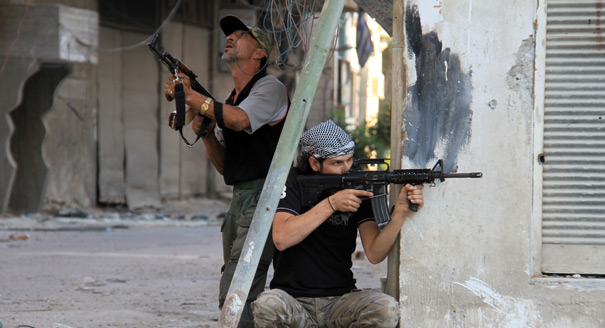
U.S.-led air raids have struck Syrian rebels not linked to the Islamic State, expanding the coalitions raids for the second time to other groups fighting in Syria, including Ahrar al-Sham and the Nusra Front.
Source: Al Jazeera English
The United States coalition has targeted two powerful al-Qaeda related groups in Syria, Nusra Front and Ahrar al-Sham in Aleppo and in Idlib province in the northwest of Syria. It is the second time groups other than the Islamic State have been hit by the coalition, as the Nusra Front has been making headway in Idlib in the past week, pushing U.S.-supported rebel groups from their stronghold in the province.
Speaking on Al Jazeera English, Carnegie’s Yezid Sayigh said that “if the situation is not brought under control, Nusra Front potentially could end up controlling at least one—if not both—of the last two border crossings open to the moderate opposition into Turkey, through which they receive the flow of recruits, trainees, weapons and munitions, and international humanitarian assistance. Everything that the liberated areas rely on now, that is based in Turkey, works through these two border crossings.”

Senior Fellow, Malcolm H. Kerr Carnegie Middle East Center
Yezid Sayigh is a senior fellow at the Malcolm H. Kerr Carnegie Middle East Center in Beirut, where he leads the program on Civil-Military Relations in Arab States (CMRAS). His work focuses on the comparative political and economic roles of Arab armed forces, the impact of war on states and societies, the politics of postconflict reconstruction and security sector transformation in Arab transitions, and authoritarian resurgence.
Recent Work
Yezid Sayigh
Yezid Sayigh
Carnegie does not take institutional positions on public policy issues; the views represented herein are those of the author(s) and do not necessarily reflect the views of Carnegie, its staff, or its trustees.
The Zaidi government’s objective to collect weapons is constrained by regional conflict, but it can take certain measures at home.
Ali Al-Mawlawi

Huawei pushed hard to enter the Egyptian data centers market, until the Americans made a better offer.

Angie Omar

The accord represents a pivotal moment in the region to avert a security vacuum in the Gulf.


Azeema Cheema, Mohanad Hage Ali

In an interview, Jason Burke discusses his sweeping account of the “revolutionists” who so shaped the 1970s and early 1980s.

Michael Young
In an interview, Sohaib Jawhar analyzes the profound changes in the ties between the neighboring countries.
Michael Young