

Paper
Ashley J. Tellis
{
  "authors": [
    "Ashley J. Tellis"
  ],
  "type": "other",
  "centerAffiliationAll": "dc",
  "centers": [
    "Carnegie Endowment for International Peace"
  ],
  "collections": [],
  "englishNewsletterAll": "ctw",
  "nonEnglishNewsletterAll": "",
  "primaryCenter": "Carnegie Endowment for International Peace",
  "programAffiliation": "SAP",
  "programs": [
    "South Asia"
  ],
  "projects": [],
  "regions": [
    "North America",
    "United States",
    "South Asia",
    "India",
    "East Asia",
    "South Korea",
    "China",
    "Japan",
    "Western Europe"
  ],
  "topics": [
    "Security",
    "Foreign Policy"
  ]
}
Source: Getty
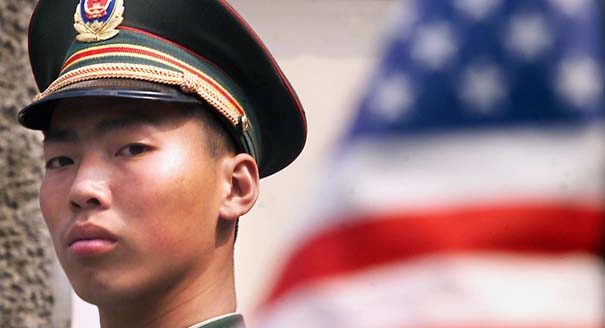
The principal strategic challenge facing the United States today is preserving its global primacy in the face of rising challengers such as China.
Source: Power Shifts and New Blocs in the Global Trading System
The principal strategic challenge facing the US today is preserving its global primacy in the face of rising challengers such as China. Managing the problems posed by major rivals is nothing new for the US; since the nation’s founding, Washington has confronted a series of rivals, first along its land and ocean frontiers, then within its hemisphere and in Asia, and finally in the Old World. Ever since the US emerged as a global power in the aftermath of the Civil War, Washington has assiduously pursued a grand strategy centred not merely on hemispheric control, but also on preventing the Eurasian space from being dominated by any single power, which could both deny the US access to this critical region and enable a rival to eventually challenge the US itself. For this reason, the US confronted Wilhelmine Germany, Nazi Germany, Imperial Japan and finally the Soviet Union to neutralise the threats each posed to American security and American primacy in the international system.
The possibility that China could emerge as the newest rival to the US in Asia and beyond only reinforces the importance of keeping the Eurasian landmass free from hegemonic domination. To be sure, China is still far from being able to realise such an ambition. Beijing confronts an array of serious domestic problems that could prove hard to overcome, and China is surrounded by regional powers who display no interest in subordination. And, of course, China continuously emphasises its desire for a peaceful strategic environment, which includes a disinterest in threatening either its neighbours or the US.
Yet the likelihood of strategic rivalry between Beijing and Washington is high. Sustained economic growth rates have made China the most likely competitor capable of dominating at least the Asian segment of the Eurasian space. As China’s growing power spawns expanded interests, these are likely to scrape against the existing security order, whose guarantees are founded upon American primacy. Beijing’s quest to recover its pre-colonial political centrality in Asia and its determination to undo the ‘century of national humiliation’ only intensify the chances of antagonism. Whether Beijing intends it or not, therefore, China’s growing strength will position it as a strategic adversary of the US, a prospect made even more consequential given the importance of the Indo-Pacific region as a motor for future global growth.Since China’s continued economic expansion and military modernisation are likely to remain the most important factors disturbing the regional and global security balance, coping with the rise of Chinese power is likely to become the single most significant geopolitical challenge facing the US since its confrontation with the Soviet Union. Washington cannot afford to take lightly the risks accompanying a Chinese eclipse of its status as the premier global power and the resulting constrictions on American strategic autonomy. Since 1945, the US has used its pre-eminent power to structure a rules-based global order based on American preferences, which has enabled a tremendous increase in the wealth and standard of living of its citizens and of individuals around the world. Because Beijing cannot be counted on to maintain this system, much less enhance it, Washington must now adopt a corrective strategy designed to attenuate the risks of China’s continued rise...
Former Senior Fellow
Ashley J. Tellis was a senior fellow at the Carnegie Endowment for International Peace.
Recent Work
Ashley J. Tellis
Ashley J. Tellis
Carnegie does not take institutional positions on public policy issues; the views represented herein are those of the author(s) and do not necessarily reflect the views of Carnegie, its staff, or its trustees.

In an interview, Rozina Ali discusses her new book on the rise and manifestations of Islamophobia in the United States.

Michael Young

In an interview, Ian Lustick and Eli Clifton discuss their new book on why a prominent ally has so much influence in America.
Michael Young

As the U.S. stumbles in its war with Iran, we are likely to see an acceleration of its disengagement from the region.
Michael Young

Middle Eastern states should welcome an accelerated U.S. disengagement from their region.
Michael Young

In an interview, former ambassador Charles Freeman assesses the Trump administration’s war against Iran.
Michael Young