

Article
Tristan Volpe
{
  "authors": [
    "Tristan Volpe"
  ],
  "type": "legacyinthemedia",
  "centerAffiliationAll": "dc",
  "centers": [
    "Carnegie Endowment for International Peace",
    "Malcolm H. Kerr Carnegie Middle East Center"
  ],
  "collections": [
    "U.S. Nuclear Policy"
  ],
  "englishNewsletterAll": "ctw",
  "nonEnglishNewsletterAll": "",
  "primaryCenter": "Carnegie Endowment for International Peace",
  "programAffiliation": "NPP",
  "programs": [
    "Nuclear Policy"
  ],
  "projects": [],
  "regions": [
    "North America",
    "United States",
    "Middle East",
    "Saudi Arabia",
    "Gulf"
  ],
  "topics": [
    "Security",
    "Nuclear Policy",
    "Foreign Policy"
  ]
}
Source: Getty
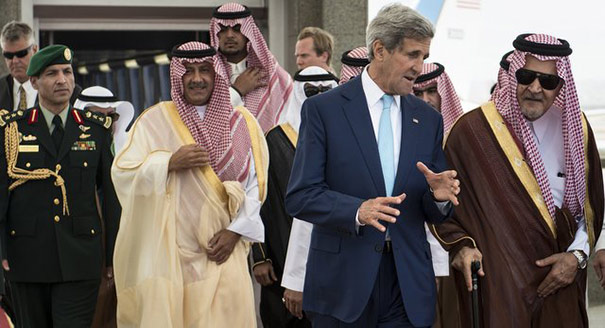
The Saudi proliferation threat is a bluff designed to put pressure on Washington. Saudi Arabia does not have the nuclear capabilities today to quickly follow through on Prince al-Faisal’s pledge.
Source: Hill
One of the key arguments against the Iran nuclear agreement is that it will spark an atomic arms race in the Middle East. Former U.S. Secretary of Defense Robert Gates underscored this risk in a speech on August 5. In it, Secretary Gates said that the Iran deal “will provoke other countries in the region to pursue equivalent nuclear capabilities, almost certainly Saudi Arabia.” High-ranking Saudi officials have fueled this fear with ominous statements in recent months. In May, former Saudi Director of General Intelligence Prince Turki al-Faisal threatened to match Iran’s nuclear program: “Whatever the Iranians have, we will have too.”
The Saudi proliferation threat is, however, a bluff designed to put pressure on Washington. Saudi Arabia does not have the nuclear capabilities today to quickly follow through on Prince al-Faisal’s pledge. Nonetheless, the administration and Congress should consider whether further deliverables are needed to reassure Riyadh. It is much easier to buy out an empty threat today than wait until the House of Saud spends enough to put a real nuclear option on the table.Saudi officials appear to be gambling with an empty nuclear hand to put pressure on Washington for enhanced support. This bargaining stratagem was on vivid display in May as high-level Saudi officials prepared for a summit at the White House and Camp David. In preparation, the Saudis made their expectations clear. As the New York Times reported, Riyadh wanted a formal “defense treaty with the United States pledging to defend them if they came under external attack.” This demand came on the heels of Prince al-Faisal’s threat to match Iranian enrichment capabilities. When the White House called Riyadh’s bluff by rejecting the request, Saudi officials lamented to the press that the meeting offered few concrete deliverables beyond modest military assistance.
Saudi officials undoubtedly know that other states have gained leverage over Washington by threatening to proliferate. In the early 1990s, for example, North Korea illustrated how to blackmail the United States for material concessions by wielding the threat of nuclear proliferation. During the late 1960s, Japanese officials more subtly raised the weapons potential of their nuclear infrastructure to pressure the return of Western Pacific islands seized by the United States during the Second World War. The Saudis appear to be taking a page out the Japanese playbook.
The key weakness with the Saudi ruse is that Kingdom lacks the technical means to follow through on the threat in the short term. Saudi Arabia has several small research centers but no ability to produce the fissile material that goes into a nuclear weapon. Even if Saudi Arabia developed an enrichment capacity in ten years, this distant threat does not give them much leverage now as they ask for more reassurances from the Americans.
Some have suggested that the Saudis could call in a favor to Pakistan, since the Kingdom allegedly financed Islamabad’s nuclear weapons program. Yet Pakistan faces strong disincentives to support Saudi proliferation. Islamabad wants to emulate India by proving it is a responsible nuclear power and aspires to join the group of nuclear suppliers that have pledged not to export sensitive nuclear technology to the Middle East. Speculation abounds over the old Saudi-Pakistan connection, but it certainly will not help Riyadh suddenly jump-start an enrichment program in the coming months.
The time is right to see if Riyadh can be enticed to formally forgo enrichment technology. In a 2008 informal agreement with the United States, Saudi Arabia stated its intent “to not pursue sensitive nuclear technologies,” but subsequent negotiations broke down as Saudi officials refused “to forfeit enrichment domestically.” The administration should parlay with Congress to consider whether it is possible to clear the sale of advanced weapon systems – most notably the F-35 fighter jet – if the Saudis agree to forgo sensitive nuclear fuel cycle technology.
There is a limit, though, to what the United States should offer to keep the Saudi nuclear bluff from materializing. The United States already provided the Kingdom with a massive $60 billion arms transfer in 2010. The most recent Saudi request for a treaty alliance seems to indicate that they hope for U.S. military backing in any confrontation Riyadh wades into with Tehran. Washington should buy out the empty threat to reassure the Saudis while pressing for nonproliferation restrictions. Yet too much support risks entrapping the United States in regional conflicts, and more importantly, creates an incentive for the Iranians to walk away from the nuclear agreement. U.S. officials must manage this delicate balancing act going forward.

Former Nonresident Fellow, Nuclear Policy Program
Tristan Volpe was a nonresident fellow at the Carnegie Endowment for International Peace and assistant professor of defense analysis at the Naval Postgraduate School.
Recent Work


Joseph Bahout, Perry Cammack, David Livingston, …
Carnegie does not take institutional positions on public policy issues; the views represented herein are those of the author(s) and do not necessarily reflect the views of Carnegie, its staff, or its trustees.

Middle Eastern states should welcome an accelerated U.S. disengagement from their region.

Michael Young

In an interview, former ambassador Charles Freeman assesses the Trump administration’s war against Iran.
Michael Young

The accord represents a pivotal moment in the region to avert a security vacuum in the Gulf.


Azeema Cheema, Mohanad Hage Ali
In an interview, Jason Burke discusses his sweeping account of the “revolutionists” who so shaped the 1970s and early 1980s.
Michael Young

By failing to address Palestinian representation, the current process is bound to lead to just another temporary arrangement.

Nathan J. Brown